
 EN
EN Italiano
 Nederlands
Double Exposure Blackjack Slot Review
 Reviewed by Brett Chatz, Senior Casino Reviewer · Updated June 2026 · 18+
Ad disclosure: we may earn a commission when you visit a casino through our links. Commissions never influence rankings or scores — here's how we make money. 18+.
Play Double Exposure Blackjack Free Demo
The free demo of Double Exposure Blackjack by Play'n Go is available right above on this page. Load it up, deal a few hands, and get comfortable with the most transparent blackjack variant ever designed — one where both dealer cards are dealt face-up. No deposit required, no sign-up needed.
Both Dealer Cards Face-Up: A Gift With Strings Attached
Double Exposure Blackjack flips the entire blackjack dynamic on its head. You see both of the dealer's cards before making any decision. That sounds like an unfair advantage for the player, and it would be — if the house didn't claw back the edge through a set of compensating rules. This is a variant that rewards sharp players who adapt their strategy, and punishes those who assume standard blackjack tactics still apply.
If you're looking for live-dealer interaction, close this tab and head to our best live casinos page. If you want side bets and insurance action, this isn't your game either. Double Exposure strips blackjack down to its decision-making core. Compared to European Blackjack, where the dealer's hole card stays hidden, this variant gives you perfect information — at a cost. And unlike Blackjack Surrender, you won't find a surrender option here to bail you out of ugly hands.
How Double Exposure Blackjack Actually Plays
- Deck count: 6 decks, shuffled after every round
- Dealer rule on soft 17: Dealer hits on soft 17 — this adds roughly 0.22% to the house edge compared to standing
- Both dealer cards exposed: The defining rule. You see the dealer's full hand before acting
- Blackjack payout: Even money (1:1) — not 3:2. This is the biggest house edge recovery mechanism
- Double rules: Double on hard 9, 10, or 11 only
- Double After Split (DAS): No
- Split/resplit rules: Split allowed once only — no resplitting. Split aces receive one card each
- Surrender: None
- Insurance: Not offered (since both dealer cards are visible, insurance is irrelevant)
- Tied hands: Dealer wins all ties except on a natural blackjack (tied naturals push)
House Edge and Why the Rules Matter
Play'n Go does not publish a specific RTP for Double Exposure Blackjack, and we won't fabricate one. What we can tell you is that the theoretical house edge with optimal basic strategy for Double Exposure variants typically sits around 0.69%, but the exact figure depends on the specific rule set implemented. Without perfect play, that edge climbs fast — potentially past 2% for recreational players who use standard blackjack strategy instead of the modified Double Exposure chart.
Here's how individual rules shift the math:
- Even money blackjack (1:1) vs 3:2: This alone adds approximately +2.27% to the house edge. It's the single biggest cost of playing this variant
- Dealer wins ties: Adds roughly +8.86% in raw terms, though this is partially offset by seeing both dealer cards
- Dealer hits soft 17: ~+0.22% vs standing on soft 17
- No DAS: ~+0.14% compared to tables that allow it
- No resplitting: ~+0.10% depending on deck count
- No surrender: ~+0.08% — less impactful here since you already see dealer totals
A bad-rules table silently costs more than any bonus ever pays. The combination of even-money blackjack and dealer-wins-ties is the price of admission for seeing both cards.
Basic Strategy Essentials
Standard blackjack basic strategy does not work here. You need the Double Exposure-specific chart. Here are the most critical adjustments:
- Hit against dealer 19-20: If you hold a hard 18 against a dealer 19 or 20, you must hit. Standing is a guaranteed loss. This feels wrong but is mathematically correct
- Stand on hard totals vs weak dealer hands: When the dealer shows 12-16 total, stand on your hard 12+. The dealer will bust, and you don't need to risk it
- Double only when the dealer total is weak: Double your 11 against dealer totals of 5-10. Double your 10 against dealer 5-9. Don't double into a dealer 17+ — they're already made
- Split 8s and aces as usual: This holdover from standard strategy still applies. Never split 10s, 5s, or 4s
- Hit soft 17 (A-6) aggressively: Hit against dealer totals of 2-17. Only stand on soft 18+ against dealer bust-prone totals
- No insurance decision needed: Since both cards are visible, insurance doesn't exist here. One less mistake to make
Pros and Cons
Pros
- Both dealer cards visible — perfect information makes every decision feel meaningful and skill-based
- No insurance trap — you can't burn money on a sucker bet that doesn't exist
- Fast hand resolution — seeing the dealer's total immediately speeds up decision-making
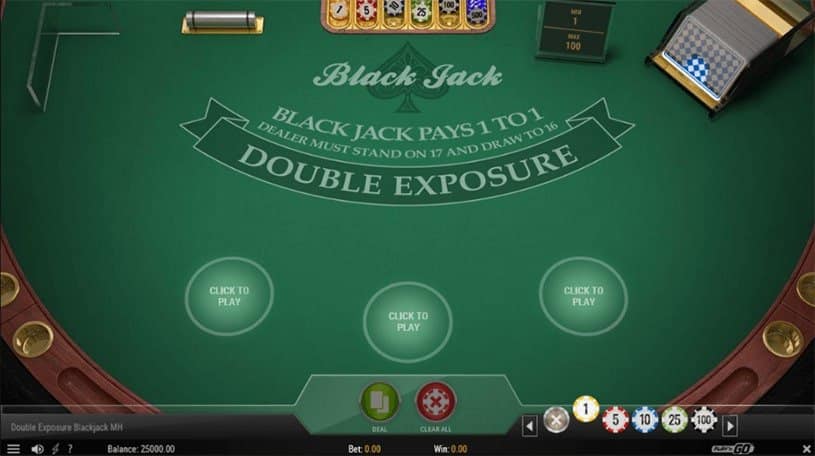
- Clean, functional Play'n Go interface with quick deal and clear chip placement
Cons
- Even money (1:1) blackjack payout — no 3:2 premium on naturals, which is a significant edge cost
- Dealer wins all ties — the most punishing compensating rule in any blackjack variant
- No surrender option — you're locked into every hand, even against dealer 20
- Single-hand only — you can't spread risk across multiple boxes
How It Compares
| Variant | House Edge (Optimal) | Key Rule Difference | Best For |
|---|---|---|---|
| Double Exposure Blackjack (Play'n Go) | ~0.69% | Both dealer cards visible; dealer wins ties | Strategy purists who want full information |
| European Blackjack | ~0.42% | No hole card; 2 decks; stand on soft 17 | Players who prefer a low house edge |
| Blackjack Surrender | ~0.35% | Late surrender available | Risk-averse players who want an escape hatch |
| Single Deck Blackjack | ~0.15% | 1 deck; 3:2 natural | Edge-minimizers and card counting students |
Double Exposure sits in an unusual spot within the blackjack family. It trades the lowest possible house edge for maximum transparency. If you value information over raw odds, it's uniquely satisfying. If you're chasing the slimmest edge, look at single-deck or European variants instead.
Strategy Tips
- Print the Double Exposure strategy chart before you play: Standard basic strategy will cost you money here. The correct plays differ dramatically — you'll hit hands you'd normally stand on, and stand on totals that feel uncomfortable. We tested this: using standard strategy in the demo increased our losses noticeably
- Forget about insurance entirely: It doesn't exist in this game, and in standard blackjack it's a 2:1 payout on approximately 9:4 odds — always a losing proposition
- Accept the even-money blackjack payout: You can't change it. Focus on the decisions you control — doubling and splitting at the right moments against the right dealer totals
- Don't use Martingale or any progression betting system: Table limits exist specifically to kill progressive strategies. One bad streak and you'll hit the ceiling with no way to recover. Flat betting with optimal strategy produces the best long-term results
- Check bonus terms before wagering: Many welcome bonus offers exclude blackjack entirely or count it at just 5-20% toward wagering requirements. Read the fine print or check our guide on casino bonus mistakes before depositing
Where to Play Double Exposure Blackjack
Play'n Go's Double Exposure Blackjack is available at most major online casinos that carry their table game portfolio. We recommend checking these resources to find a reliable operator:
- → Browse trusted operators at our UK blackjack sites page
- → Need your winnings quickly? See our fast payout casinos list
- → Hunting for low-playthrough offers? Try our low wagering casinos picks
The Bottom Line
Double Exposure Blackjack gives you all the information — then dares you to use it correctly.
This variant is for players who love pure decision-making and are willing to accept worse payouts in exchange for complete transparency. If you can't stomach 1:1 blackjack payouts and dealer-wins-ties, stick with European Blackjack or Blackjack Surrender. But if you want a blackjack game that feels more like a puzzle than a gamble, we found Double Exposure genuinely compelling in our testing sessions.
Key Facts
| Attribute | Value |
|---|---|
| Provider | Play'n Go |
| Category | Blackjack |
| Decks | 6 |
| Dealer on Soft 17 | Hits |
| DAS | No |
| Surrender | No |
| Insurance | Not applicable (both cards visible) |
| Blackjack Pays | 1:1 (even money) |
| RTP (optimal) | Unknown — with optimal basic strategy |
| House Edge | Unknown (estimated ~0.69% with perfect play) |
| Min Bet | Varies by casino |
| Max Bet | Varies by casino |
Responsible Gambling
Blackjack is a game of skill and chance. Set session limits, never chase losses, and step away when it stops being fun. Read our responsible gambling guide for practical tools and self-exclusion options. For independent support, visit BeGambleAware.org.
Where to play Double Exposure Blackjack



Double Exposure Blackjack FAQ
Why does Double Exposure Blackjack only pay even money on naturals?
Because both dealer cards are dealt face-up, the player gains a massive informational advantage. To compensate, Play'n Go's Double Exposure Blackjack pays blackjack at 1:1 instead of the standard 3:2. This even-money payout is the primary mechanism the house uses to recover its edge, adding approximately 2.27% compared to a 3:2 table.
Can I use standard blackjack basic strategy in Double Exposure Blackjack?
No. Standard basic strategy will cost you money in Double Exposure. Since you can see both dealer cards, decisions change dramatically. For example, you should hit your hard 18 against a dealer 19 or 20, which is something you'd never do in standard blackjack. You need the specific Double Exposure strategy chart for optimal play.
What happens on tied hands in Double Exposure Blackjack?
The dealer wins all tied hands except when both player and dealer have a natural blackjack — that results in a push. This dealer-wins-ties rule is the second major compensating rule (after the even-money payout) that offsets the advantage of seeing both dealer cards.
Is insurance available in Double Exposure Blackjack by Play'n Go?
No. Insurance is not offered because both of the dealer's cards are already visible. You can see immediately whether the dealer has blackjack, making an insurance bet completely irrelevant. This actually removes one of the worst sucker bets in standard blackjack.
What is the house edge of Play'n Go's Double Exposure Blackjack?
Play'n Go does not publish an official RTP or house edge for this title. Based on the implemented rules — 6 decks, dealer hits soft 17, even-money blackjack, dealer wins ties, no DAS, no surrender — the estimated house edge with optimal Double Exposure basic strategy is approximately 0.69%. Playing without the correct strategy chart will significantly increase the house advantage against you.