
 EN
EN Italiano
 Nederlands
Caribbean Stud Poker Review
 Playtech4.0/5 · Great
 Reviewed by Brett Chatz, Senior Casino Reviewer · Updated June 2026 · 18+
Ad disclosure: we may earn a commission when you visit a casino through our links. Commissions never influence rankings or scores — here's how we make money. 18+.
Play Caribbean Stud Poker Free Demo
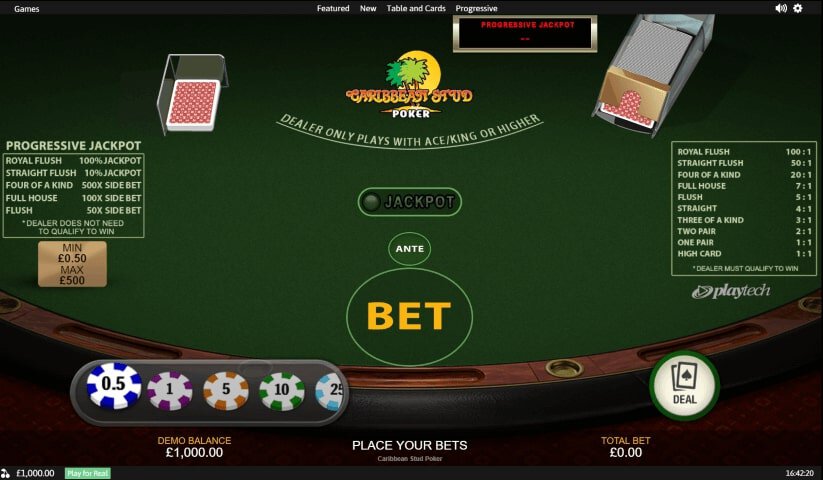
Try Playtech's Caribbean Stud Poker below before wagering real money. The demo uses the same paytable and mechanics as the real-money version, so it's ideal for testing strategy decisions risk-free.
Caribbean Stud Poker by Playtech: A Table Game Hybrid Wearing Video Poker Clothes
Let's be upfront: Caribbean Stud Poker occupies an unusual space. It's classified under the video poker umbrella because you're dealt five cards and make decisions about your hand against a paytable — but it plays more like a house-banked poker game than traditional draw poker. There's no draw phase. You receive five cards, the dealer receives five cards (one face-up), and you decide to fold or raise. That's it. This makes it fundamentally different from Jacks or Better or Deuces Wild variants where the hold/draw mechanic drives the strategy.
Who should play this? Anyone who enjoys the poker hand hierarchy but wants a straightforward player-vs-dealer format without bluffing. If you're after pure mathematical edge-grinding with optimal hold/draw decisions, you'd be better served by best live casinos offering traditional video poker or sticking with proven variants like Aces and Faces or Double Double Bonus Poker. Caribbean Stud is more forgiving for casual players because decisions are binary — call or fold — rather than requiring memorization of complex hold matrices.
How Caribbean Stud Poker Actually Plays
Forget the standard deal-five-hold-draw cycle. Here's how Playtech's Caribbean Stud actually works:
- Place an Ante bet. This is mandatory to enter the hand.
- Receive five cards face-up. The dealer also gets five cards, but only one is exposed.
- Decide: Fold or Call. Folding forfeits your ante. Calling costs exactly 2x your ante — a raise bet.
- Dealer reveals. The dealer must have Ace-King or better to qualify. If the dealer doesn't qualify, your ante pays even money and your raise pushes (returned, no win). If the dealer qualifies and your hand beats theirs, both ante and raise pay according to the paytable.
There are no wild cards. No draw. No multi-hand options. The minimum qualifying hand for the dealer is Ace-King high; for you, simply beating the dealer's hand is enough to win. The progressive-style jackpot side bet (if available) typically requires a flush or better, but the core game doesn't require a minimum hand strength to collect — you just need to beat what the dealer shows.
The Paytable and Why It Matters
The raise bet pays according to hand strength when the dealer qualifies:
| Hand | Ante Payout | Raise Payout |
|---|---|---|
| Royal Flush | 1:1 | 100:1 |
| Straight Flush | 1:1 | 50:1 |
| Four of a Kind | 1:1 | 20:1 |
| Full House | 1:1 | 7:1 |
| Flush | 1:1 | 5:1 |
| Straight | 1:1 | 4:1 |
| Three of a Kind | 1:1 | 3:1 |
| Two Pair | 1:1 | 2:1 |
| One Pair or Less | 1:1 | 1:1 |
Notice the ante always pays even money regardless of hand strength — the real value extraction happens through the raise bet. This is critical: unlike Jacks or Better where the difference between a 9/6 and 8/5 paytable swings RTP by roughly 1.5%, Caribbean Stud's return is more sensitive to how often the dealer qualifies (approximately 56% of the time) and your fold/call decisions. The fixed structure means there's no "full-pay" vs "short-pay" distinction the way traditional video poker works, but some versions do adjust the raise payouts for top hands — always verify before you sit down.
RTP with Optimal Strategy
Playtech lists the RTP as unknown for this title. Industry-standard Caribbean Stud Poker typically returns around 94.78% to 96.30% with optimal strategy, depending on the specific paytable and whether a progressive jackpot side bet is factored in. Every suboptimal fold or call costs you expected value.
Three key strategy rules we rely on:
- Always call with a pair or better. This is non-negotiable. Any made pair outperforms folding in the long run.
- Always fold with less than Ace-King. If you don't hold at least A-K, the math says fold every time.
- A-K hands require nuance. When you hold A-K, call if your third-highest card matches or beats the dealer's face-up card, or if you hold a card matching the dealer's up card (reducing their qualifying chances). This single decision point accounts for most of the EV gap between optimal and amateur play.
Pros and Cons
- Pro: Simpler strategy than traditional video poker — binary fold/call decisions rather than complex hold combinations.
- Pro: The dealer non-qualification mechanic means roughly 44% of hands give you a guaranteed ante win when you call.
- Pro: Playtech's implementation runs smoothly with clear card displays and intuitive bet placement.
- Pro: Good entry point for players transitioning from table games to digital poker formats.
- Con: The house edge is typically higher than optimally played Jacks or Better (0.46%) or Deuces Wild (0.76%).
- Con: No draw phase means less player agency — you can't improve your hand.
- Con: The mandatory 2x raise to continue makes the effective cost per hand three units, not one.
- Con: Most welcome bonus wagering requirements either exclude Caribbean Stud or weight it at 5-10%.
How It Compares
| Variant | Optimal RTP | Wild Cards | Best For |
|---|---|---|---|
| Jacks or Better (9/6) | 99.54% | None | Strategy purists seeking lowest house edge |
| Deuces Wild (Full-Pay) | 100.76% | All 2s | Players comfortable with wild card hierarchy |
| Caribbean Stud Poker | ~94.78-96.30% | None | Casual players wanting simple fold/call decisions |
| Double Double Bonus | 98.98% | None | Players chasing big four-of-a-kind payouts |
Strategy Tips
- Memorize the A-K decision rule. This single hand type — where you hold Ace-King without a pair — is where all the strategy complexity lives. Use a reference chart until it becomes automatic. If your highest kicker beats the dealer's up card, call. If you share a card with the dealer's up card, call.
- Check the paytable before committing real money. Not all Playtech Caribbean Stud implementations are identical. Some casinos modify raise payouts. We noticed small variations across operators, and even a 1-unit change on the Full House payout shifts the expected return measurably.
- Skip the progressive side bet in most cases. If a progressive jackpot is offered, the break-even point is typically above £250,000 for a £1 side bet. Below that threshold, it's a negative EV wager that inflates the house edge.
- Manage your bankroll for the 3-unit cost structure. Each played hand costs 3 units (1 ante + 2 raise). Budget accordingly — 100 hands requires at least 300 units, and you'll fold roughly 47% of hands (costing 1 unit each). A session bankroll of 150-200 units gives reasonable staying power.
- Understand bonus wagering exclusions. Caribbean Stud is frequently excluded from or heavily restricted in bonus playthrough requirements. Before attempting to clear any promotion, read the terms carefully — we cover the most common pitfalls in our guide to casino bonus mistakes.
Where to Play Caribbean Stud Poker
Playtech's Caribbean Stud Poker is available at most major operators carrying the Playtech suite. UK players will find it at licensed sites with full regulatory protection. For the best experience, we recommend choosing fast payout casinos so your winnings reach your account without unnecessary delays. Always verify the paytable matches what we've described above before placing real-money bets.
The Bottom Line
Caribbean Stud Poker trades the strategic depth of traditional video poker for straightforward fold-or-call simplicity. If you want the lowest possible house edge, Jacks or Better and Deuces Wild remain superior choices. But if you enjoy the player-vs-dealer dynamic and prefer making one decision per hand instead of five, Playtech's implementation delivers a clean, reliable experience. Just stay away from the side bets unless the progressive jackpot is astronomically high.
Key Facts
| Detail | Info |
|---|---|
| Provider | Playtech |
| Category | Video Poker (House-Banked) |
| Variant | Caribbean Stud Poker |
| Wild Cards | None |
| Paytable | Standard (verify per operator) |
| RTP (Optimal) | Unknown (industry standard ~94.78-96.30%) |
| House Edge | Unknown |
| Hands | Single hand |
| Min Bet | Varies by operator |
| Max Bet | Varies by operator |
Responsible Gambling
Caribbean Stud's 3-unit-per-hand cost structure can deplete bankrolls faster than single-coin video poker. Set session limits before you start. If gambling stops being enjoyable, seek support through our responsible gambling resources or visit BeGambleAware.org.
Where to play Caribbean Stud Poker



Caribbean Stud Poker FAQ
Is Caribbean Stud Poker by Playtech the same as traditional video poker?
No. Traditional video poker (like Jacks or Better) uses a deal-and-draw mechanic where you choose which cards to hold and replace. Caribbean Stud Poker is a house-banked game where you receive five cards and make a single fold-or-call decision against the dealer's hand. There is no draw phase.
What is the optimal strategy for Caribbean Stud Poker?
Always call with any pair or better. Always fold with less than Ace-King. When you hold exactly Ace-King high, call if your third-highest card beats the dealer's face-up card, or if one of your cards matches the dealer's up card. This A-K decision is where most of the strategy complexity resides.
What happens when the dealer doesn't qualify in Caribbean Stud Poker?
If the dealer's hand is worse than Ace-King high, they don't qualify. Your ante bet pays even money (1:1), and your raise bet is returned as a push — you don't win or lose it. This occurs approximately 44% of the time, which is why folding too often is a costly mistake.
Should I take the progressive side bet in Playtech's Caribbean Stud Poker?
In most cases, no. The progressive side bet typically has a much higher house edge than the base game. The break-even jackpot amount for a standard £1 side bet is usually above £250,000. Unless the jackpot has grown well past that threshold, the side bet is a negative expected value wager.
Why is Caribbean Stud Poker's house edge higher than Jacks or Better?
Caribbean Stud's house edge (typically 3.5-5.2%) is higher because you cannot improve your hand through drawing, and you must pay 2x your ante to stay in the hand. In Jacks or Better (9/6), optimal play yields a 99.54% RTP because the draw mechanic lets skilled players discard weak cards. The lack of a draw phase in Caribbean Stud removes much of that player advantage.