 EN
EN Italiano
 Nederlands
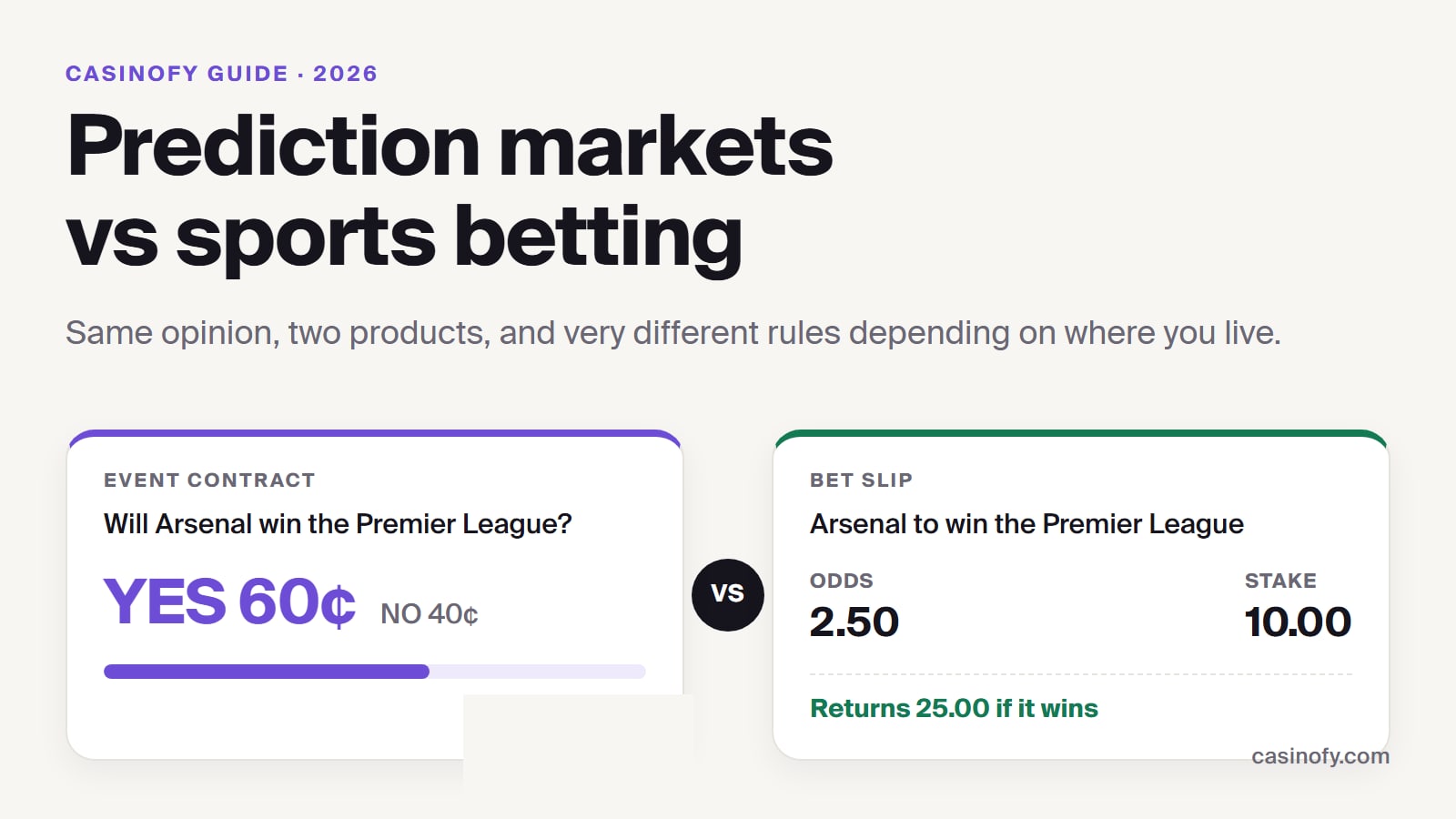
Status checked 28 September 2026. Prediction markets were a niche corner of finance until last year. In 2026 they are the most argued-about product in betting. Two US appeals courts have ruled that Kalshi's sports contracts are gambling that states can police, a third has said the opposite, and New Jersey has asked the Supreme Court to settle it. Regulators in Britain, Spain, France, the Netherlands, Italy and Australia have told the platforms, in one form or another, to get a licence or get out, and Canada's securities regulators have handed the product to provincial gambling law. Meanwhile monthly trading on the two biggest platforms went from under $5 billion to about $24 billion in seven months.
This guide explains what a prediction market actually is, how it differs from a sportsbook and from a betting exchange, where each product stands legally in the markets our readers care about, and what to check before you put money into either.
Prediction markets vs sports betting at a glance
| Prediction market | Sportsbook | |
|---|---|---|
| Who you trade with | Other participants, matched on an exchange | The bookmaker |
| What you buy | A Yes/No contract priced between 0 and 1 | A bet at fixed odds |
| How the price is set | Supply and demand | The bookmaker's odds, with a margin built in |
| Payout | The contract settles at 1 or 0 | Stake multiplied by the odds |
| What it costs you | Trading fees and the gap between buy and sell prices | The overround baked into the odds |
| Getting out early | Sell the contract, if there is a buyer | Cash out, if the bookmaker offers it |
| Regulated as | Derivatives in the US; betting almost everywhere else | Gambling, under a licence in each market |
What is a prediction market and how does it work?
A prediction market is an exchange where people buy and sell contracts on whether a future event will happen. Each contract asks a Yes/No question: will a team win its next match, will a central bank cut rates, will a film top the box office. A Yes contract pays a fixed amount, usually $1, if the event happens and nothing if it doesn't. Its price, somewhere between 0 and 1, moves with supply and demand, so a Yes contract trading at 0.60 means the market is pricing the outcome at roughly a 60% chance.
The platform is not your opponent. It matches buyers with sellers and charges a fee, much like a stock exchange. In the United States the contracts are treated as derivatives and the exchanges answer to the Commodity Futures Trading Commission (CFTC). Almost everywhere else, as we cover below, regulators look at the same product and see betting.
Who runs prediction markets?
- Kalshi has been a CFTC-regulated exchange since November 2020. It began listing sports contracts in January 2025, which is what set off the fight with state gambling regulators.
- Polymarket is the largest platform by volume. It runs on crypto rails, blocks trading from the United States on its main site, and in July 2025 paid $112 million for QCEX, a CFTC-licensed exchange and clearing house, to build a regulated US arm.
- DraftKings Predictions launched on 19 December 2025 with event contracts in 38 states, including sports contracts in states that have no legal sportsbook, such as California, Florida, Georgia and Texas. The contracts trade through CME Group.
- FanDuel Predicts, built with CME Group, went live on 22 December 2025 in five states, with more states following through early 2026.
- Matchbook, the British betting exchange, announced in December 2025 that it would offer Yes/No prediction markets under its existing Gambling Commission licence, and its prediction hub now runs on a Matchbook domain declared on the Commission's register. That is the clearest clue to how the product is expected to be offered in the UK.
A worked example
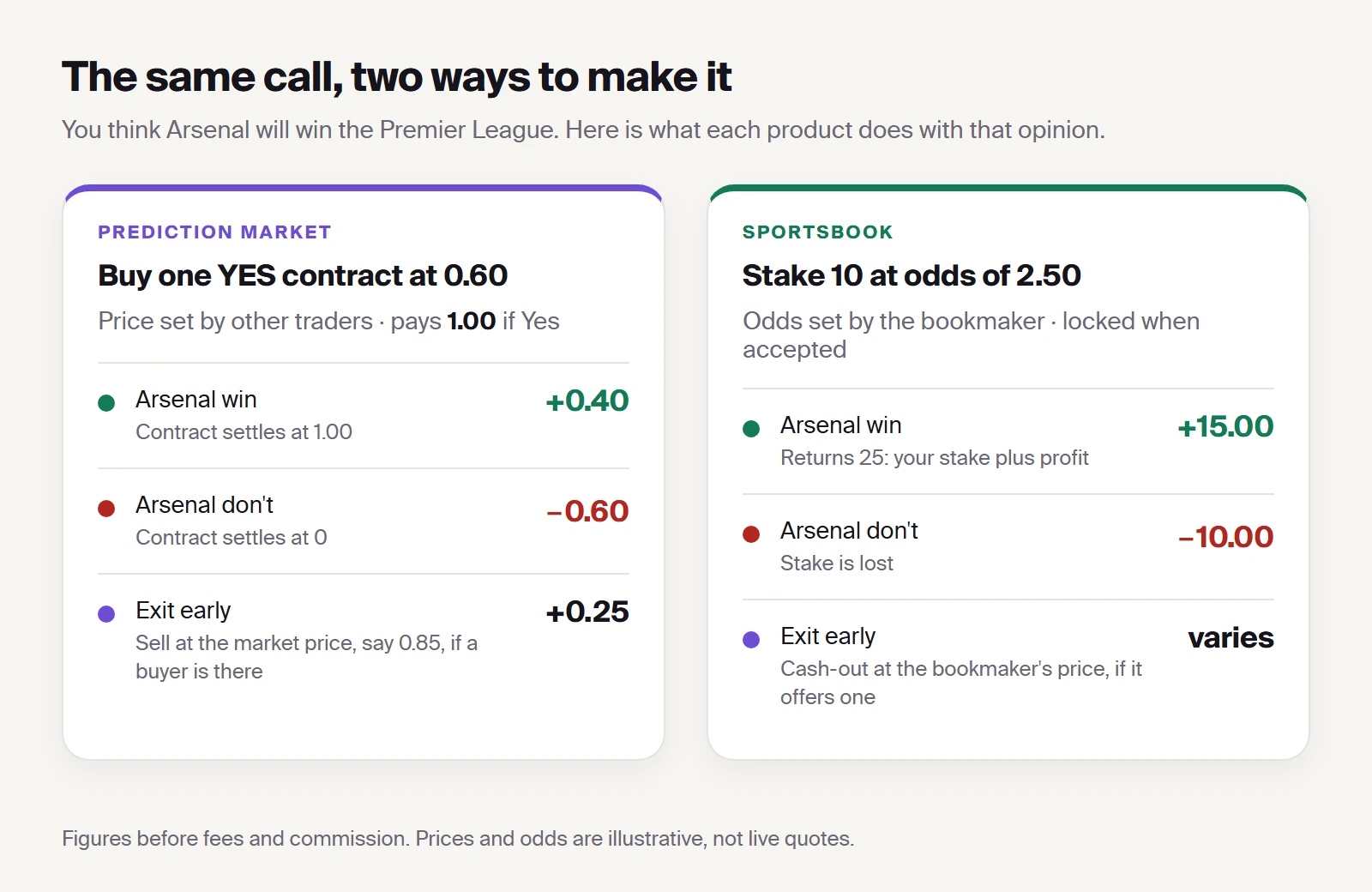
Take a market asking "Will Arsenal win the Premier League?" with Yes trading at 0.60. One Yes contract costs 0.60. If Arsenal win, the contract settles at 1.00 and you make 0.40 before fees. If they don't, it settles at zero and you lose your 0.60. That 60% is what the crowd is paying today, not a verified probability.
You don't have to wait for the season to end. If Arsenal go ten points clear and Yes climbs to 0.85, you can sell for a 0.25 profit. If they collapse and Yes drops to 0.30, you can sell and cut the loss. Whether you can actually get out depends on there being a buyer at that moment, and on thin markets there often isn't one at the price you want.
How does traditional sports betting work?
A sportsbook sets odds on each outcome and takes your bet against its own book. Decimal odds of 2.50 on a team to win mean a 10 stake returns 25 if it wins, your stake plus 15 profit, and nothing if it loses. The odds you take are locked in when the bet is accepted, whatever the bookmaker does to its prices afterwards.
The bookmaker's edge is the overround. The implied probabilities of every outcome in a market add up to more than 100%, and the excess is the margin. A two-way market priced at 1.90 on each side implies about 105% in total, so the book keeps roughly 5% of turnover over time. It works like the house edge in casino games: no single bet is guaranteed to lose, but the pricing favours the operator.
Not every bet is against a bookmaker
Two other models matter here, because prediction markets borrow from both. Betting exchanges such as Betfair and Matchbook let customers bet against each other, with the exchange taking a commission on net winnings. Structurally that is the same as a prediction market, which is exactly why the UK regulator treats the two alike. Pool betting, also called pari-mutuel and common in horse racing, puts all stakes into one pot and splits it among the winners after deductions, so nobody knows the final payout until the pool closes.
If you want to compare licensed bookmakers, our sports betting sites page lists the ones we rate.
Key differences: prediction markets vs sportsbooks
| Feature | Prediction markets | Traditional sportsbooks |
|---|---|---|
| How they work | You buy and sell contracts on future outcomes from other participants | You place a wager at odds offered by the bookmaker |
| Pricing | Contract prices move with trading activity, open orders and liquidity | The bookmaker sets and adjusts the odds |
| Payouts | Fixed settlement at 1 or 0, minus any fees | Stake multiplied by the accepted odds, subject to the betting rules |
| Fees | Trading fees plus the spread between buy and sell prices | The margin built into the odds |
| Early exit | Sell before settlement if the market is open and there is liquidity | Cash-out, where offered and on the bookmaker's terms |
| Available events | Sports, politics, economics, entertainment, weather, anything measurable | Mainly sports, with some novelty markets where permitted |
| Regulation | Depends on the contract, the platform and the country; financial and gambling rules can both apply | Gambling law and a licence in each market where it operates |
Pricing and payouts
A bookmaker's odds tell you your return before you bet. A prediction market's price tells you what other people currently think, and it keeps moving after you buy. Neither is automatically better value. On a sportsbook you pay the overround; on a prediction market you pay the trading fee and the spread, and on a quiet market that spread can be wider than a bookmaker's margin.
Getting out early
Selling a contract is the prediction market's built-in cash-out, and it is often the better one because the price is set by the market rather than by the operator. The catch is liquidity. Popular markets on a big match trade constantly; a niche market may have nobody on the other side when you want out. Bookmaker cash-out has the opposite profile: always priced, but priced by the house.
What you can bet on
Prediction markets are far broader. Sports are the biggest category, but the same account trades on elections, interest rates, awards shows and crypto prices. Licensed sportsbooks are mostly confined to sport, and in many countries novelty and political markets are restricted or banned outright.
Who protects you
This is the difference that matters most and gets discussed least. A licensed sportsbook has to verify your identity, offer deposit limits and self-exclusion, and answer to a regulator you can complain to. A CFTC-regulated exchange gives you the protections of US derivatives law. An unlicensed offshore platform gives you whatever it chooses to, and if it is blocked in your country, no local regulator will help you get your money back. Our guides to identity checks and self-exclusion cover what licensed operators are required to do.
How big have prediction markets become?
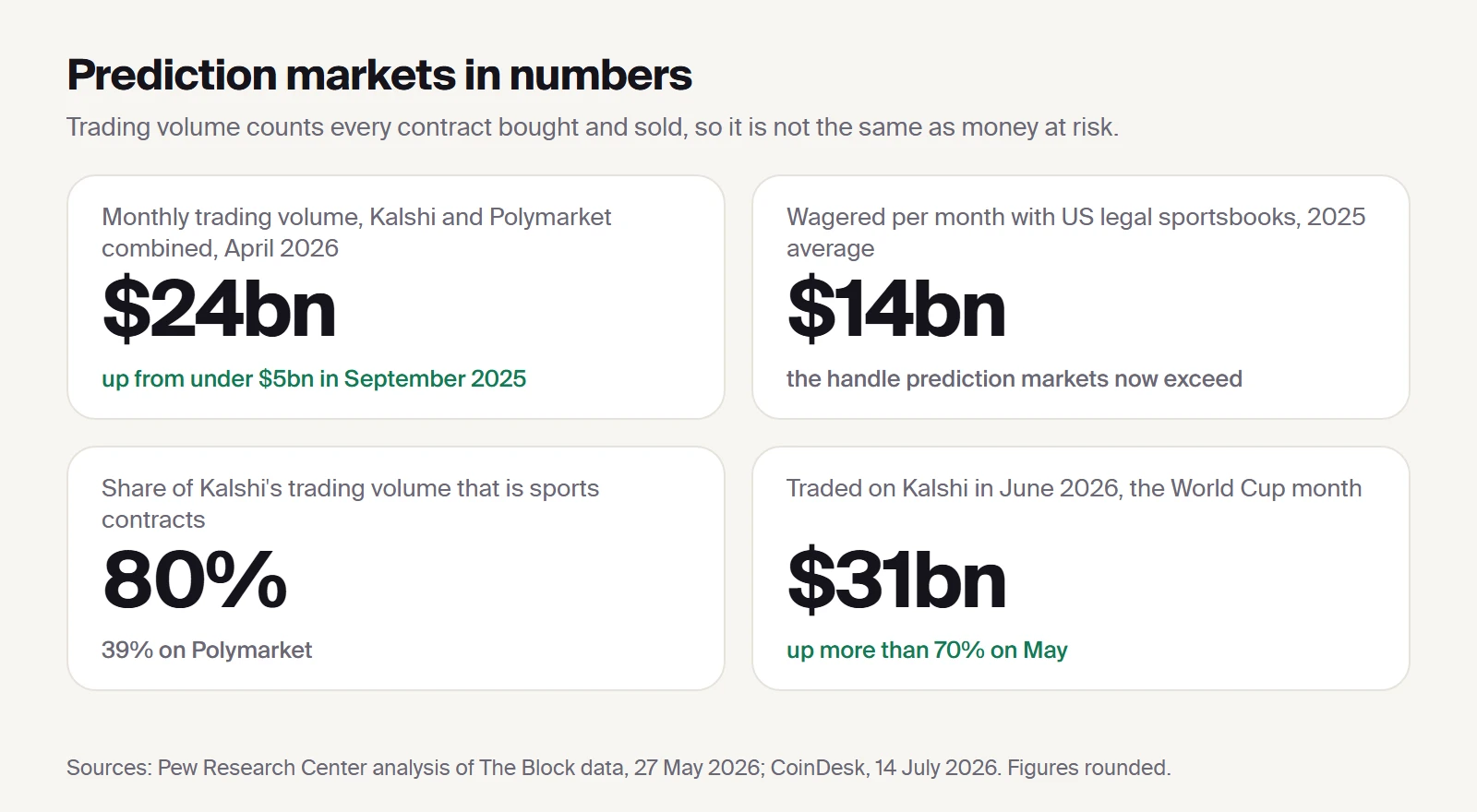
Pew Research Center's May 2026 analysis of data from The Block found that combined monthly trading volume on Kalshi and Polymarket rose from less than $5 billion in September 2025 to about $24 billion in April 2026. Sports contracts made up 80% of Kalshi's volume and 39% of Polymarket's, and sports, politics and crypto together accounted for around 90% of trading on both. For scale, Americans wagered roughly $14 billion a month with legal sportsbooks in 2025.
The World Cup pushed it further. Kalshi reported $31 billion of trading in June 2026, up more than 70% on May, and combined volume across the platforms topped $50 billion for the month. Data from the analytics firm Apptopia, reported by CoinDesk, showed usage of the DraftKings and FanDuel sportsbook apps down 36% and 41% from their tournament peaks over the same weeks.
One caveat before you compare those figures with sportsbook handle: volume counts every contract bought and sold, including positions flipped many times during a match, so it overstates the money actually at risk. It is still the clearest sign yet that a large number of bettors are happy to trade probabilities instead of taking odds.
Where prediction markets stand around the world in 2026
The product is the same everywhere. The legal answer is not. The table sums up the position in the markets we cover, with the detail and sources below.
| Market | Who decides | Position at 28 September 2026 |
|---|---|---|
| United States | CFTC, the federal courts and state regulators | Legal on CFTC-regulated exchanges. Sports contracts contested: two appeals courts side with the states, one with Kalshi, and the Supreme Court has been asked to rule. |
| Great Britain | Gambling Commission | Treated as betting. Operators need a licence, and unlicensed platforms have been told not to serve British customers. |
| European Union | ESMA and national gambling regulators | Contracts that count as financial instruments are binary options, banned for retail investors. Nine gambling regulators are acting together; Spain, France, the Netherlands and Italy have already blocked or fined platforms. |
| Canada | Securities regulators (CSA and CIRO) and the provinces | Sports and entertainment contracts are not securities or derivatives, so they fall to provincial gambling law. Investment dealers will not be approved to trade them. |
| Australia | ASIC and ACMA | No platform holds a financial market licence. ASIC warns against offshore platforms. |
United States: legal federally, contested state by state
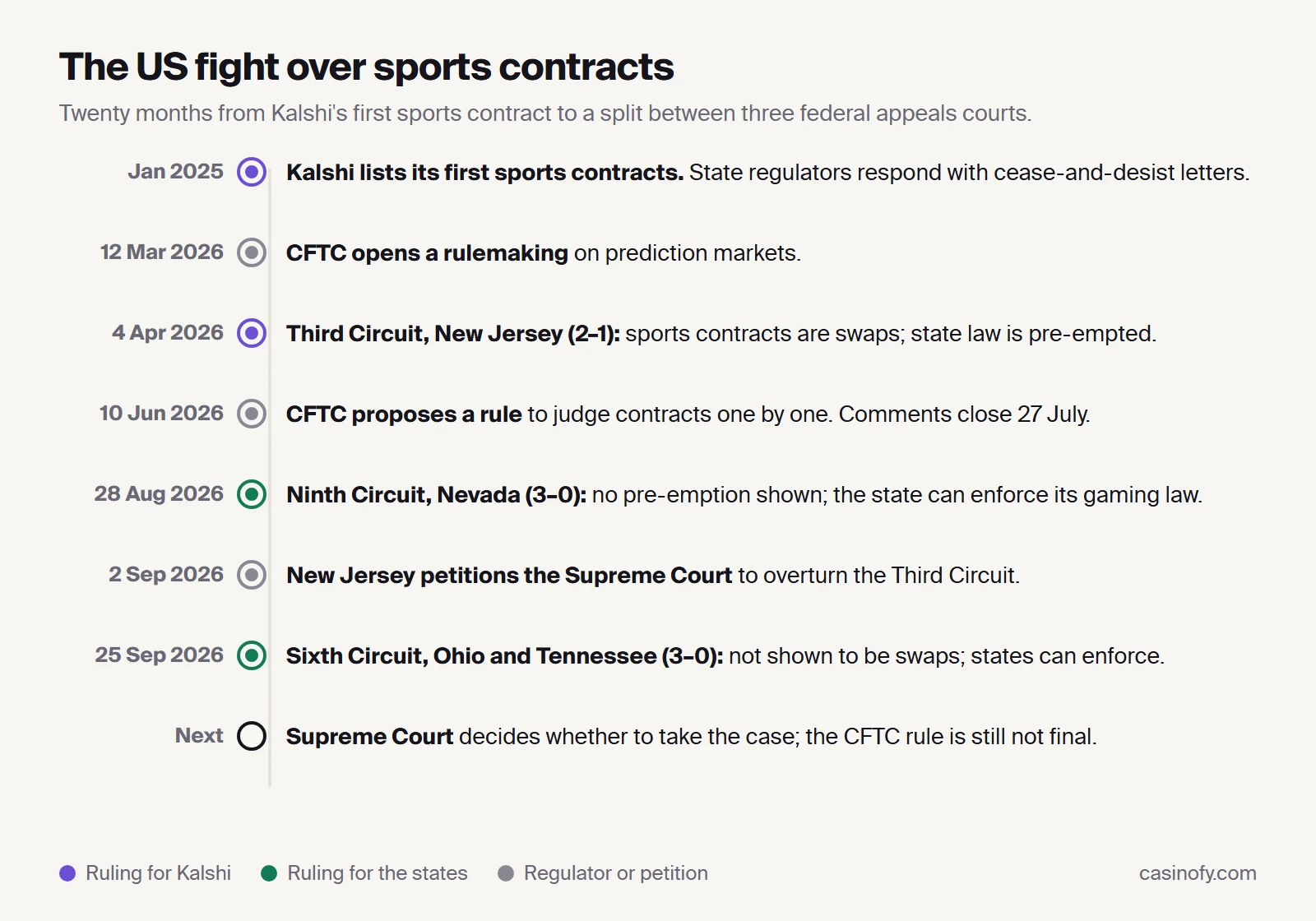
Sports betting in the US is legal state by state, and online casinos in only a handful of states, as our US guide explains. Prediction markets cut across that map. Because Kalshi is a federally regulated exchange, it argued that the Commodity Exchange Act gives the CFTC exclusive jurisdiction over its contracts and that state gambling laws cannot touch them. That argument has now been tested three times at appeals-court level.
- 4 April 2026, Third Circuit. In Kalshi's case against New Jersey, a divided court ruled 2 to 1 that sports event contracts are "swaps" under the Act and that federal law pre-empts the state's gambling rules. New Jersey petitioned the Supreme Court on 2 September.
- 28 August 2026, Ninth Circuit. In Nevada's case, a unanimous panel held that Kalshi had not shown federal law pre-empts state gaming regulation of its sports contracts, and noted that a CFTC rule of its own, Regulation 40.11, bars exchanges from listing contracts that involve gaming.
- 25 September 2026, Sixth Circuit. In the Ohio and Tennessee cases, another unanimous panel found Kalshi had not shown its sports contracts meet the definition of a swap at all, and that even if they did, the Act would not pre-empt either state's gambling laws.
That is a direct split between federal circuits, which is the classic trigger for Supreme Court review. Until it is resolved, Kalshi's New Jersey injunction stands while Nevada, Ohio and Tennessee are free to enforce their gambling laws.
The regulator is moving in parallel. The CFTC opened a rulemaking on prediction markets in March 2026 and on 10 June published a proposed rule setting out how it would judge, contract by contract, whether an event contract involves gaming or is otherwise against the public interest. The consultation closed on 27 July, and as of late September the rule has not been finalised. Notably, the proposal's definition of gaming covers sports but not elections or awards.
For players, the practical upshot is that the sportsbooks themselves have joined in. DraftKings and FanDuel both run prediction apps that reach states where they cannot offer a sportsbook, which is the same commercial logic that drove the growth of sweepstakes casinos before states began legislating against them.
Great Britain: it is betting, and it needs a licence
The Gambling Commission set out its view in a blog post by its director of strategy on 4 February 2026. In its analysis the core of a prediction market is "akin to what in the UK would be described as a 'Betting Exchange'", and an operator would most likely need a betting intermediary licence. On the argument that event contracts are financial products rather than bets, the Commission was blunt: "we do not believe they would be able to classify themselves as non-gambling products."
The warning to the platforms was equally direct. Operators not licensed in Great Britain "should take steps to ensure they are not targeting or transacting with consumers in Great Britain", and the Commission reminded them that operating without a licence is a criminal offence. Neither Kalshi nor Polymarket appears anywhere on the Commission's register of licensed businesses, trading names or domains as of 28 September 2026. Matchbook's prediction hub, declared under its licence, shows the route the regulator prefers. If you are in the UK, our UK guide covers what a Gambling Commission licence gets you, and our licensing explainer covers how to check one.
European Union: binary options rules and a regulators' crackdown
Europe's financial regulator and its gambling regulators have both spoken this year, and they point the same way. On 3 July 2026 the European Securities and Markets Authority (ESMA) reminded firms that where event contracts are financial instruments they are derivatives, and that they "fall within the scope of the existing national product intervention measures on binary options", which prohibit marketing or selling them to retail clients. Where they are not financial instruments, ESMA noted, they may be bets under national gambling law instead. Either way, the door for an unlicensed platform is shut.
On 17 June 2026, days into the World Cup, the gambling regulators of Belgium, France, Germany, Italy, the Netherlands, Poland, Portugal, Spain and Switzerland issued a joint declaration calling prediction markets a form of gambling with "several addictive characteristics", pledging enforcement against non-compliant platforms and urging sports federations, leagues and clubs to check a platform's legality before signing sponsorship deals. Individual regulators had already acted:
- Netherlands. On 17 February 2026 the Kansspelautoriteit ordered Polymarket's operator, Adventure One QSS Inc., to stop serving Dutch players on pain of a penalty of €420,000 a week, capped at €840,000. The regulator's own summary: anyone without a Ksa licence has no business on the Dutch market.
- Spain. On 26 May 2026 the Ministry of Consumer Affairs, through the gambling regulator DGOJ, opened disciplinary proceedings against Polymarket and Kalshi for operating without authorisation and ordered both websites blocked in Spain while the case runs, citing the lack of identity checks and controls for minors and self-excluded players.
- France. The ANJ administratively blocked Polymarket on 16 July 2026, noting that the site had drawn more than 578,000 visits from France in June alone and had no user identification system.
- Italy. The customs and monopolies agency ADM ordered Polymarket blocked in July 2026, its second attempt after an administrative court suspended the first order in late 2025, and the block took effect on 27 July. Both polymarket.com and kalshi.com now appear on ADM's official list of blocked gambling domains.
If you play from the EU, our EU casino guide explains which licences apply to you. For the sports-integrity worries that keep coming up in the regulators' statements, our look at the Italian football betting scandal is a reminder of why they care.
Canada: sports contracts are not securities
Canada answered a different question. On 27 August 2026 the Canadian Securities Administrators and the Canadian Investment Regulatory Organization published a joint notice stating that event contracts based on sports or entertainment "should not be regulated within securities and derivatives legislation", and that CIRO will not approve its dealer members to trade them. That does not make them legal; it hands them to provincial gambling law, where only provincially authorised operators can offer them. Two CIRO dealers have been allowed to trade a limited set of other event contracts, and the status of the rest is still under review.
Australia: nobody is licensed
ASIC's consumer site Moneysmart, updated on 3 August 2026, is unambiguous: "No prediction market operators are licensed as financial markets to operate in Australia." It likens event contracts to binary options, a product ASIC found lost money for around 75% of retail clients, and tells Australians to check the ACMA list of blocked gambling websites and to avoid offshore platforms, because none of the protections of Australian financial services law apply to them.
What this means for sportsbooks and for you
For the industry, 2026 settled one thing: prediction markets are a competitor, not a curiosity. The two largest US sportsbooks now sell probabilities alongside odds, exchanges like Matchbook are packaging the same product under a gambling licence, and regulators from London to Canberra are pulling the platforms into the licensing system rather than leaving them outside it. Expect sportsbooks to answer with better cash-out, more exchange-style pricing and more "will it happen" markets of their own.
For you, the deciding factor is not which product is cleverer but where you live. In most of the US you can trade event contracts on a regulated exchange; in Britain and most of Europe the only legal version is one offered under a gambling licence, and the big offshore platforms are being blocked. Whatever you use, read the terms first, the way you would read a bonus's terms: settlement rules, fees and what happens to open positions if the platform stops serving your country.
Risks to weigh before you trade or bet
Both products put your money at risk, and both have hazards particular to them.
- Trading fees and spreads on a prediction market can quietly cost more than a bookmaker's margin, especially on quiet markets.
- Limited liquidity means you may not be able to sell when you want to, or only at a poor price.
- Price changes after you buy can wipe out a position on news that has nothing to do with the final result.
- Insider trading. ASIC and the European regulators both warn that on an event contract you may be trading against someone with confidential information.
- Losing the full stake is the base case on a sportsbook, and bookmaker margins, betting rules and cash-out conditions all shave the return on the bets you do win.
- No local protection on an unlicensed platform: no self-exclusion, no dispute route and no help if your country blocks the site while you have money on it.
Whichever you choose, set a budget and stick to it. Our responsible gambling guide lists the tools and support lines in your market.
Prediction markets vs sports betting: FAQ
Are prediction markets gambling?
Legally it depends on the country. US federal law treats event contracts on regulated exchanges as derivatives, although two appeals courts now say sports contracts are gambling that states can regulate. Britain, the EU's gambling regulators, Spain, France, the Netherlands and Italy treat them as betting. Canada's securities regulators say sports contracts are not securities, which leaves them to provincial gambling law. Economically the answer is simpler: you stake money on an uncertain outcome and can lose it all.
Are prediction markets legal in the UK?
Only under a Gambling Commission licence. The Commission's February 2026 position is that a prediction market is a betting intermediary and cannot label itself a financial product to escape gambling law. Matchbook offers Yes/No markets under its licence; Kalshi and Polymarket are not on the Commission's register and have been told not to serve British customers.
Are prediction markets legal in the US?
Trading event contracts on a CFTC-regulated exchange is legal nationally. Sports contracts are the exception: the Ninth and Sixth Circuits have ruled that states can enforce their gambling laws against them, the Third Circuit ruled they cannot, and the Supreme Court has been asked to decide. Some platforms also restrict sports contracts in certain states by choice.
Is a prediction market better value than a sportsbook?
Not automatically. You swap the overround for fees and a spread, and on a liquid market that can be cheaper, while on a thin one it can be dearer. The real difference is that you can sell your position at a market price instead of accepting a bookmaker's cash-out offer.
Can I lose more than I put in?
Not on a fully collateralised event contract. You pay the contract price up front and it settles at 1 or 0, so the most you can lose on a Yes bought at 0.60 is that 0.60 plus fees. A sportsbook bet works the same way: the stake is the maximum loss.
What happens to my money if a platform is blocked in my country?
That depends on the platform's terms, not on your regulator, because an unlicensed operator is outside its reach. Some platforms move blocked countries to a withdraw-only mode; others do not say. It is the strongest argument for using a licensed operator in the first place.
The bottom line
A prediction market and a sportsbook let you back the same opinion in different clothes. The sportsbook gives you a fixed price and a counterparty; the prediction market gives you a moving price and a crowd. In 2026 the bigger difference is legal. The US treats event contracts as regulated derivatives and is fighting in court over sports; Britain, Europe, Canada and Australia are steering the product into gambling licensing or blocking it. Know which side of that line your country is on before you decide which product to use, and treat both as what they are: money at risk on an uncertain outcome.
Sources
- Gambling Commission, "Prediction markets: here's what you need to know", 4 February 2026
- ESMA statement on binary option measures and prediction markets, 3 July 2026
- ANJ, joint declaration of nine European gambling regulators on prediction markets, 17 June 2026
- ANJ, blocking of the Polymarket website, 17 July 2026
- Kansspelautoriteit, penalty order against Polymarket, 17 February 2026
- DGOJ, disciplinary proceedings and blocking order against Polymarket and Kalshi, 26 May 2026
- CSA and CIRO, guidance on certain types of event contracts, 27 August 2026
- ADM, list of gambling websites subject to blocking in Italy, updated 23 September 2026
- ASIC Moneysmart, "Prediction markets", updated 3 August 2026
- CFTC, proposed rule on event contracts involving enumerated activities, 10 June 2026
- Ninth Circuit opinion, KalshiEX LLC v. Assad, 28 August 2026
- Sixth Circuit opinion in the Ohio and Tennessee cases, 25 September 2026
- New Jersey petition for certiorari in KalshiEX LLC v. Flaherty, 2 September 2026
- Pew Research Center, trading volume on prediction markets, 27 May 2026
- DraftKings, launch of DraftKings Predictions, 19 December 2025
- FanDuel and CME Group, launch of FanDuel Predicts, 22 December 2025
- Polymarket, acquisition of QCEX, July 2025