EN
 Italiano
 Nederlands
 Slovenščina
 Suomi

The house edge is the share of every bet that a casino game is built to keep over the long run. It is the most useful single number for comparing games, and also one of the most misread. This guide explains what it measures, how it relates to RTP, what it is for the common table games and slots under stated rules, and how to turn it into a realistic cost for a session or a bonus.
What the house edge measures
Casino bets pay a little less than the true odds of winning. The house edge is that gap, expressed as a percentage of the stake. It tells you the average amount you lose per unit bet if the same bet were repeated a very large number of times.
Take a €10 bet on red in European roulette. The wheel has 37 pockets: 18 red, 18 black and one green zero. You win €10 on 18 of the 37 outcomes and lose €10 on the other 19. The average result per spin is (18 × €10 minus 19 × €10) divided by 37, a loss of about €0.27. Divided by the €10 stake, that is 2.70%.
The same edge shows up on a single number. A straight-up bet pays 35 to 1, but with 37 pockets a fair payout would be 36 to 1. The missing unit, spread over 37 spins, is again 1/37, or 2.70%.
Short run versus long run
The edge is an average, not a fee taken from each bet. In a single session you can finish well ahead or well behind what the edge suggests. What the edge controls is the direction of travel: the more you bet in total, the closer your actual result tends to move towards the expected loss.
House edge vs RTP
RTP (return to player) is the same idea seen from the other side. For a fixed bet, RTP is 100% minus the house edge. European roulette has a 2.70% edge, so its RTP is 97.30%. Slot studios publish RTP, while table game guides usually quote the edge. Neither number is a promise about your session. Both describe the long-run average across a very large number of rounds.
Three details matter when you compare figures:
- Strategy is assumed. Blackjack figures assume you make the best decision every time. Mistakes raise the edge you actually face.
- The edge is quoted per initial bet. In blackjack, money added when you double or split is not counted in the base, so the cost per euro you actually stake is slightly lower than the quoted figure.
- Rules change the number. The same game name can hide different rules. A blackjack table that pays 6:5 is, mathematically, a different game from one that pays 3:2.
Your cost depends on turnover, not on your deposit
The edge applies to every euro you wager, including winnings you bet again. If you deposit €100 and keep re-betting until €1,000 has gone through a slot with 96% RTP, the expected loss is 4% of €1,000, which is €40. That is why small edges add up on fast games.
House edge by game
For table games the figures below follow directly from the rules and payouts stated. For slots they are whatever the studio has set for that version of the game.
| Game and bet | Rules assumed | House edge | RTP |
|---|---|---|---|
| European roulette, any standard bet | Single zero, 37 pockets | 2.70% | 97.30% |
| American roulette, standard bets other than the five-number bet | Zero and double zero, 38 pockets | 5.26% | 94.74% |
| American roulette, five-number bet (0, 00, 1, 2, 3) | Pays 6 to 1 | 7.89% | 92.11% |
| Blackjack, basic strategy | 6 to 8 decks, dealer stands on soft 17, blackjack pays 3:2, double after split allowed, no surrender | About 0.5% | About 99.5% |
| Blackjack, basic strategy | Same rules, but blackjack pays 6:5 | About 1.8% to 1.9% | About 98.1% to 98.2% |
| Baccarat, Banker | 8 decks, 5% commission on wins | 1.06% | 98.94% |
| Baccarat, Player | 8 decks | 1.24% | 98.76% |
| Baccarat, Tie | 8 decks, pays 8 to 1 | 14.36% | 85.64% |
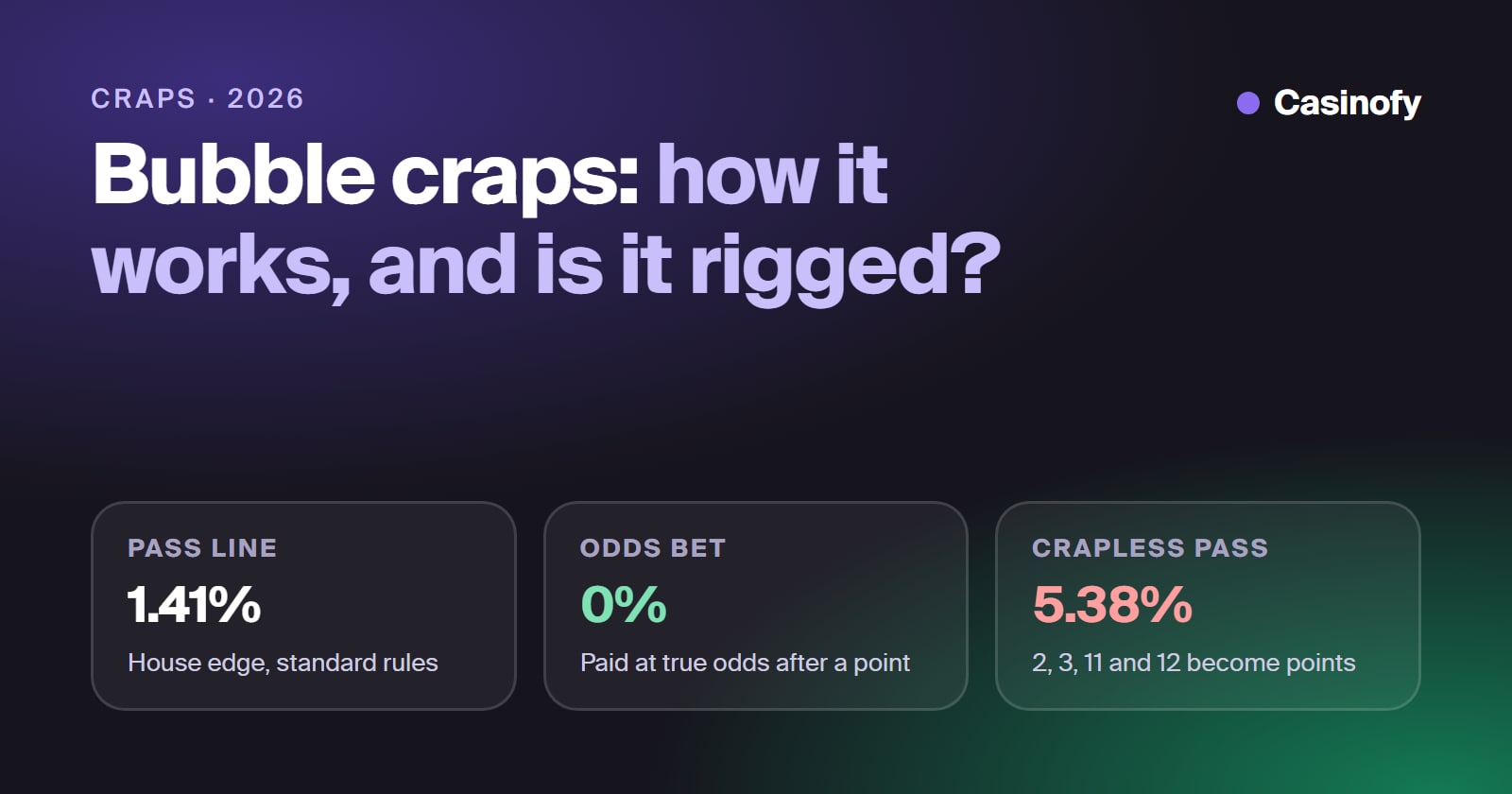
| Craps, Pass Line | Standard rules | 1.41% | 98.59% |
| Slots | RTP set by the studio for each version of a game | 3.50% to 11.58% in the examples below | 88.42% to 96.50% in the examples below |
Roulette
Single-zero (European) roulette has a 2.70% edge on every standard bet. Adding a second zero, as American roulette does, raises it to 5.26%, because the wheel now has 38 pockets while the payouts stay the same. The five-number bet on 0, 00, 1, 2 and 3 is worse still at 7.89%. For the same stake, the single-zero wheel is the cheaper game. Our roulette odds chart and calculator shows the payout and probability of every bet.
Blackjack
Blackjack has the lowest edge in the table, but only if you follow basic strategy. Under the rules listed above the edge is about 0.5%. Small rule changes move it:
- Dealer hits soft 17: about 0.22 percentage points more for the house.
- No doubling after a split: about 0.14 points more.
- Late surrender allowed: about 0.08 points less.
- Blackjack pays 6:5 instead of 3:2: about 1.39 points more.
That last change is the big one, and we break it down in how 6:5 blackjack payouts cost more than you think. To learn the decisions behind the 0.5% figure, use our blackjack strategy chart and trainer. Card counting tracks the cards already dealt from a shoe, so it has nothing to work with in a game that reshuffles after every round. Our card counting trainer explains how it works and where its limits are.
Baccarat
With an eight-deck shoe, the Banker bet wins about 45.86% of hands, the Player bet about 44.62%, and about 9.52% end in a tie. Because Banker wins slightly more often, winning Banker bets pay 19 to 20, a 5% commission. After commission, Banker carries a 1.06% edge and Player 1.24%. The Tie bet at 8 to 1 is the expensive one at 14.36%. Some tables pay 9 to 1 on a tie, which cuts that edge to 4.84%, still far above the two main bets. Our comparison of blackjack and baccarat covers how the two games differ in practice.
Craps
The Pass Line bet wins 244 times in every 495 on average and pays even money, which leaves the house 7/495, or 1.41%. The odds bet you can add behind it pays true odds and has no house edge, so adding odds lowers the average edge on your total stake. Single-roll proposition bets cost far more: "any seven" pays 4 to 1 on a roll that comes up one time in six, a 16.67% edge.
Slots
A slot's edge is not set by rules you can see on the table. The studio's maths sets the RTP, and many studios supply the same game in several RTP versions so that the casino can choose one. Hacksaw Gaming lists Wanted Dead or a Wild at 96.38%, 94.55%, 92.33% and 88.42%. Same game and same graphics, but a house edge anywhere from 3.62% to 11.58% depending on the version a casino runs. Pragmatic Play lists Gates of Olympus at 96.50%, an edge of 3.50%.
Before you play, look in the game's paytable or information screen for the RTP of the version you are on. If it is not shown, you cannot tell which version it is. Each spin's result comes from a random number generator, which we explain in what is RNG. RTP also says nothing about volatility: two slots with the same RTP can pay out in very different patterns.
Putting the edge to work
Estimate the cost of a session
Multiply your average bet by the number of rounds and by the edge. At €5 a hand for 60 hands, blackjack at 0.5% has an expected cost of €1.50. At €5 a spin for 60 spins, European roulette at 2.70% costs €8.10 on average, and a slot at 94% RTP costs €18. Fast games pack in more rounds, so a modest edge on a fast game can cost more per hour than a higher edge on a slow one.
Check what a bonus really costs to clear
Wagering requirements turn the edge into a predictable cost. A €50 bonus with 35x wagering means €1,750 in bets. On a slot with 96% RTP, the expected loss while clearing it is 4% of €1,750, or €70, which is more than the bonus itself. On a 97% game the same requirement costs €52.50. Our casino bonus calculators run these numbers for any offer.
Betting systems do not change it
Doubling after a loss (the Martingale), progressive staking and similar systems change how your bets are sized, not the odds of any bet. Every bet in the sequence still carries the same edge, so the expected loss is still the edge times the total wagered. A system can make small wins more frequent while making rare large losses bigger.
Common misreadings
- "96% RTP means I get €96 back from €100." No. It is a long-run average over a very large number of spins and players. A single €100 session can end at zero or well above €100.
- "I am due a win." Each spin, hand or roll is independent. Past results do not change the next one, or the edge.
- "A low edge means I will win." A low edge means you lose less on average. The game is still built in the house's favour.
- "A higher RTP slot pays more often." RTP and hit frequency are different things. A high-volatility slot can have a high RTP and long runs without a win.
Quick answers
Which common bet has the lowest house edge?
Of the bets in the table, blackjack played with basic strategy under good rules, at about 0.5%. Next come the baccarat Banker bet at 1.06%, the Player bet at 1.24% and the craps Pass Line at 1.41%. The craps odds bet has no edge, but you can only place it alongside a Pass Line or similar bet.
Is the house edge the same at every casino?
For roulette, baccarat and craps with the standard payouts above, yes. For blackjack it depends on the table rules, and for slots it depends on which RTP version the casino runs.
Play responsibly. Gambling is for adults aged 18 and over. Treat what you stake as the cost of entertainment, set a limit before you start and stop when you reach it. For tools and support, see our responsible gambling guide.