 EN
EN Italiano
 Nederlands
 Slovenščina
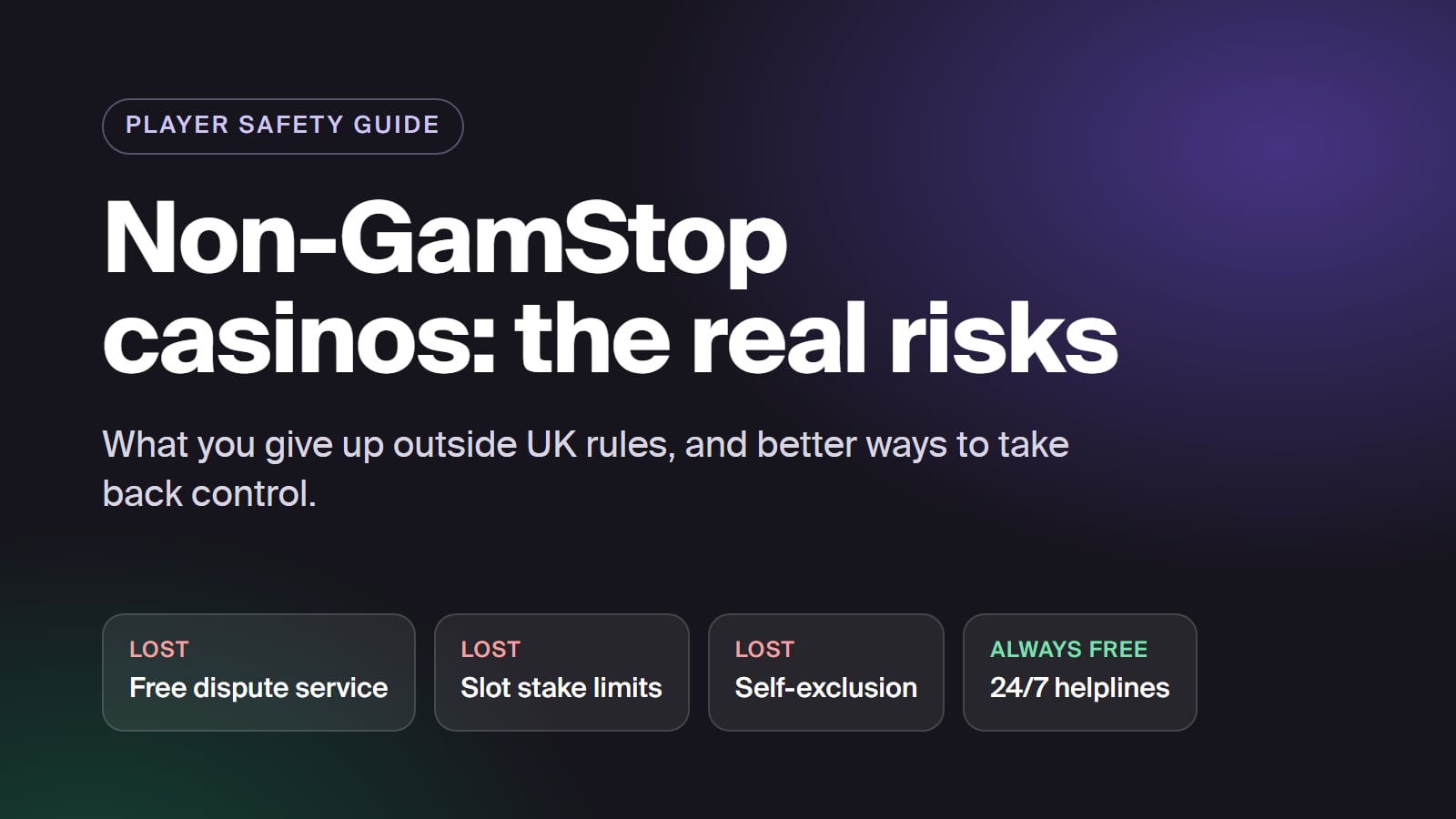
Search for "non-GamStop casinos" and you will find hundreds of pages promising no limits, bigger bonuses and no ID checks. We are not going to add another list to that pile. This guide does something different: it explains what a non-GamStop casino actually is, what changes for you the moment you play on one, and what you can do instead if GamStop, or the rules around UK gambling, are the reason you went looking.
No lecture. If you have already self-excluded and the exclusion feels too long, skip straight to what you can actually do about it. If you are simply curious why these sites exist, read on.
What "non-GamStop" really means
GAMSTOP is the free national self-exclusion scheme for online gambling in Great Britain. Sign up once and you are blocked from every participating site for the period you choose.
Taking part is not optional for licensed operators. Since 31 March 2020, every online operator licensed by the UK Gambling Commission (UKGC) has had to join, under social responsibility code provision 3.5.5. Two operators had their licences suspended for missing that deadline. Since 1 April 2024 the scheme also covers telephone and email betting.
So "non-GamStop casino" is a polite way of saying a casino with no UKGC licence. Most hold a licence from another country instead, often presented prominently. The UKGC is blunt about what that is worth to a player in Britain: "A gambling licence issued in another country does not permit an operator to provide gambling to consumers in Great Britain" (UKGC).
Is it illegal for you to play?
No. The law in Great Britain targets the businesses, not the players. When the UKGC surveyed online gamblers in 2025, it told respondents that it is not illegal to gamble on an illegal website, only to operate one (UKGC).
Operating or advertising one is a different matter. Providing gambling facilities without a licence (section 33 of the Gambling Act 2005) and advertising unlawful gambling (section 330) are both criminal offences, with up to 51 weeks in prison, a fine, or both. That is why no responsible review site will link you to one, and why you never get the full picture from the sites that do.
The practical point for you is simpler: you are not breaking the law, but you are also stepping outside every protection the law gives you.
What you give up
These are the rules every UKGC-licensed casino has to follow. None of them applies to a casino outside the licensing system.
| Protection | On a UKGC-licensed casino | On a non-GamStop casino |
|---|---|---|
| Self-exclusion | GAMSTOP blocks you from every licensed site at once | No link to GAMSTOP; any exclusion is the site's own |
| Complaints | If the casino has not resolved it within 8 weeks, a free, independent dispute service (ADR) decides | The casino has the final word |
| Slot stakes | Maximum £5 a spin; £2 for 18 to 24-year-olds | No cap |
| Bonus wagering | Capped at 10x since 19 January 2026 | Whatever the terms say |
| Credit cards | Banned for gambling since 14 April 2020 | No such ban |
| ID checks | Done before you can deposit or play | No duty to check before you play, so checks can land at withdrawal |
| Your balance | The site must tell you whether your funds are not protected, or have medium or high protection | No disclosure duty |
| Slot design | At least 2.5 seconds per spin, no autoplay, no turbo spins, losses never shown as wins | No such rules |
The table is a summary. The details: the stake limits started on 9 April 2025 (£5) and 21 May 2025 (£2) and apply to online slots, not table games. The 10x wagering cap came in alongside a ban on promotions that mix casino, betting and bingo. The slot design rules took effect on 31 October 2021 and also banned "reverse withdrawals", where a pending cash-out could be pulled back into your balance and played. We cover what the bonus changes mean in practice in our guide to the UKGC bonus rules.
The risks that cost players money
1. Winnings that never arrive
This is the big one. The UKGC has said that people who contact it about unlicensed sites often do so because they have been unable to withdraw their funds, that their complaints are often not dealt with, and that there is no right of appeal (UKGC). On a licensed site you would take that dispute to a free independent service. Here, there is nobody above the casino.
2. "No ID needed" until you want your money
Skipping checks at sign-up is sold as a perk. In the UKGC's 2025 survey, 10% of online gamblers said they had signed up somewhere because they knew they would not need to show ID (UKGC). But a site that does not check you at the door can still ask for documents when you cash out, on its own terms and its own timetable. A licensed casino has to verify you before you play, so a withdrawal is never the first time it asks. Our guide to KYC checks explains what normal verification looks like.
3. Bonus terms with no ceiling
Without a wagering cap, a generous-looking bonus can come with playthrough requirements many times higher than the 10x a licensed UK site may set, plus maximum-bet and maximum-cashout clauses that void winnings if you break them. Bigger headline numbers often mean harder terms.
4. Your data and your deposits
The UKGC warns that personal information given to unlicensed sites cannot be relied upon to be handled properly, and that some of these sites are linked to organised crime (UKGC). In the same 2025 survey, 63% of the people the UKGC identified as using illegal sites had used a VPN. If a site steers you towards a VPN or crypto deposits, remember that neither gives you anything back if the site keeps your balance.
5. Sites that disappear
Between April and December 2025 the UKGC sent 592 cease-and-desist notices to illegal operators and their advertisers. It also says it reported more than 327,000 web addresses to search engines, of which 203,571 had been removed so far (UKGC, January 2026). Operators now get 48 hours, down from 14 days, to block British players once notified. In May 2026 the government set up an Illegal Gambling Taskforce focused on cutting off payments and advertising. If a site you use is blocked or vanishes, there is no regulator that can help you recover a balance.
6. They are built for people who self-excluded
This is the uncomfortable part. Back in 2023 the UKGC's Tim Miller said these sites and their affiliates target people who have sought to self-exclude, and called it "especially insidious" (UKGC). The phrase "not on GamStop" is itself the pitch: it is aimed at the moment you decided you needed a break.
If GamStop feels too long
Most people who search for non-GamStop casinos are not looking for a criminal enterprise. They signed up to GAMSTOP at a hard moment, and now the exclusion feels like more than they need. If that is you, here is how the scheme actually works, from GAMSTOP's own terms:
- The periods. You choose 6 months, 1 year, 5 years, or 5 years with automatic renewal.
- It does not end on its own. When your minimum period is over, the exclusion stays active until you contact GAMSTOP and ask for it to be removed. There is then a cooling-off period of at least 24 hours before it lifts.
- It is not forever by default. If you never ask, it keeps running for up to a further seven years after the minimum period, then deactivates.
- Licensed sites will know. For seven years after removal, GAMSTOP tells operators you were previously excluded, so expect a licensed casino to ask a few extra questions.
If your period has ended, the honest route back is to remove the exclusion properly and return to a licensed site, where the limits above still protect you. If it has not ended, the urge to play before it does is worth taking seriously. That is exactly the moment the free helplines below are there for, and talking to them costs you nothing.
If you are not self-excluded and just want more choice, the UK market is bigger than many people assume. Our UK casino hub lists only UKGC-licensed sites.
Tools that work alongside GamStop
GAMSTOP covers licensed sites. These cover the gaps, including the unlicensed ones:
- Your bank's gambling block. Many UK banks let you block card payments to gambling merchants from the app. The UKGC keeps a list of banks that offer one, including Barclays, HSBC, Lloyds, Halifax, Monzo, NatWest, Santander and Starling. Some, like HSBC, add a cooling-off period before the block can be turned off.
- Blocking software. Apps such as Gamban block gambling sites and apps on your devices, including unlicensed ones. The free licence scheme in England and Scotland ended on 31 March 2026; it now costs £4.99 a month or £29.99 a year after a 7-day trial, and it is still free in Wales. Halifax and Lloyds customers can get access through their bank.
- Limits on licensed sites. Every UKGC casino offers deposit limits, time-outs and its own self-exclusion. Our responsible gambling guide walks through them.
How to check a casino is UKGC-licensed
Scroll to the footer. Licensed casinos normally show their UKGC account number there. Search for that number or the company name on the Gambling Commission's public register and check that the licence is active and that the website you are on is listed under it. A logo alone proves nothing, and a licence from another country does not count for players in Britain. For more on what different licences mean, see casino licensing explained.
How common is this?
Nobody knows the size of the unlicensed market precisely, and the UKGC has said it is not yet ready to publish an estimate (UKGC). Its 2025 survey of 2,046 online gamblers, which it stresses is not representative, found that 9% said they had ever intentionally gambled on a site without a GB licence, rising to 20% among 18 to 34-year-olds. Its tracking of web traffic up to February 2026 shows no consistent or sustained growth in visits to illegal sites (UKGC).
Free, confidential help
- England and Scotland: the National Gambling Helpline, run by GamCare, on 0808 8020 133. Free, 24 hours a day, with live chat and WhatsApp on the same number.
- Wales: the NHS Wales gambling helpline on 0808 2819 265, also 24/7 (NHS Wales).
You do not need to be in crisis to call. "I'm thinking about getting round my self-exclusion" is a perfectly good reason.
FAQ
Are non-GamStop casinos legal in the UK?
No. A casino that takes players in Great Britain without a UKGC licence is operating illegally, whatever licence it holds elsewhere. Playing on one is not an offence for you, but you have none of the protections of a licensed site.
Can I be fined for playing at a non-GamStop casino?
No. The offences in the Gambling Act 2005 apply to operating and advertising unlicensed gambling, not to playing. The risk to you is financial: losing a balance or winnings with no one to complain to.
Can I cancel GamStop early?
Not before your minimum period ends. After that, the exclusion stays active until you contact GAMSTOP to remove it, and there is a cooling-off period of at least 24 hours before it lifts.
Does GamStop cover every online casino?
It covers every online casino licensed by the UK Gambling Commission. It does not cover unlicensed sites, which is why a bank gambling block or blocking software is worth adding if you want full coverage.
What can I do if a non-GamStop casino will not pay me?
Very little, which is the core problem. There is no free independent dispute service and no UK regulator that can order the site to pay. Keep records, stop depositing, and if gambling has become hard to control, call one of the helplines above.
Status checked 7 October 2026 against the UK Gambling Commission, GAMSTOP, legislation.gov.uk and gov.uk. Rules change; we update this page when they do.
Sources
Law and regulation
- Gambling Act 2005, section 33 and section 330
- UKGC: LCCP 3.5.5, national multi-operator self-exclusion
- UKGC: online slots stake limit guidance
- UKGC: gambling promotions to be safer and simpler
- UKGC: gambling on credit cards banned from April 2020
- UKGC: age and identity verification rules, May 2019
- UKGC: online slot design changes
- UKGC: information on customer funds
- gov.uk: Illegal Gambling Taskforce terms of reference
Illegal gambling: enforcement and research
- UKGC: how we tackle illegal gambling
- UKGC: compliance and enforcement report 2019 to 2020, illegal gambling
- UKGC: Tim Miller speech, ICE Barcelona, January 2026
- UKGC: Tim Miller speech, ICE World Regulatory Briefing, February 2023
- UKGC: illegal online gambling phase 2 findings
- UKGC: illegal gambling, update on trends and data