EN
 Italiano
 Nederlands
 Slovenščina
 Suomi

If you have suddenly started seeing Kalshi everywhere, you are not imagining it. Prediction markets have moved from a fairly niche corner of the internet into mainstream sports, politics and finance, and two names keep coming up: Kalshi and Polymarket.
That naturally leads to a few questions. Is Kalshi legit? Is Kalshi legal? Is it basically sports betting with a different name? And when it comes to Kalshi vs Polymarket, is one actually better than the other?
Casinofy went through the regulation, the legal arguments and how the platforms actually work. The short version: Kalshi is a real, federally regulated exchange. That does not mean every question about prediction markets has suddenly become simple. (If you want the wider picture first, our guide to prediction markets vs sports betting explains how the two differ.)
Is Kalshi legit?
Yes. Kalshi is a legitimate prediction market exchange regulated in the United States by the Commodity Futures Trading Commission, the CFTC.
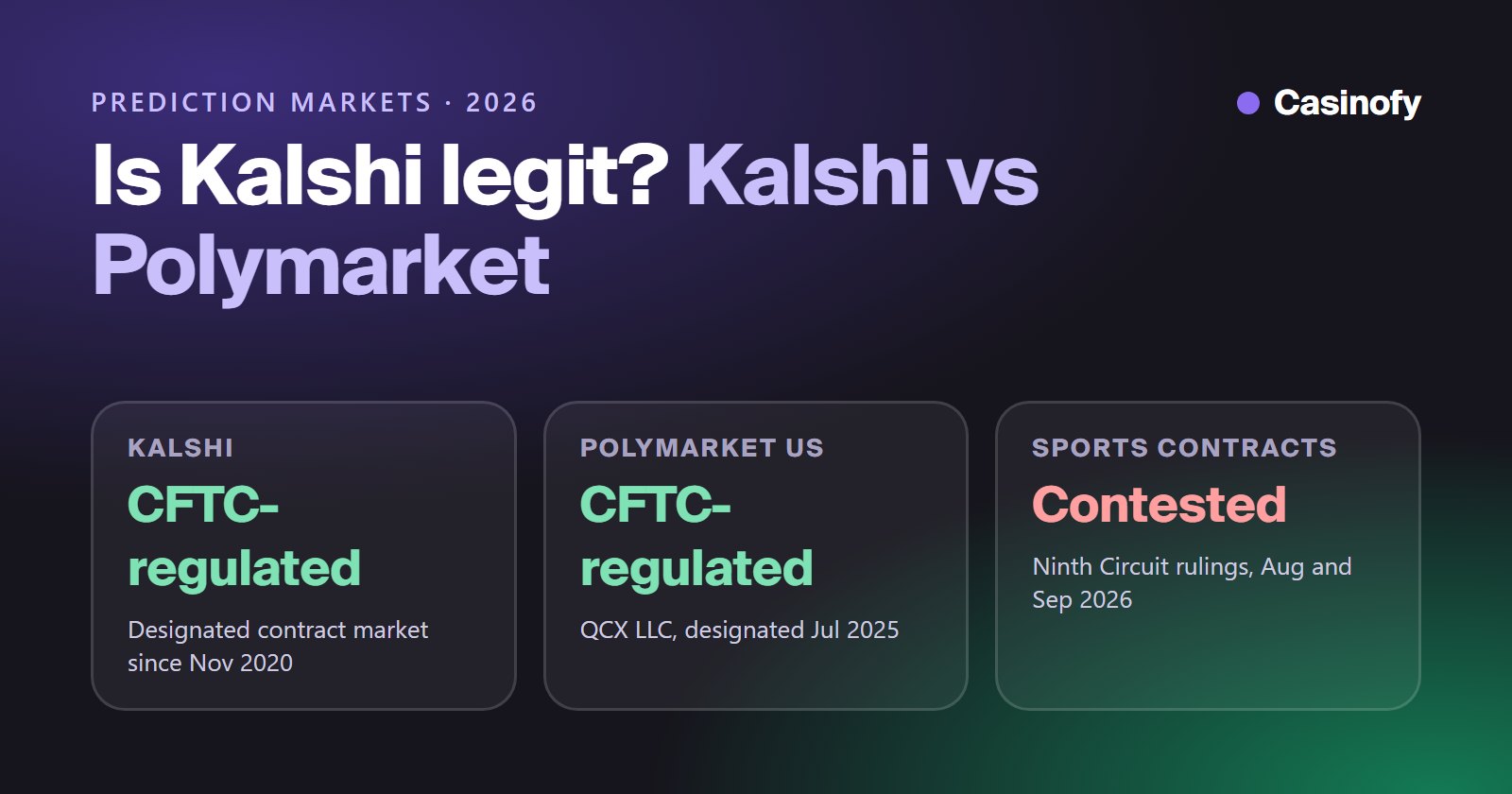
KalshiEX LLC has been a CFTC-designated contract market since 3 November 2020, and its affiliated clearing operation is also CFTC-registered. That is an important distinction. Kalshi is not an anonymous betting website operating from an offshore licence. It is a regulated US exchange operating under federal derivatives law.
But "legit" does not mean risk-free. You can still lose money, markets can move against you, and fees can affect your return. And, particularly when it comes to sports event contracts, there is a serious legal fight over where federal regulation ends and state gambling law begins.
So if the question is "Is Kalshi a scam?", the answer is no. If the question is "Is everything on Kalshi unquestionably legal everywhere in America?", the answer is much more complicated.
What exactly is Kalshi?
Kalshi is a prediction market. Instead of placing a traditional sportsbook bet, you trade contracts based on whether an event will happen. A market might ask: will a particular team win? Will inflation be above a certain level? Will a candidate win an election? Will a company hit a particular target?
You generally buy a YES or NO position. The price moves depending on what traders think the probability of that outcome is. If a YES contract is trading at around 65 cents, the market is roughly pricing the event at a 65% chance. If the event resolves in your favour, the contract settles at $1. If it does not, it settles at $0. You can also usually sell your position before the event is resolved rather than holding it until settlement.
That trading structure is one of the reasons Kalshi argues it is a financial exchange rather than a sportsbook.
Is Kalshi gambling?
This is where things become interesting. Ask Kalshi, and it operates a federally regulated derivatives exchange. Ask some state gambling regulators, and they see certain event contracts, particularly sports contracts, as gambling.
Courts have not been consistent either. Some federal courts have sided with Kalshi's argument that its contracts fall under federal commodities regulation. Others have found that states can still apply their gambling laws, particularly to sports-related contracts. That disagreement has become one of the biggest legal questions surrounding prediction markets in 2026, and it may eventually take the US Supreme Court to settle where the line is drawn.
The simplest way to look at it: Kalshi is federally regulated, and that is not in dispute. What is being fought over is whether federal regulation prevents individual states from regulating certain event contracts as gambling.
How does Kalshi work?
The concept is simple once you get past the financial-market terminology. You choose an event. You decide whether you think the answer will be YES or NO. You buy contracts at the current market price. If the result goes your way, winning contracts settle at $1.
Your potential return depends on what you paid. Buying a YES contract at 40 cents gives you more potential upside than buying the same contract later at 80 cents, but the market is also telling you that traders currently believe the outcome is less likely. It is closer to trading a probability than placing fixed sportsbook odds, and the price can move constantly as new information comes in.
Kalshi vs Polymarket: what is the difference?
Kalshi and Polymarket are often grouped together, but they are not the same thing. One important point in 2026 is that you need to distinguish between Polymarket US and Polymarket's international platform.
Polymarket US is operated by QCX LLC, doing business as Polymarket US, and has been registered with the CFTC as a designated contract market since 9 July 2025. The international Polymarket platform operates separately and is not regulated by the CFTC. That distinction gets missed surprisingly often.
Kalshi vs Polymarket at a glance
| Feature | Kalshi | Polymarket |
|---|---|---|
| Regulation | CFTC-designated US contract market (since November 2020) | Polymarket US: CFTC-designated US contract market (since July 2025). Polymarket international: a separate platform, not regulated by the CFTC |
| How you trade | YES and NO event contracts priced between $0 and $1 | Prediction contracts priced on the probability of an event |
| Markets | Sports, politics, economics, crypto, technology, current events, culture, financial markets | The same broad categories |
| Funding | A familiar US setup: bank transfers, debit cards and other supported methods | Known for its crypto-based approach, particularly on the international platform |
| Fees | Trading fees vary by contract and market conditions; check the fee shown on the market | Taker fees on certain categories; some markets fee-free; makers may be treated differently |
Neither platform is as simple as "every trade costs X". Always check the fee shown on the actual market before trading rather than relying on an old fee comparison.
Kalshi vs Polymarket: which is better?
There is no automatic winner. Kalshi will probably feel more familiar if you want a US-regulated platform with conventional funding options and an exchange built around the American market. Polymarket has a very different history and became popular through its crypto-based international prediction market. Polymarket US has changed that comparison, because there is now a separate CFTC-regulated US operation as well.
The bigger questions are not "Kalshi vs Polymarket?" but: which version of the platform are you using, which market are you trading, what fees apply, and what are the legal rules where you are physically located? Those details matter more than the logo on the app.
Is Kalshi legal in the US?
Kalshi is federally regulated by the CFTC. That part is clear. What is not settled is whether states can separately regulate or prohibit particular event contracts under their own gambling laws. Sports contracts are the main battleground.
Several states and tribal gaming interests have challenged Kalshi, arguing that sports event contracts effectively amount to sports betting. Kalshi argues that the contracts are derivatives traded on a federally regulated exchange and that federal commodities law takes priority. Different courts have reached different conclusions, so be cautious with articles claiming that Kalshi is simply "legal in all 50 states". The legal position in 2026 is more complicated than that.
Is Kalshi legal in California?
This has become a popular question, largely because California still does not have legal statewide online sports betting.
As of October 2026, Kalshi remains available to eligible users in California generally. However, California is also home to one of the most important prediction-market legal disputes. On 16 September 2026 the Ninth Circuit Court of Appeals ruled that two California tribes, the Blue Lake Rancheria and the Chicken Ranch Rancheria of Me-Wuk Indians, were likely to succeed in arguing that Kalshi's sports event contracts, when entered into from their tribal lands, amount to unauthorised gaming under federal tribal gaming law. That ruling relates specifically to tribal lands rather than creating a blanket statewide ban.
So the accurate answer is: Kalshi remains available in California, but sports event contracts face active legal challenges, and the position is not as simple as saying prediction-market sports trading is universally legal everywhere in the state.
Is Kalshi legal in Texas?
As of October 2026, Kalshi remains available in Texas, and there has not been the same direct enforcement action against Kalshi in Texas that some other states have taken. That makes Texas particularly interesting, because traditional online sports betting is still not legal there.
Texas lawmakers are looking more closely, though. In March 2026 Lieutenant Governor Dan Patrick's interim charges asked the Senate State Affairs Committee to examine prediction-market gambling and its use of federal law to get around the state's gambling bans, ahead of the 2027 legislative session. So for now Kalshi operates in Texas, but do not assume the rules can never change.
Is Kalshi legal in every state?
No article should give a blanket answer without explaining the legal fight. Kalshi is a federally regulated exchange. At the same time, states including Nevada have challenged its ability to offer sports event contracts without complying with state gambling rules. On 28 August 2026 the Ninth Circuit sided with Nevada, finding that Kalshi was unlikely to show that its sports event contracts are federally regulated "swaps" that shield it from state gaming law. Other federal courts have reached different conclusions, which is one reason the industry may end up before the Supreme Court.
If you are specifically interested in sports contracts, check the current situation in your state rather than assuming that access automatically means the legal position has been settled.
Is Polymarket legit?
Yes, with an important distinction. Polymarket US is a CFTC-designated contract market operated by QCX LLC, doing business as Polymarket US. The international Polymarket platform is separate. When comparing Kalshi vs Polymarket, make sure you are comparing Kalshi with the correct Polymarket product. Saying "Polymarket is regulated by the CFTC" without that distinction would be misleading.
What are Kalshi's fees?
Kalshi charges transaction fees on trading activity, and the exact fee depends on the market, the price and the type of order. Some funding methods can also carry their own costs: bank transfers for US users can be fee-free from Kalshi's side, while card or third-party payment methods may carry charges. There is no good reason to memorise a fee table, because the schedule changes. Before placing an order, check the fee displayed for that trade. The same principle applies to Polymarket, where fees vary by market category and by whether you are adding or taking liquidity.
Can you make money on Kalshi?
Yes. You can also lose it. Prediction markets look deceptively simple because everything is reduced to YES or NO, but your result depends on whether your view is better than the price you are paying. Being right about an event does not automatically mean you made a good trade: if a contract is priced at 95 cents and you win $1, your upside was tiny compared with the amount at risk. The price matters just as much as the prediction.
What are the risks of using Kalshi?
The biggest risk is obvious: you can lose your trade. A few others are worth understanding.
| Risk | What it means in practice |
|---|---|
| Market risk | The probability can move quickly when new information appears. |
| Liquidity | Some markets attract far more trading than others. A thin market can make it harder to enter or leave at the price you want. |
| Settlement rules | Read exactly how the market will be resolved. A prediction that sounds obvious in the headline can have very specific settlement criteria. |
| Fees | Frequent trading means fees can add up. |
| Legal changes | Prediction-market regulation is moving quickly, particularly around sports. A market being available today does not mean the regulatory environment cannot change. |
| Overtrading | Prediction markets can feel like news, sport and trading rolled into one, which makes it easy to keep opening positions because something interesting is happening. Treat the money at risk as money you can afford to lose. |
So, is Kalshi legit?
Yes. Kalshi is a legitimate, federally regulated prediction market exchange. That is the easy part. The harder question is how prediction markets fit alongside state gambling laws, particularly when contracts are based on sports outcomes, and that argument is still being fought in courts across the United States.
Kalshi's federal regulation gives it a very different status from an unlicensed betting site, but it does not make every trade safe, profitable or legally uncontested. And when comparing Kalshi vs Polymarket, remember that the market has changed: both Kalshi and Polymarket US now operate CFTC-regulated exchanges, while Polymarket's international platform remains separate. Prediction markets are becoming mainstream very quickly. Regulation is trying to keep up.
Frequently asked questions
Is Kalshi legit?
Yes. Kalshi is a real prediction market exchange regulated by the US Commodity Futures Trading Commission as a designated contract market. That does not guarantee profits or mean every type of event contract is free from state-level legal challenges.
Is Kalshi legal?
Kalshi is federally regulated in the United States, but individual states are challenging whether some contracts, particularly sports contracts, can also be regulated under state gambling laws. The legal position is still developing.
Is Kalshi legal in California?
Kalshi remains generally available in California as of October 2026. A federal appeals court has ruled against Kalshi in a case involving sports event contracts accessed from California tribal lands, but that case does not amount to a blanket statewide prohibition.
Is Kalshi legal in Texas?
Kalshi remains available in Texas as of October 2026, and no statewide enforcement action currently blocks the platform. Texas senators have been asked to study prediction markets before the 2027 session, so the position could change.
Is Kalshi sports betting?
Kalshi describes its products as federally regulated event contracts rather than sportsbook bets. Some state regulators and courts argue that certain sports contracts function as gambling. This is one of the central legal disputes surrounding prediction markets.
Is Polymarket legit?
Polymarket US is operated by QCX LLC, doing business as Polymarket US, and is registered with the CFTC as a designated contract market. The international Polymarket platform is a separate operation and should not be confused with Polymarket US.
Kalshi vs Polymarket: which is better?
It depends on what you want to trade, where you live, the fees on the individual market and which version of Polymarket you are using. Kalshi offers a US-focused regulated exchange with familiar funding methods, while Polymarket has both a US-regulated operation and a separate international platform.
Can you lose money on Kalshi?
Yes. Event contracts can settle at zero if your prediction is wrong, and trading fees can reduce your return. Only trade with money you can afford to lose.
Sources
- CFTC, designated contract markets: Kalshi (designated 3 November 2020) and the CFTC press release of 3 November 2020 on the designation of KalshiEX LLC.
- CFTC, designated contract markets: QCX LLC d/b/a Polymarket US (designated 9 July 2025).
- KalshiEX LLC v. Assad, Ninth Circuit, No. 25-7516, opinion of 28 August 2026 (Nevada).
- Blue Lake Rancheria v. KalshiEX LLC, Ninth Circuit, No. 25-7504, opinion of 16 September 2026 (California tribal lands).
- Kalshi's published fee schedule.
- The Texas Tribune, 27 March 2026, on the Lieutenant Governor's interim charges for the Senate.
Information checked October 2026; sources re-checked 2 November 2026. Prediction-market regulation is changing quickly, particularly around sports event contracts. Legal status varies by location and may change following court decisions or new state legislation. This article is general information, not legal or financial advice.