 EN
EN Italiano
 Nederlands
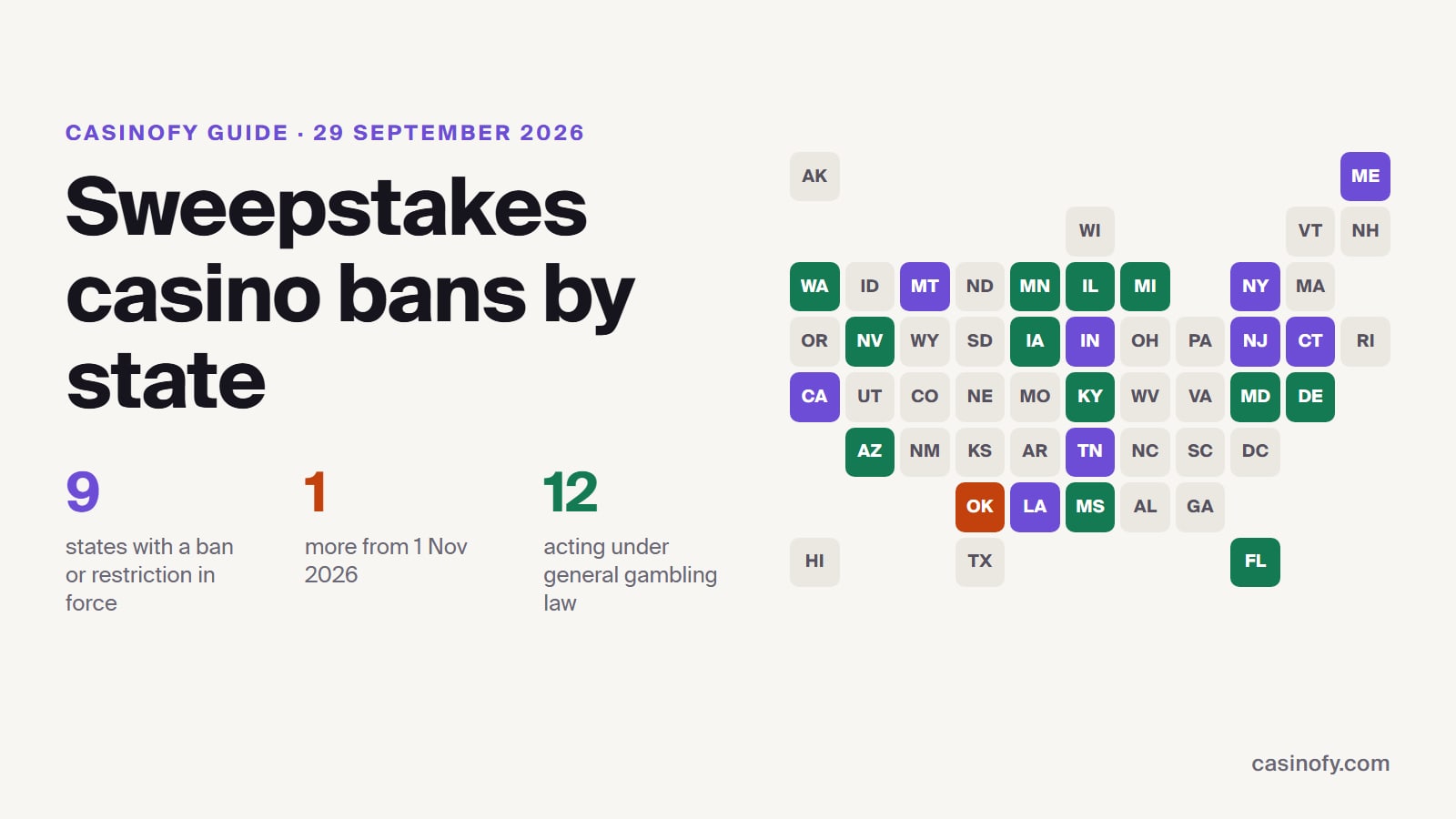
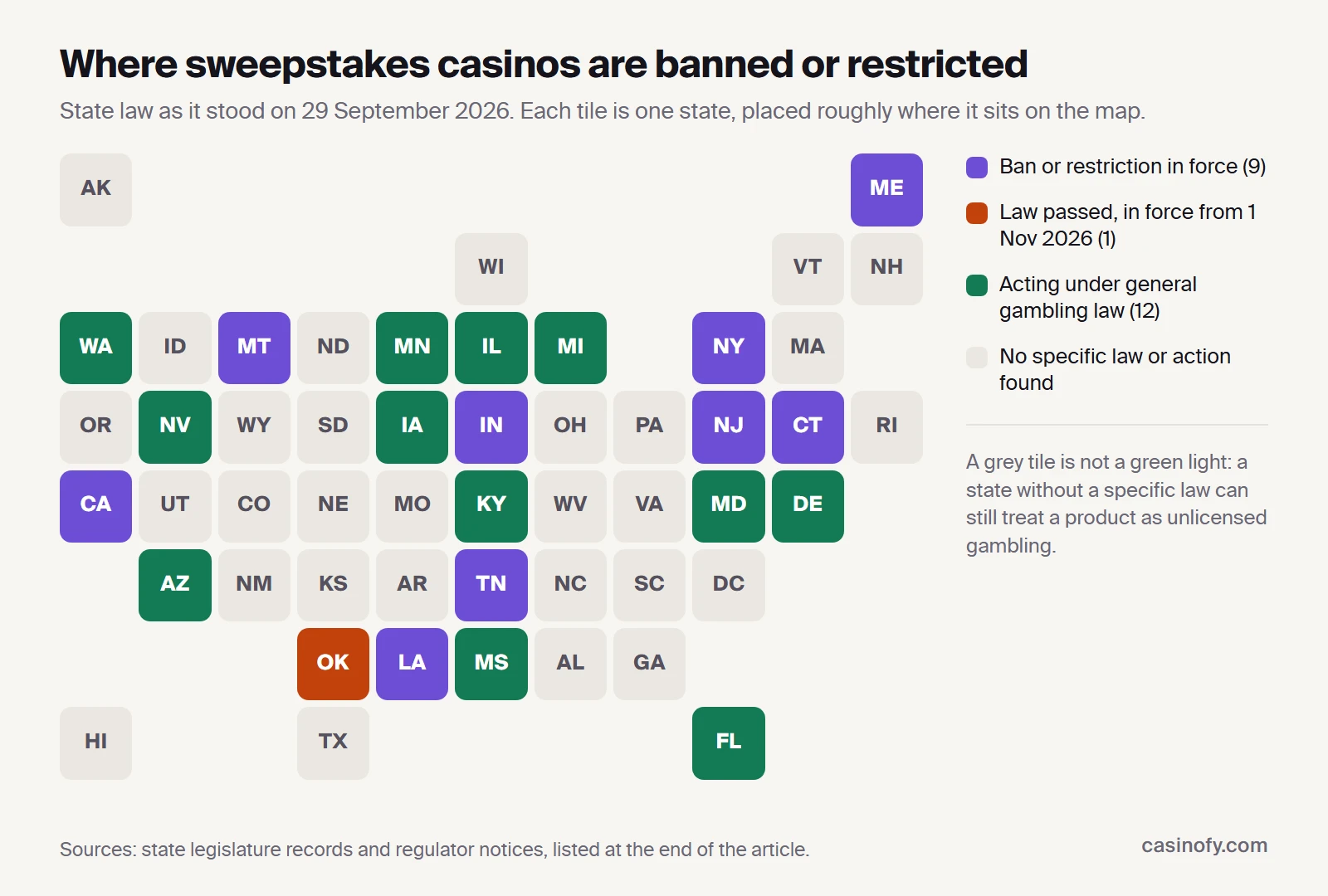
Legal status checked 29 September 2026. The US sweepstakes casino industry has been through its toughest year yet. Nine states now have a law in force that bans or restricts dual-currency sweepstakes casinos, five of them passed in 2025 and four in 2026, and Oklahoma's ban starts on 1 November 2026. Other states are acting against individual operators under the gambling laws they already have.
These platforms have always argued that they run promotional sweepstakes rather than cash gambling. Regulators in a growing number of states disagree, and the new laws say so in terms. This guide sets out which states have banned or restricted sweepstakes casinos, what each law covers and when it took effect, which states are using existing law instead, and what the changes mean for players, operators and the businesses around them.
What are sweepstakes casinos and how do they work?
To understand why states are banning or restricting sweepstakes casinos, it helps to know how they work. A sweepstakes casino is a website or app that offers casino-style games, mostly slots, plus table games, bingo and instant-win titles, without taking conventional cash bets. Instead it runs on two virtual currencies.
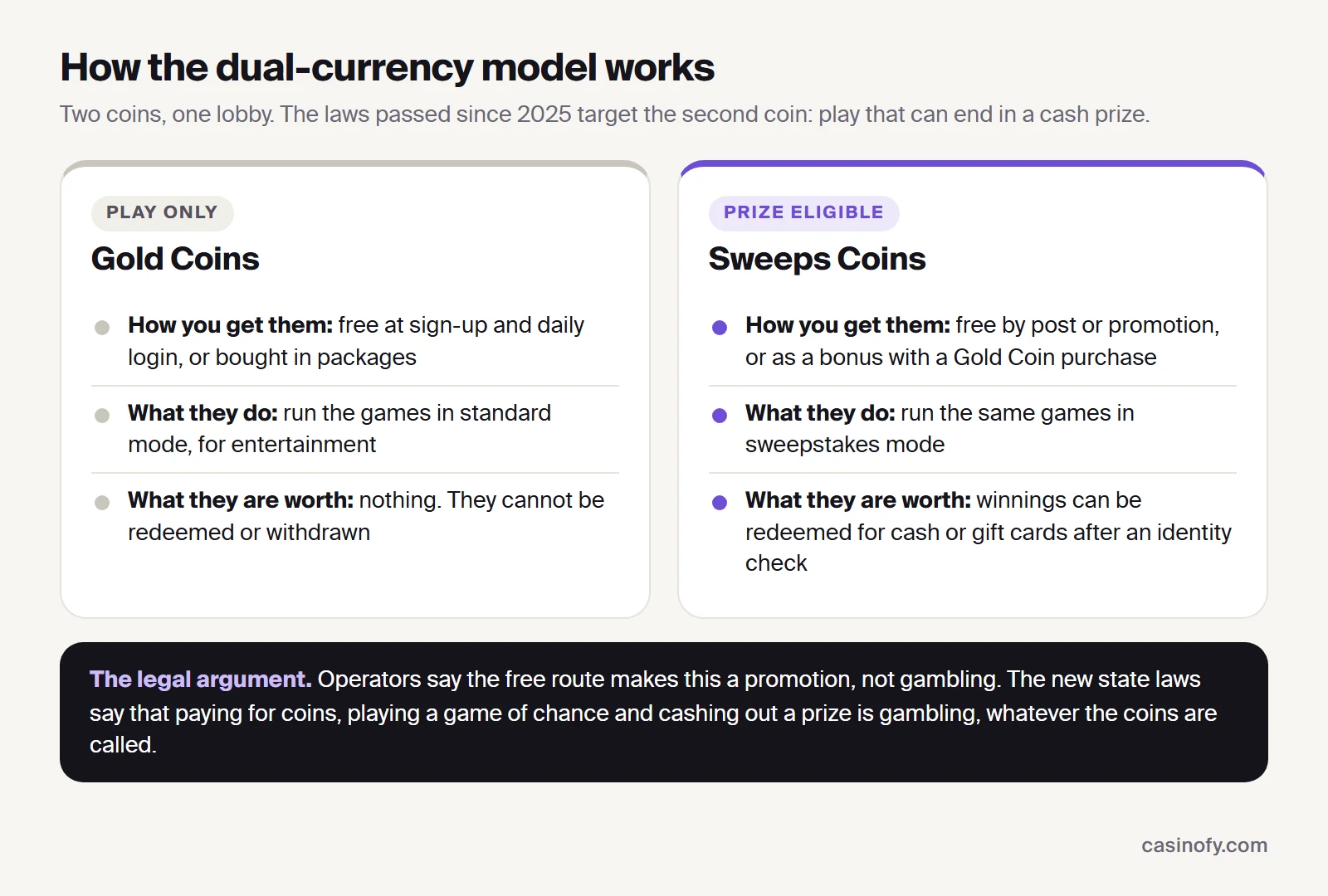
Gold Coins (GC) are for entertainment only. Players get them free at sign-up and through daily rewards, or buy them in packages. They have no cash value and cannot be redeemed.
Sweeps Coins (SC) are promotional credits. They come free through a mail-in request or other promotions, or as a bonus with a Gold Coin purchase. Sweeps Coins run the same games in sweepstakes mode, and winnings can be redeemed for cash or gift cards once the operator's rules are met: minimum redemption amounts, identity verification and eligibility checks.
Because a purchase is never required to get Sweeps Coins, operators offer a free route to play, usually called an Alternative Method of Entry (AMOE). That free route is the legal foundation of the model: operators argue it makes the product a promotional sweepstakes rather than gambling. Our guide to US sweepstakes casinos explains how individual brands work, and the social casinos guide covers play-money sites that never pay out prizes.
Why are US states restricting sweepstakes casinos?
The rules changed quickly between 2025 and 2026. Regulators and lawmakers raised three concerns. The first is that buying coins, playing a game of chance and redeeming a cash prize looks like online gambling, whatever the coins are called. The second is consumer protection: unlike state-licensed online casinos, sweepstakes operators are not bound by gambling-specific rules on age verification, responsible gambling, game testing and dispute handling. The third is licensing and tax: licensed operators pay state gaming taxes and fees that sweepstakes operators do not. Our explainer on how casino licensing works sets out what a state licence requires.
Supporters of the model disagree. The sweepstakes industry maintains that its free-entry promotional structure is lawful and different from gambling, and its trade body wants industry standards written into state law instead of bans. So far, most legislatures that have acted have chosen to prohibit the dual-currency model rather than license it.
Which US states have banned or restricted sweepstakes casinos?
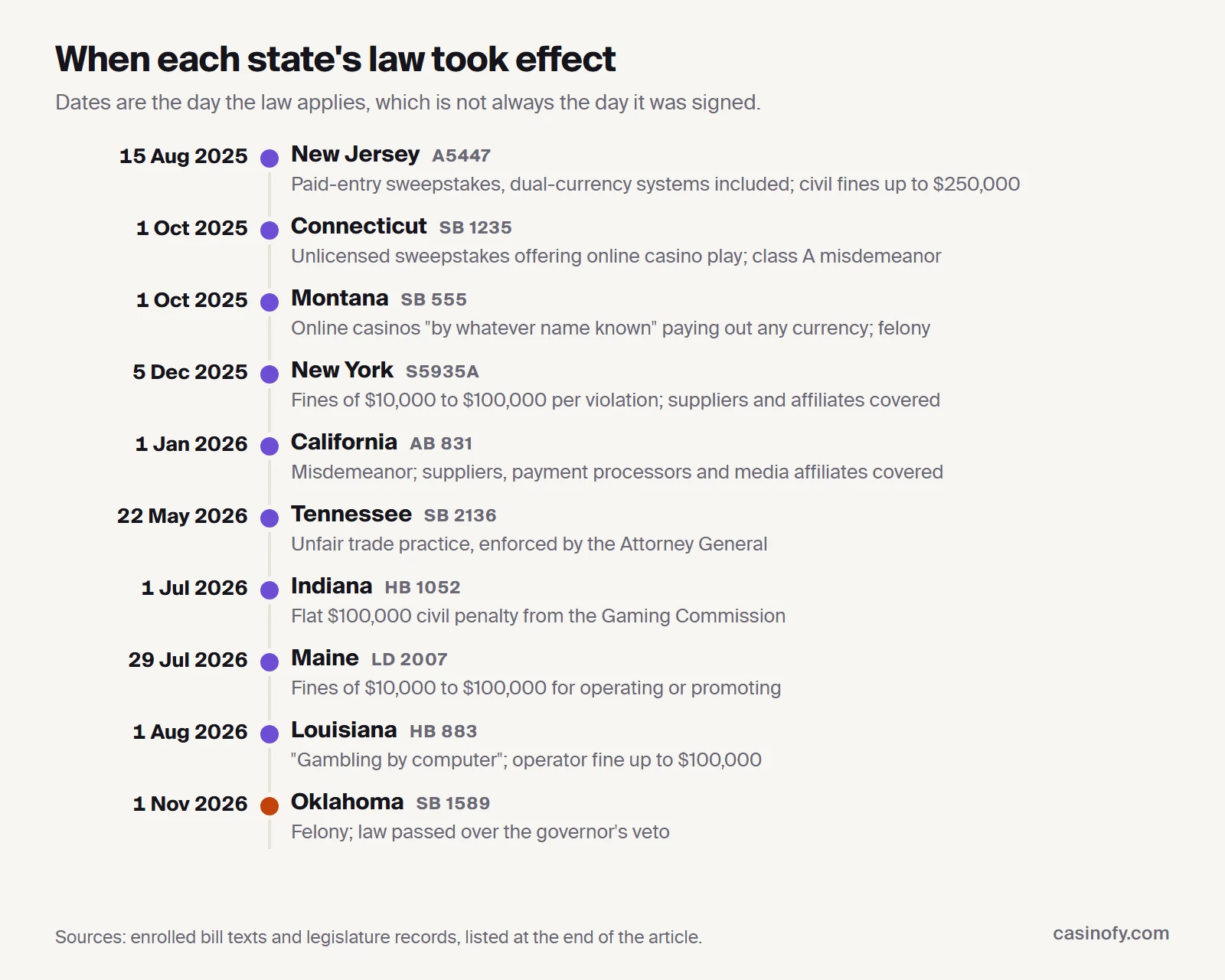
Nine states have a law in force that bans or restricts dual-currency sweepstakes casinos, and a tenth, Oklahoma, follows on 1 November 2026. The laws differ in wording, but each targets online casino-style games that use a dual-currency system and let players redeem winnings for cash or cash equivalents. The table lists them in the order they took effect; the penalties column shows the main sanction for operators.
Legal status reviewed: 29 September 2026. Effective dates and provisions are taken from the enacted bill texts and legislature records listed at the end of this guide. Laws, enforcement practice and operator availability can change.
| State | Law | In force | What it prohibits | Penalties |
|---|---|---|---|---|
| New Jersey | A5447 (P.L.2025, c.128) | 15 August 2025 | Sweepstakes that players pay to enter, including dual-currency prize systems, unless narrow statutory conditions are met | Civil fines up to $100,000 for a first offence and $250,000 for each later one, per day |
| Connecticut | SB 1235 (Public Act 25-112) | 1 October 2025 | Conducting or promoting sweepstakes that allow real or simulated online casino gaming or sports wagering, unless licensed | Class A misdemeanor (up to one year and $2,000) plus unfair-trade-practice liability |
| Montana | SB 555 (Chapter 626 of 2025) | 1 October 2025 | Online casinos "by whatever name known" that take bets and pay out in any form of currency; advertising or soliciting play | Felony: fine up to $50,000 and up to ten years in prison |
| New York | S5935A (Chapter 605 of 2025) | 5 December 2025 | Online sweepstakes games that use a dual-currency system and simulate casino gaming, plus knowingly supporting them (payment processors, suppliers, platforms, media affiliates) | Fines of $10,000 to $100,000 per violation; loss of gaming licence eligibility |
| California | AB 831 (Chapter 623 of 2025) | 1 January 2026 | Operating, conducting or offering an online sweepstakes game that simulates gambling and awards cash or cash equivalents, plus knowingly supporting one | Misdemeanor: fine of $1,000 to $25,000, up to one year in jail, or both |
| Tennessee | SB 2136 (Public Chapter 1117) | 22 May 2026 | Operating, conducting or commercially promoting an online sweepstakes game that simulates gambling, or supporting one | Unfair or deceptive practice under the Consumer Protection Act, enforced by the Attorney General |
| Indiana | HB 1052 (Public Law 153-2026) | 1 July 2026 | Knowingly conducting an online dual-currency sweepstakes game in Indiana or with players located there | Flat civil penalty of $100,000, imposed by the Indiana Gaming Commission |
| Maine | LD 2007 (Public Law 2025, chapter 645) | 29 July 2026 | Operating or promoting an online dual-currency sweepstakes game that simulates casino-style gaming | Fines of $10,000 to $100,000; revocation of any state gambling licence |
| Louisiana | HB 883 (Act 182 of 2026) | 1 August 2026 | Online dual-currency games that simulate any form of gambling, now "gambling by computer"; knowingly supporting or processing payments for them | Operators: fine up to $100,000 and up to five years in prison |
How the laws differ
The laws share a target, but they are not copies of one another. They differ on what exactly is banned, who can be held liable and how hard they hit. None of them treats a free entry route as proof that a dual-currency casino is lawful.
- New Jersey (A5447, P.L.2025, c.128, signed and in force 15 August 2025) makes any sweepstakes that New Jersey players pay to enter unlawful gambling, and its definition expressly includes dual-currency systems that let players exchange coins for prizes. Paid entry is allowed only in narrow cases, such as a purchase of food or merchandise worth up to $20, and never through coins, tokens or online credits. Operators face civil fines of up to $100,000 for a first offence and up to $250,000 for each later one, with each day counted separately, enforced by the Division of Consumer Affairs. The same law makes running an unregulated online gambling site open to New Jersey players a third-degree crime.
- Connecticut (SB 1235, Public Act 25-112, in force 1 October 2025) bars anyone not licensed under the state's online gaming law from conducting or promoting a sweepstakes or promotional drawing that allows or facilitates real or simulated online casino gaming or sports wagering. A violation is a class A misdemeanor, punishable by up to a year in prison and a $2,000 fine, and also a breach of the Connecticut Unfair Trade Practices Act.
- Montana (SB 555, Chapter 626 of 2025, in force 1 October 2025) does not mention sweepstakes at all. It redefines illegal internet gambling to include online casinos "by whatever name known" that take bets and pay out in any form of currency, exempts only play with no currency of any kind, and makes knowingly operating such a site in Montana a felony, with fines of up to $50,000 and up to ten years in prison. Knowingly advertising or soliciting play is covered too.
- New York (S5935A, Chapter 605 of 2025, signed and in force 5 December 2025) bans online sweepstakes games that use a dual-currency system and simulate casino gaming. It sets fines of $10,000 to $100,000 per violation, extends liability to financial institutions, payment processors, geolocation providers, game content suppliers, platform providers and media affiliates that support such games, and bars violators from holding a New York gaming licence. The State Gaming Commission, the State Police and the Attorney General share enforcement.
- California (AB 831, Chapter 623 of 2025, in force 1 January 2026) makes it a misdemeanor to operate, conduct or offer an online sweepstakes game in the state, punishable by a fine of $1,000 to $25,000, up to a year in county jail, or both. It also makes it unlawful for a financial institution, payment processor, geolocation provider, gaming content supplier, platform provider or media affiliate to knowingly support one. Occasional promotions run as a marketing tool alongside genuine product sales are exempt.
- Tennessee (SB 2136, Public Chapter 1117, signed and in force 22 May 2026) makes it unlawful to operate, conduct or commercially promote an online sweepstakes game, or to support, facilitate or assist one, and treats a violation as an unfair or deceptive practice under the Tennessee Consumer Protection Act, enforced by the Attorney General.
- Indiana (HB 1052, Public Law 153-2026, in force 1 July 2026) does not use a general ban clause. Instead it lets the Indiana Gaming Commission impose a flat civil penalty of $100,000 on any operator or individual who knowingly runs an online dual-currency sweepstakes game in Indiana or with a player located there.
- Maine (LD 2007, Public Law 2025, chapter 645, in force 29 July 2026) classifies operating or promoting an online sweepstakes game as unlawful gambling, with fines of $10,000 to $100,000 paid into the state's Gambling Addiction Prevention and Treatment Fund, and requires any state gambling licence held by a violator to be revoked.
- Louisiana (HB 883, Act 182 of 2026, in force 1 August 2026) brings any online dual-currency game that simulates gambling within the crime of "gambling by computer". The maximum fine for operators rises from $20,000 to $100,000, with up to five years in prison, and platform providers, content suppliers, promoters, media affiliates and payment processors that knowingly support such a game are also liable. A companion law, HB 53 (Act 48), adds these gambling crimes to Louisiana's racketeering statute from the same date.
Oklahoma: a further ban from 1 November 2026
Oklahoma is next. SB 1589 passed the Senate 48-0 and the House 65-21, was vetoed by Governor Kevin Stitt on 7 May 2026, and became law on 14 May, the last day of the session, when both chambers overrode the veto (34-10 in the Senate, 68-19 in the House). It takes effect on 1 November 2026, so it is not yet in force as this guide is published.
The law never uses the word "sweepstakes". It amends the state's gambling code so that any currency used in a dual-currency system and exchangeable for prizes or cash counts as a "representative of value", which brings online casino games played with such coins within Oklahoma's existing gambling offences, a felony carrying a fine and a prison term. Geolocation providers, gaming suppliers, platform providers, promoters and media affiliates that support such games are covered too. Gaming conducted on Indian lands under the federal Indian Gaming Regulatory Act is exempt.
Which states restrict sweepstakes casinos under existing gambling law?
Not every state has passed a sweepstakes-specific law. Several regulators are using the gambling laws they already have to act against operators that offer casino-style games without a licence, and the absence of a new statute does not mean a platform is authorised to operate.
Washington
Washington takes the hardest line of any state, and it reaches even social casinos that never pay out cash. The Washington State Gambling Commission's guidance on online social casinos says virtual casino currency can count as a "thing of value" under state law even though it cannot be cashed out, and that such games are likely to be illegal gambling. That view rests on federal court rulings applying Washington law. In Kater v. Churchill Downs (9th Circuit, March 2018), the court held that the Big Fish Casino app was illegal gambling under Washington law although its chips could not be exchanged for money. In Larsen v. PTT, a class action against High 5 Games, a federal jury verdict led to a judgment of about $24.9 million in June 2025, and a class settlement received preliminary approval in August 2026. The large sweepstakes operators exclude Washington entirely.
Michigan
Michigan's Gaming Control Board sent cease-and-desist letters to Sweepstakes Limited, the operator of Stake.us, on 2 November 2023, and to VGW LuckyLand on 5 December 2023, and announced them in January 2024, citing the state's internet gaming, sports betting and gaming control laws and the penal code. The Board said the companies had taken steps to stop Michigan residents from playing. Its enforcement since then has focused on offshore real-money sites: in April 2026 it ordered 45 illegal offshore operators to stop serving the state.
Arizona
The Arizona Department of Gaming has issued cease-and-desist orders in waves since April 2025. The order announced on 27 June 2025 named seven operators, including Stake.US and High 5, and alleged felonies under state law, among them promotion of gambling, illegal control of an enterprise and money laundering. Further orders followed in August 2025, naming sweepstakes brands BettySweeps and Pulsz, and in July 2026.
Nevada
Nevada only allows gambling, online or off, under a state licence, and it tightened the penalties in 2025. SB 256, sponsored by Senator Rochelle Nguyen, passed both houses unanimously and was signed by Governor Joe Lombardo. It lets courts impose fines above the previous $50,000 maximum for breaking the state's online gaming laws, turns some offences from misdemeanors into gross misdemeanors, and requires unlicensed operators to give up the profits they made. The law is aimed at illegal online gambling in general rather than at sweepstakes casinos by name, which is why Nevada is not in the table above.
Iowa
Iowa took a middle route in 2026. SF 2289, signed on 15 May and in force since 1 July, does not define or ban the dual-currency model, but it gives the Iowa Racing and Gaming Commission the power to issue cease-and-desist orders and to seek court injunctions against anyone offering illegal sweepstakes without a licence. High 5 Casino, one of the larger operators, has listed Iowa among its restricted states since 16 June 2026.
Other states that have acted
Regulators and attorneys general elsewhere have used their existing powers too:
- Delaware: the Division of Gaming Enforcement ordered VGW LuckyLand to stop offering its games in the state in April 2025.
- Maryland: the Lottery and Gaming Control Agency has published cease-and-desist letters to sweepstakes operators since May 2024, including Stake.us, VGW, High 5 Casino and WOW Vegas. A bill to ban the model outright passed the House of Delegates in 2026 but died in the Senate.
- Mississippi: the Gaming Commission sent cease-and-desist letters in June 2025 and warned in a public notice that there is no exception for so-called sweepstakes casinos.
- Minnesota: the Attorney General wrote to operators including VGW LuckyLand, Zula and Fortune Coins in November 2025 under the state's consumer-protection law.
- Illinois: the Gaming Board, working with the Attorney General, sent more than 60 cease-and-desist letters to online casino and sweepstakes operators in February 2026.
- Kentucky: the Attorney General sued VGW in Franklin Circuit Court in June 2026 under the state's consumer-protection and gambling-loss recovery laws.
- Florida: the Attorney General filed two lawsuits in August 2026 against Stake, VGW and payment processors, under Florida's gambling laws and its deceptive trade practices act.
Some states with bans in force also acted before their laws took effect. New York's Attorney General told 26 operators to stop selling Sweeps Coins in the state in June 2025, and Connecticut's Department of Consumer Protection suspended High5Games' licence in March 2025 before reaching a settlement of nearly $1.5 million, under which High5Games closed its online casino in the state.
What do sweepstakes casino restrictions mean for players?
In a state with a ban, the large operators stop accepting new registrations and switch off sweepstakes-mode play for existing accounts, usually by location check. What happens to an existing balance depends on the operator's terms and any transition arrangements, so anyone holding Sweeps Coins should read the operator's official notice and redeem what is eligible before the deadline it sets.
The largest operators publish their own lists, and they exclude more states than the laws require. When we checked on 29 September 2026, VGW's Chumba Casino, LuckyLand Slots and Global Poker were unavailable altogether in Connecticut, Delaware, Michigan, Montana, Nevada and Washington, and offered Gold Coin play only in California, Idaho, Indiana, Louisiana, Maine, Mississippi, New Jersey, New York, Tennessee and West Virginia. Stake.us listed 22 restricted states and High 5 Casino 21, including every state with a sweepstakes-specific law in force. None of the three listed Oklahoma yet.
Three practical points follow:
- A site that loads is not a site that is legal. Access from your state does not mean the product is authorised there. Several of the new laws target the model, not individual brands, so smaller or offshore sites that keep serving a banned state are operating outside the law.
- Location checks work both ways. Operators typically prohibit playing through a VPN or proxy in their terms, and a breach can mean confiscated winnings and a closed account.
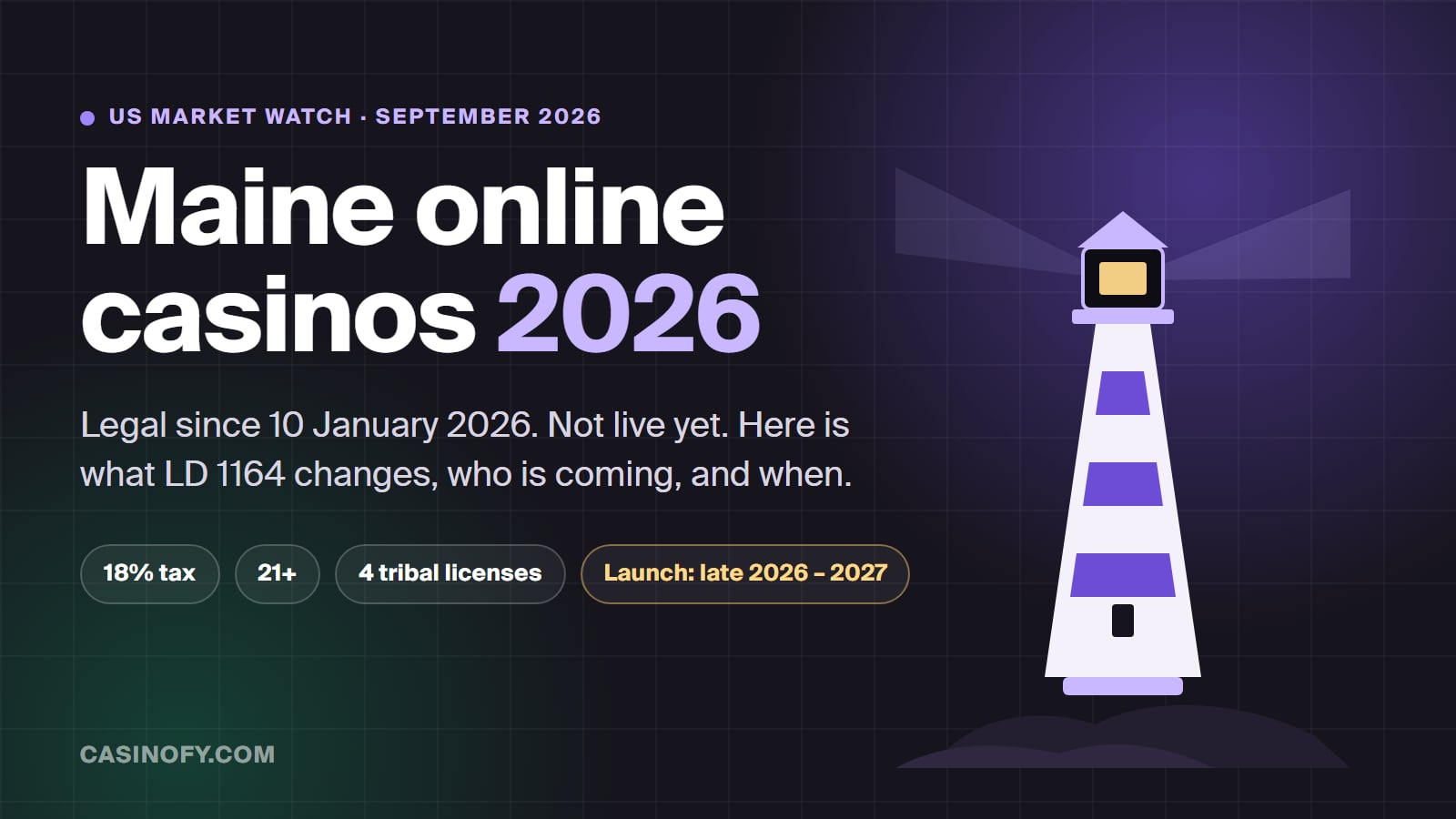
- Licensed alternatives exist in some states. New Jersey, Pennsylvania, Michigan, West Virginia, Connecticut, Delaware and Rhode Island license real-money online casinos, and Maine has legislated for tribal online casinos that have yet to launch. Those sites are regulated, taxed and covered by state self-exclusion schemes.
How do the restrictions affect operators, payment providers and affiliates?
The newer laws reach well beyond the sweepstakes casino itself. California and New York make it unlawful for a financial institution, payment processor, geolocation provider, game content supplier, platform provider or media affiliate to knowingly support the operation or promotion of an online sweepstakes game, and Maine fines anyone who operates or promotes one. Suppliers, payment partners and marketers therefore need to check which states they serve, not only operators.
For operators the practical result has been state-by-state exits: when a ban is signed, the large brands typically announce a date after which players in that state can no longer take part in sweepstakes play. The absence of a sweepstakes-specific law does not make a state safe either. Regulators can and do act under their existing gambling law, as the next section shows.
What happens next
More states tried and failed in 2026. Bills to ban dual-currency sweepstakes casinos passed one chamber in Mississippi, Maryland and Minnesota and then died when the other chamber did not act before the session ended. Virginia's Senate committee carried its bill over to 2027, and a Florida bill was tabled. None of the bills that cleared a chamber is still alive this year, so the next wave will come when legislatures reconvene in 2027.
The fight is also moving into the courts, through players rather than states. In California, a federal judge refused on 18 September 2026 to send a class action against VGW, the owner of Chumba Casino, LuckyLand Slots and Global Poker, to arbitration or to dismiss it; the suit seeks to recover players' losses and also names payment and identity-verification providers. In Minnesota, a similar class action against Stake.us is on appeal after the district court refused to compel arbitration. We found no court order blocking any of the state bans listed above.
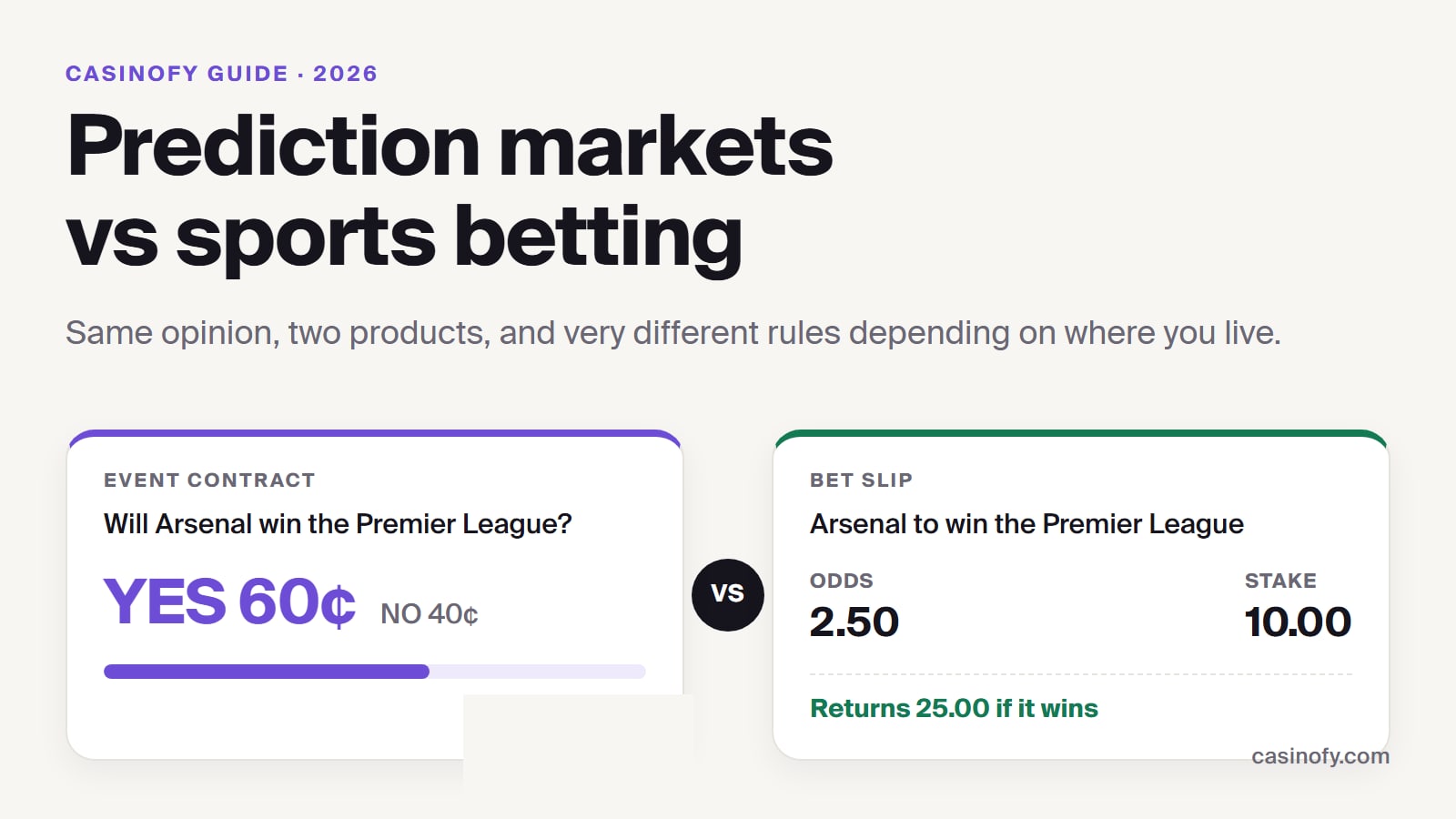
At federal level there is no bill that targets sweepstakes casinos specifically. The debate stays in the states, with the American Gaming Association, which represents licensed operators, arguing that sweepstakes sites present themselves as legal while operating outside state gambling regulation, and the industry's trade body, the Social Gaming Leadership Alliance, opposing the bans and pressing for its own standards to be written into law instead. A similar contest over how far state gambling law reaches is playing out with prediction markets.
Sweepstakes casino bans: FAQ
Are sweepstakes casinos legal in every US state?
No. Nine states have laws in force that ban or restrict dual-currency sweepstakes casinos (New Jersey, Connecticut, Montana, New York, California, Tennessee, Indiana, Maine and Louisiana), and Oklahoma joins them on 1 November 2026. Several other states treat them as unlicensed gambling under existing law, and the large operators already exclude a number of states on their own.
Are all sweepstakes casinos banned in 2026?
No. The bans target the dual-currency casino model: casino-style games played with purchasable coins that can be redeemed for cash prizes. Ordinary promotional sweepstakes, such as a drink-can prize draw, and social casinos that never pay out prizes are generally not covered. California, for example, exempts occasional promotions run as a marketing tool alongside genuine product sales.
Are sweepstakes casinos the same as licensed online casinos?
No. A licensed online casino takes real-money bets under a state gambling licence, with state oversight of game fairness, payouts, age checks and self-exclusion. A sweepstakes casino uses promotional virtual currencies and operates without a state gambling licence, which is exactly why several states now prohibit the model.
Can I still redeem my Sweeps Coins if my state introduces a ban?
That depends on the operator's terms, the new law and any transition period. Operators usually post a notice with a cut-off date after which sweepstakes play and redemptions stop for players in that state. Check the notice, redeem eligible balances before the deadline, and keep copies of your account history. Redemptions usually require identity verification, so complete it early.
Is it legal to play from a banned state using a VPN?
Playing through a VPN typically breaches the operator's terms, and operators can refuse redemptions and close accounts when they detect it. Most of the new laws are aimed at operators and the businesses that support them rather than individual players, but Louisiana's also makes playing an offence, with a fine of up to $500, and none of them makes the product lawful where you are.
Which state is next?
Oklahoma's ban takes effect on 1 November 2026. No other bill that passed a chamber in 2026 is still alive, so the next changes will come when legislatures meet again in 2027. Mississippi, Maryland, Minnesota and Virginia, where bills advanced this year, are the states to watch.
Sweepstakes casinos in 2026: the bottom line
In little over a year, nine states have put laws against dual-currency sweepstakes casinos into force, Oklahoma follows on 1 November 2026, and several more are acting under the gambling laws they already have. The laws differ in detail, but they share one idea: buying coins, playing a casino-style game and redeeming a cash prize is gambling, and a free entry route does not change that.
For players, the question to ask is not whether a site loads but whether the product is lawful where you are. For operators, suppliers and marketers, the question is which states a product reaches, because the newer laws hold the whole supply chain responsible. With more bills moving and at least one more ban due on 1 November 2026, this map will keep changing; we will update this guide when it does. If gambling of any kind stops being fun, our responsible gambling guide lists free, confidential help.
This guide is general information about state law as it stood on 29 September 2026, based on the enacted bill texts and regulator notices listed below. It is not legal advice.
Sources
Every law, date and penalty in this guide was checked on 29 September 2026 against the enacted text or the legislature's own record, and every enforcement action against the regulator's or court's own record. The key sources are below.
State laws
- New Jersey Legislature: P.L.2025, c.128 (A5447), archived copy
- Connecticut General Assembly: SB 1235 (2025), Public Act 25-112
- Montana Code Annotated: 23-5-112, as amended by SB 555 (2025)
- New York State Senate: S5935A (2025), Chapter 605 of 2025
- California Legislature: AB 831 (2025), Chapter 623
- Tennessee Secretary of State: Public Chapter 1117 (SB 2136), 2026
- Indiana General Assembly: HB 1052 (2026)
- Maine Legislature: digest of enacted laws, 2026 session (LD 2007, Public Law 2025, chapter 645)
- Louisiana State Legislature: HB 883 (2026), Act 182
- Oklahoma Legislature: SB 1589 (2026), bill history and enrolled text
Enforcement and court cases
- The Nevada Independent: 2025 legislative session tracker (SB 256)
- Iowa Legislature: SF 2289 (2026)
- US Court of Appeals, Ninth Circuit: Kater v. Churchill Downs Inc., 28 March 2018
- Michigan Gaming Control Board: cease-and-desist letters to Stake.us and VGW LuckyLand, January 2024
- New York Attorney General: action against online sweepstakes casinos, June 2025
- Illinois Gaming Board: cease-and-desist letters, 5 February 2026
- Florida Attorney General: lawsuits against Stake, VGW and payment processors, 19 August 2026
- US District Court, N.D. California: Brown v. VGW Holdings US Inc., order of 18 September 2026