 EN
EN Italiano
 Nederlands
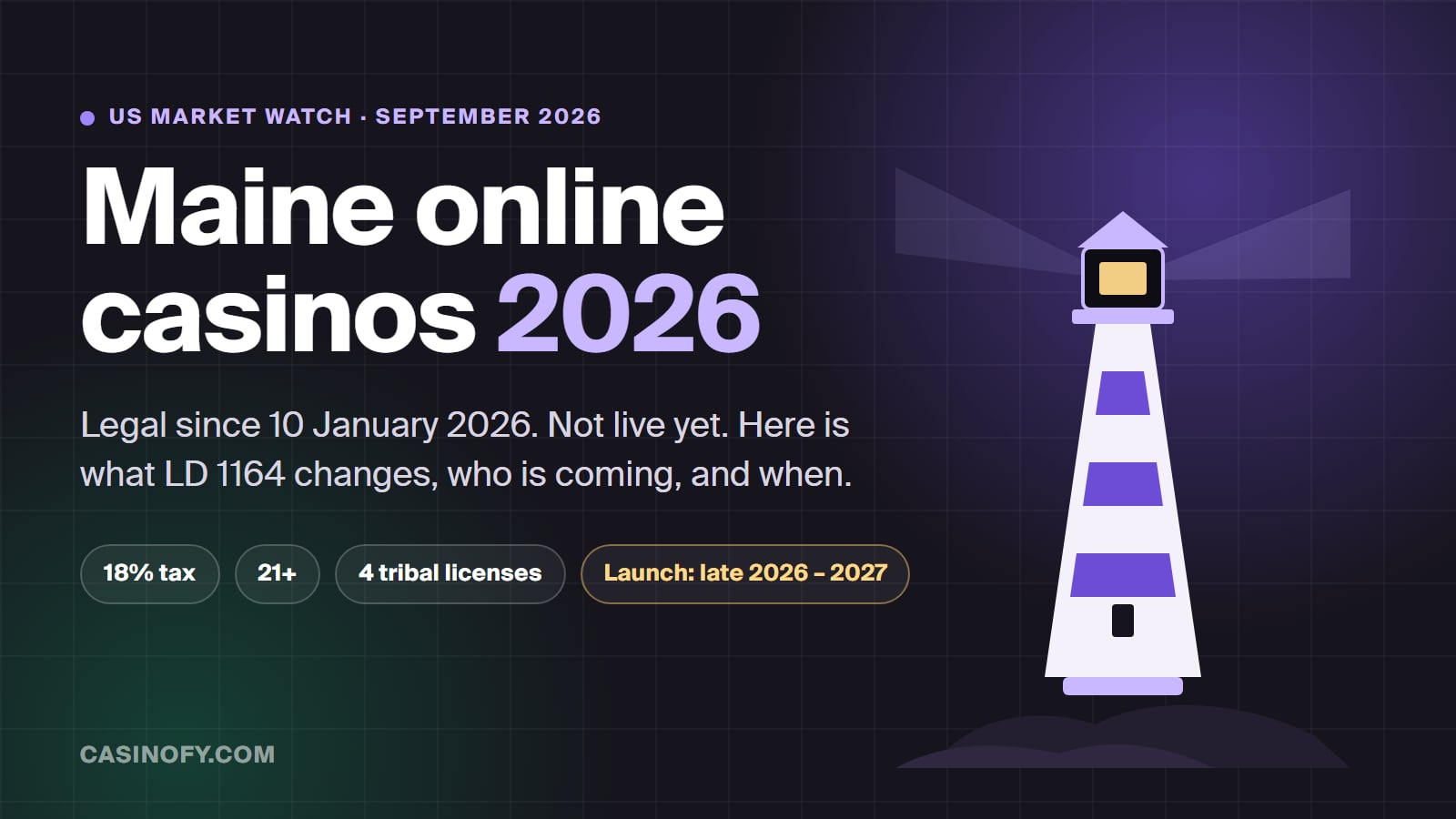
Maine has legalized online casinos, and nobody in Maine can play at one yet. That has been the position since 10 January 2026, when LD 1164 became law without Governor Janet Mills's signature, and it is still the position today. The law took effect on 29 July 2026. The state regulator is finalizing its rules, no license applications have opened, and the earliest realistic launch is late 2026, with early 2027 the more common estimate.
This guide explains what the law does, who will run Maine's online casinos, what is holding up the launch, and why a state of 1.4 million people matters to the wider US market. Status checked on 16 September 2026. We update this page at each milestone.
Maine online casinos at a glance
| Legal status | Legal since 10 January 2026, in force since 29 July 2026. No site licensed or live. |
|---|---|
| The law | LD 1164, "An Act to Create Economic Opportunity for the Wabanaki Nations Through Internet Gaming" |
| Who can hold a license | Maine's four federally recognized Wabanaki Nations, one operator license each |
| Platforms | Maximum four. Each nation may contract with one management services provider. |
| Regulator | Gambling Control Unit (GCU), Maine Department of Public Safety |
| Tax | 18% of adjusted gross internet gaming receipts |
| Minimum age | 21 |
| Deposits | Credit cards barred for online casino and sportsbook accounts (LD 2080) |
| Games | Online slots, table games such as blackjack and roulette, and poker |
| Expected launch | Late 2026 at the earliest; early 2027 more likely. No date set. |
| Legal challenge | Churchill Downs and Oxford Casino Hotel are contesting tribal exclusivity in federal court. No injunction. |
What LD 1164 actually does
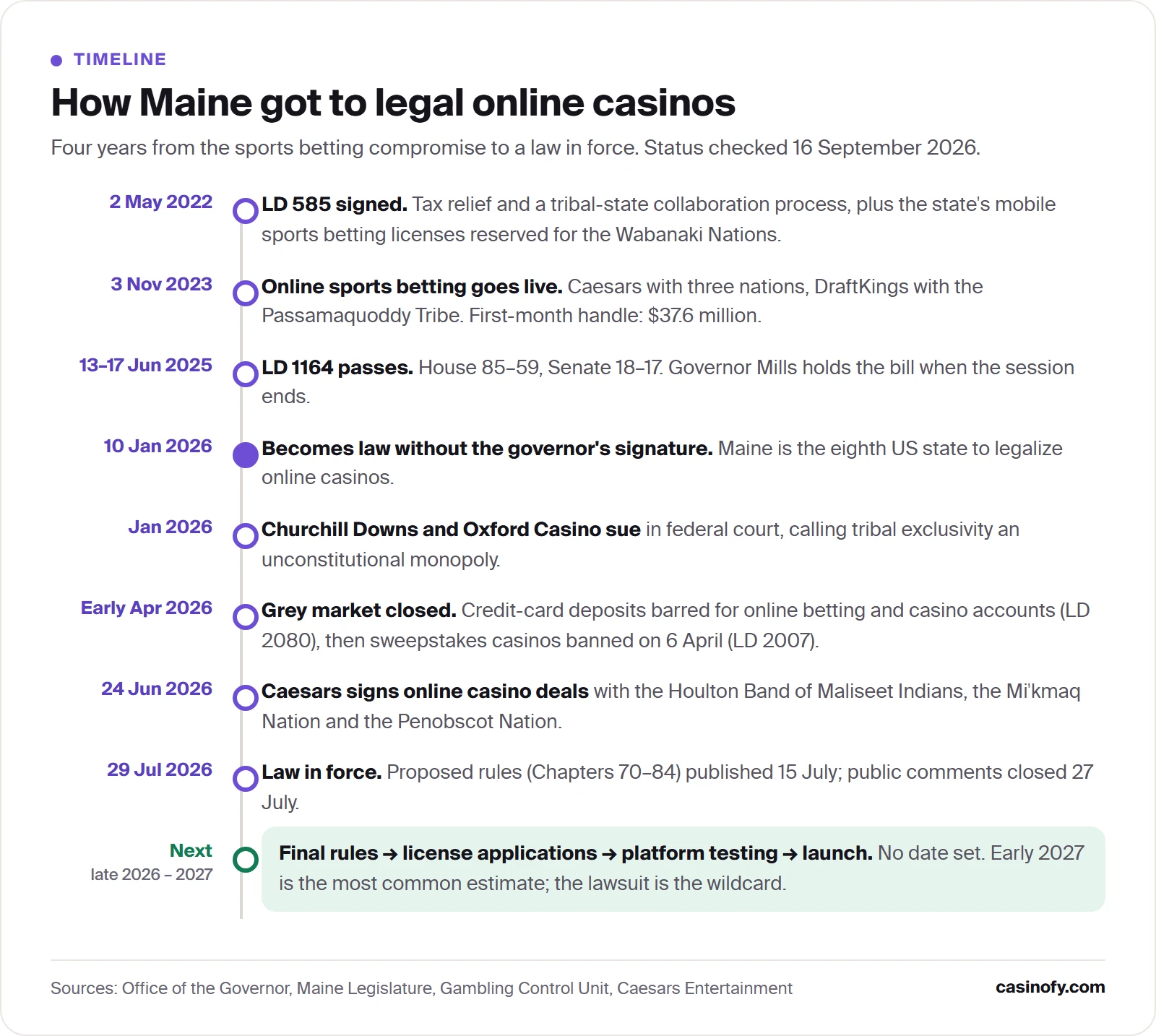
LD 1164, "An Act to Create Economic Opportunity for the Wabanaki Nations Through Internet Gaming," was sponsored by Rep. Ambureen Rana and co-sponsored by Rep. Aaron Dana, who represents the Passamaquoddy Tribe in the Maine House. It passed the House 85–59 on 13 June 2025 and squeaked through the Senate 18–17 days later. The governor neither signed nor vetoed it before the session ended, which held the bill over to January 2026. When lawmakers returned on 7 January, she let it become law at midnight on 10 January without her signature.
"I considered this bill carefully, and while I have concerns about the impacts of gambling on public health, I believe that this new form of gambling should be regulated," Governor Mills said, adding that she was confident the Gambling Control Unit would "develop responsible rules and standards."
The statute is short on hype and long on structure. Its main provisions:
- Exclusive tribal licenses. Only Maine's federally recognized Indian nations, tribes or bands may hold an internet gaming operator license. There are four: the Houlton Band of Maliseet Indians, the Mi'kmaq Nation, the Passamaquoddy Tribe and the Penobscot Nation.
- One platform partner each. An operator may contract with a single management services provider, the commercial company that builds and runs the site. Four nations, four partners, a maximum of four platforms.
- An 18% tax on adjusted gross internet gaming receipts, paid by the licensees.
- Fees and terms. Licenses run for one year, with temporary licensure available. The operator license fee is $50,000, a management services or supplier license costs $10,000, and occupational licenses carry a $250 application fee.
- Players must be 21 or older, and winnings can be intercepted for unpaid child support.
- Games. The law covers online casino games, which in practice means slots, table games such as blackjack and roulette, and poker.
- The regulator is the Gambling Control Unit within the Maine Department of Public Safety, the same small agency that licenses the state's sportsbooks.
Because the bill was finalized in the second regular session of the 132nd Legislature, which adjourned on 29 April 2026, the law took effect 90 days later, on 29 July 2026. Nothing could formally happen before that date.
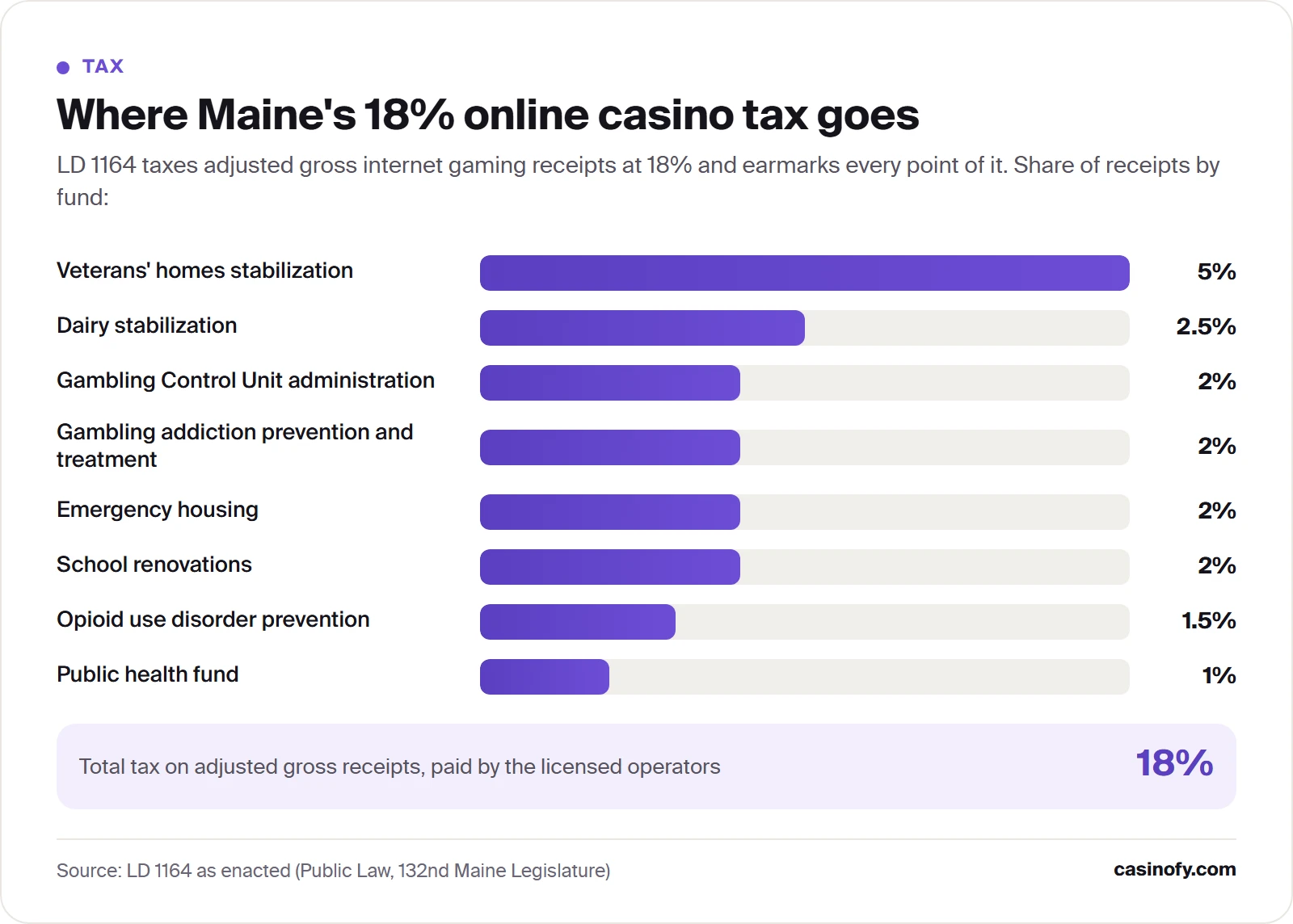
The tax is unusual in how precisely it is earmarked. Of the 18%, 5% of receipts goes to veterans' homes stabilization, 2.5% to dairy stabilization, 2% each to GCU administration, gambling addiction prevention and treatment, emergency housing and school renovations, 1.5% to opioid use disorder prevention and 1% to a public health fund. None of it flows to the general fund as an unallocated windfall, which tells you how the votes were assembled.
How Maine got here: sports betting came first
The 2026 law copies a structure Maine already trusted. On 2 May 2022 Governor Mills signed LD 585, a three-part deal negotiated with the Wabanaki Nations. It created a formal tribal-state collaboration process, delivered tax relief to tribal members and businesses, and reserved the state's mobile sports betting licenses for the federally recognized tribes, while the commercial casinos, off-track betting facilities and tracks were limited to in-person wagering.
"This law provides meaningful economic opportunities for the Wabanaki Nations," the governor said at the signing. "It incentivizes investment in Tribal communities, and it formalizes a collaboration process on policy that sets the foundation for a stronger relationship in the future."
Online sports betting went live on 3 November 2023 with two platforms: Caesars Sportsbook, partnered with the Houlton Band of Maliseet Indians, the Mi'kmaq Nation and the Penobscot Nation, and DraftKings, partnered with the Passamaquoddy Tribe. The GCU's first monthly report showed $37.6 million in handle and $4.6 million in adjusted gross revenue for November 2023, with DraftKings taking $30.5 million of the handle. For a state with no prior online gambling, the launch was clean, and it gave lawmakers a working template: tribal licenses, national brands as partners, state oversight.
LD 1164 is that template applied to casino games. The difference is the money. In the mature US states, online casino revenue runs several times higher than sports betting revenue, which is why Maine's two commercial casinos fought the bill so hard.
Why the Wabanaki Nations hold the keys
Maine has two commercial casinos: Hollywood Casino Hotel & Raceway in Bangor, owned by Penn Entertainment, and Oxford Casino Hotel, owned by Churchill Downs. Both opposed LD 1164, arguing it would hurt their land-based revenue and shut them out of fair competition. Under the law they cannot hold an online casino license at all. Their only route online is as a nation's single platform partner, and three of the four slots are already taken.
The rationale is economic. The Wabanaki Nations were excluded from Maine's gaming industry for decades, and the governor's office framed the 2022 law as the first meaningful way for the tribes to take part in it. Penobscot Nation Chief Kirk Francis has said internet gaming revenue will fund health, education, housing, law enforcement, social services and environmental management in tribal communities. Four nations, five elected chiefs (the Passamaquoddy Tribe has two), all backed the bill.
Who will run Maine's online casinos
Three of the four licenses are spoken for. On 24 June 2026 Caesars Entertainment announced it had extended its sports betting relationship with the Houlton Band of Maliseet Indians, the Mi'kmaq Nation and the Penobscot Nation to cover online casino gaming. Caesars plans to bring three brands to Maine: Caesars Palace Online Casino, Caesars Sportsbook & Casino and Horseshoe Online Casino, on a single login and wallet linked to Caesars Rewards. The company also committed to training members of each nation and to funding tribal community programs. Its own wording on timing was careful: a "potential iGaming launch in the state in 2026, pending regulatory approvals."
"Our experience working together on sports wagering has demonstrated the value of aligning with a partner that respects our sovereignty," said Chief Kirk Francis of the Penobscot Nation.
The Passamaquoddy Tribe has not announced an online casino partner. DraftKings is its sportsbook partner and already runs online casinos in several states, so it is the obvious candidate, but as of mid-September 2026 no agreement has been made public.
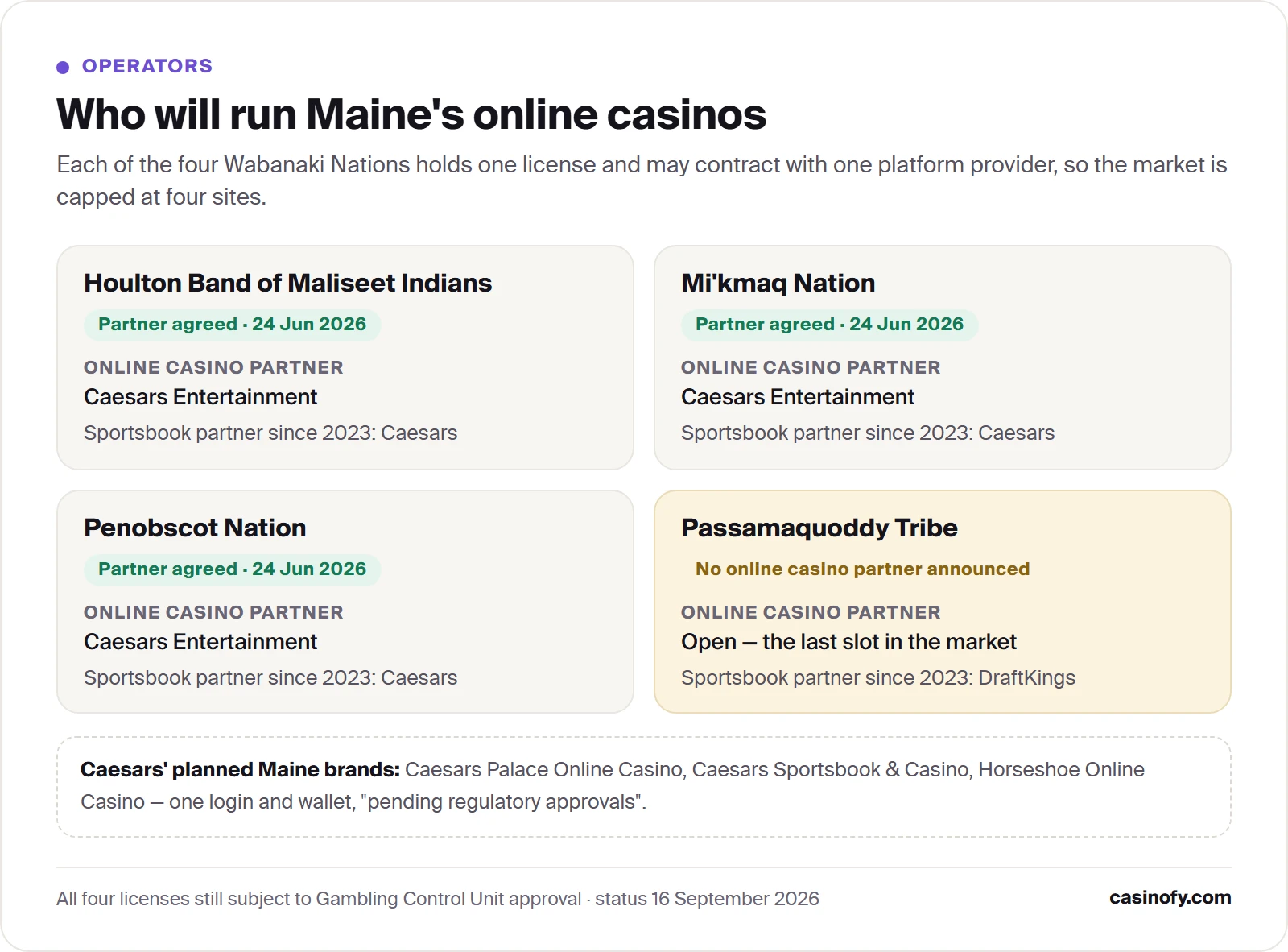
Could other brands enter Maine? Only through that one remaining slot. The law caps the market at four platforms, one per nation, so BetMGM, FanDuel, Fanatics or any other operator would need the Passamaquoddy partnership to get in. There is no path to a fifth site unless the Legislature rewrites the statute.
What is holding up the launch
Two clocks are running. The first is regulatory. The GCU opened its internet gaming rulemaking with an initial notice on 6 May 2026, published proposed rules (Chapters 70 to 84) together with a notice of public hearing on 15 July, and closed written comments on 27 July. The unit must now adopt final rules, then accept and process license applications from the nations and their platform partners, then test and certify each platform, covering geolocation, identity checks, game integrity and responsible gambling tools, before anyone goes live.
The GCU is a small agency that was not built with a four-platform casino launch in mind. Its executive director, Milton Champion, told legislators earlier this year that he planned to add staff once the law took effect and expected the process to move relatively quickly. Even so, comparable launches in other states have usually taken longer than first projected. Late 2026 is possible if everything lands at once. Early 2027 is the estimate most observers, and we, consider realistic.
The lawsuit that could reshape the market
The second clock is the courtroom. In January 2026 Churchill Downs and Oxford Casino Hotel sued in the US District Court for the District of Maine, arguing that LD 1164 creates a race-based monopoly that violates the equal protection clauses of the US and Maine constitutions and the Commerce Clause. They want the law declared unconstitutional and its enforcement blocked.
The Wabanaki Nations moved to join the case as defendants on 1 April 2026 and were admitted that month, arguing that an equal protection attack on tribal preferences would put a wide body of federal Indian law at risk, not just Maine's statute. As of mid-September no injunction has been granted, no trial date is set, and the law remains fully in effect. That sequencing matters: the GCU can finish its rules and issue licenses while the case is pending, and Caesars is building on that assumption. The uncomfortable scenario is a ruling against the law after sites have launched.
What Maine means for the US iGaming market
Maine is the eighth state with legal online casinos, after New Jersey, Delaware, Pennsylvania, West Virginia, Michigan, Connecticut and Rhode Island. It is the first to build its market on tribal exclusivity from day one, with no commercial operator licensed in its own right. That model is being watched in states where tribal gaming compacts have stalled online casino bills for years. If it survives the courts and produces revenue, it gives those legislatures a workable template. If it is struck down, it will set the boundary for how far a state can go in reserving a new industry for its tribes.
Maine also spent 2026 clearing out the grey market around its new law. In the first week of April Governor Mills signed LD 2080, sponsored by Rep. Marc Malon, which bars credit cards from funding online sportsbook and casino accounts; debit cards, bank transfers, eligible prepaid cards and approved digital wallets remain allowed. On 6 April she signed LD 2007, which classifies dual-currency sweepstakes casinos as unlawful gambling and sets fines of $10,000 to $100,000 per violation, payable into the state's Gambling Addiction Prevention and Treatment Fund. The message to operators is consistent: a regulated, taxed market is opening, and the unregulated one is being shut.
Expect a modest market by revenue. Maine has about 1.4 million residents, and the sports betting figures give a sense of scale. What makes it important is the structure, not the size. For a very different launch model, one built on dozens of commercial licenses rather than four tribal ones, see our piece on Brazil's regulated market launch.
What Maine players can do right now
- Legal today: online sports betting with Caesars Sportsbook or DraftKings (21+), and in-person casino gaming at Hollywood Casino Bangor and Oxford Casino.
- Not legal, and not protected: any website calling itself a "Maine online casino." The GCU has warned that no online casino, iGaming or sweepstakes site is licensed in Maine, and dual-currency sweepstakes sites are now unlawful under LD 2007. Offshore sites offer none of the protections the new law creates: no state-supervised payouts, no self-exclusion, no complaints route.
- How to know when it is real: the GCU will publish the licensed operators, and the Caesars brands will appear in the official app stores with Maine listed. Until then, treat any "Maine casino app" as a red flag.
- Use the wait: read how casino licensing protects you, brush up on the blackjack, roulette and video poker rules you will meet in the lobbies, and see how we test every casino we review before the Maine sites open.
If gambling stops being fun, help in Maine is free and confidential: call 1-800-GAMBLER, which routes callers from the 207 area code to 211 Maine, or read our responsible gambling guide. Maine also runs a voluntary self-exclusion program for its casinos.
Maine online casino FAQ
Is online casino gambling legal in Maine?
Yes. LD 1164 became law on 10 January 2026 and took effect on 29 July 2026. No site is licensed or live yet, so there is no legal way to play online casino games for real money in Maine today.
When will Maine online casinos launch?
No date has been set. The GCU must adopt final rules, license the nations and their partners and test each platform. Late 2026 is the earliest plausible window; early 2027 is the most common estimate.
Who can get a Maine online casino license?
Only the four federally recognized Wabanaki Nations. Each may partner with one platform provider, so the market is capped at four sites.
Which brands are coming to Maine?
Caesars Palace Online Casino, Caesars Sportsbook & Casino and Horseshoe Online Casino, through Caesars' agreements with three nations. The Passamaquoddy Tribe's partner has not been announced.
How old do you have to be?
21, the same as for online sports betting in Maine.
What is the tax rate?
18% of adjusted gross receipts, earmarked across eight funds including veterans' homes, addiction treatment, emergency housing and school renovations.
Can I deposit with a credit card?
No. LD 2080, signed in April 2026, bars credit cards for online casino and sportsbook accounts. Debit cards, bank transfers, eligible prepaid cards and approved digital wallets are allowed.
Are sweepstakes casinos legal in Maine?
No. LD 2007 classifies dual-currency sweepstakes casinos as unlawful gambling, with fines of $10,000 to $100,000 per violation.
Does the law include online poker?
Yes. LD 1164 covers online poker along with slots and table games. Whether operators offer poker on day one, and whether Maine ever shares poker liquidity with other states, are decisions still to come.
Is the law being challenged?
Yes. Churchill Downs and Oxford Casino Hotel are challenging the tribal-exclusive structure in federal court. The Wabanaki Nations have joined the case as defendants, and no injunction has been granted.
Sources
- Office of Governor Janet T. Mills, Governor Mills Announces Bill to Create Economic Opportunities for the Wabanaki Nations to Become Law, 8 January 2026
- Office of Governor Janet T. Mills, Governor Mills Signs Historic, Three-Part Tribal Legislation Into Law, 2 May 2022
- Maine Legislature, LD 1164 bill status, 132nd Legislature
- Maine Gambling Control Unit, Internet Gaming rulemaking and monthly sports wagering reports
- Caesars Entertainment, Caesars Entertainment and Three Wabanaki Nations Expand Relationship to Include Planned Maine Online Casino Launch, 24 June 2026
- Fox Rothschild LLP, Maine Opens Door to Tribal Internet Gaming, 14 January 2026
- Maine House Democrats, Governor signs Malon's bill to protect Maine consumers from gambling addiction (LD 2080)
- Maine Morning Star, Legislature approves exclusive rights to internet gaming for Wabanaki Nations, 16 June 2025