EN
 Italiano
 Nederlands
 Slovenščina
 Suomi

Boombear Bros Slot Review
 Bullshark Games4.3/5 · Excellent
 Reviewed by Spencer Mitchell, Bonus & Payments Editor · Updated October 2026 · 18+
Ad disclosure: we may earn a commission when you visit a casino through our links. Commissions never influence our scores: here's how we make money. 18+.
Play Boombear Bros Free Demo
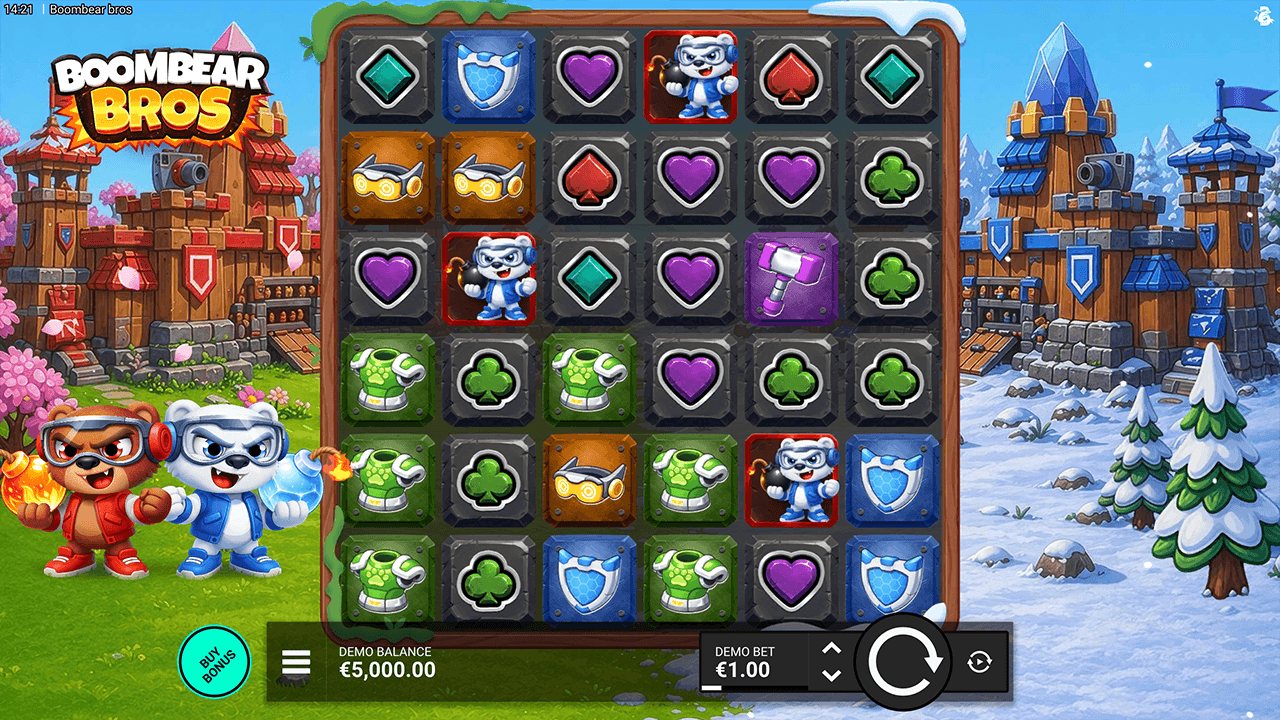
Boombear Bros is a 6x6 cascading cluster game from Bullshark Games, released on 23 September 2026 and built on Hacksaw Gaming's OpenRGS platform, which is where the studio builds and distributes all of its titles. The headline figures are a default RTP of 96.32%, a hit frequency of 27.39%, a maximum win of 12,000x the stake and a volatility rating of 3 out of 5 on Bullshark's own scale. The demo above runs the studio's free-play build with a play-money balance, so you can watch the cascade and bomb mechanics behave without staking anything. It is the sensible way to get a feel for the rhythm before committing real funds. 18+ only.
What follows is an analysis of the published maths and the studio's own documentation rather than an account of any session. The numbers tell you more about how a bankroll will behave than any anecdote could.
How the game plays
The grid is six reels by six rows and wins are formed by clusters of matching symbols. Every win cascades: the winning symbols are cleared, new symbols drop in to fill the gaps, and the sequence continues for as long as fresh clusters keep forming. That is the core loop, and it matters for how the hit rate should be read, because one qualifying spin can resolve into a chain of several clears rather than a single payout.
Layered on top is the bomb mechanic that gives the game its name. The two bears throw Power Bomb symbols onto the grid, and those bombs detonate across the playing area, either adding matching symbol clusters or raising the multiplier value attached to individual cells. The theme is a tundra setting with a pair of demolition-minded bears, and the presentation follows Bullshark's usual cartoon house style rather than attempting anything atmospheric.
The features and what they do to the maths
Cell multipliers
Each cell on the grid starts with no multiplier attached. Fire Bomb symbols are the only thing that raises them. Once a cell carries a multiplier, that value is applied to any win which includes a symbol sitting on that cell, and if a winning cluster spans several multiplied cells, those values are added together before being applied. That addition rule is important: it is a summing model, not a compounding one, so the ceiling on any single cascade is set by how many multiplied cells a cluster can physically cover rather than by runaway multiplication.
In the base game, cell multipliers build progressively across the cascades within a single spin but reset when the next spin begins. That is the single biggest structural reason the base game is relatively tame: every spin starts the multiplier map from scratch, so value has to be constructed and spent inside one spin's cascade sequence.
Power Bomb
Power Bombs can land in the base game and in the bonus games, or be added by the Bomb Frenzy mystery event. Each bomb has a randomly assigned direction and length, which determines how much of the grid it affects. The possible patterns are horizontal (blast travels left and right), vertical (up and down) and cross (all four directions at once). A cross bomb with meaningful length is obviously the outcome you want, because it touches two axes of the grid and therefore has a far better chance of either seeding a cluster or upgrading several cells at once. The randomness of direction and length is a volatility source in itself: two spins with identical bomb counts can produce very different grids.
Bonus games and Maximum Blast
The bonus rounds change the multiplier rule in the way that matters most. Cell multipliers are progressive in the bonus and do not reset between spins, so the grid accumulates value across the whole round rather than resetting every time. Note the carry-over restriction: multipliers built on the triggering spin do not transfer into the bonus, so the round starts clean and builds from there.
Maximum Blast is the top bonus mode, and in it the bears' bombs always blast in all four directions. Removing the horizontal/vertical variance from the bomb draw raises the floor of every detonation, which is exactly the sort of change that concentrates return into the feature. The studio confirms the 12,000x maximum win is reachable in all bonus modes, not just the premium one.
Reading the maths
A 27.39% hit frequency means roughly one spin in 3.65 returns something. For a cascading cluster game that is on the low side; cluster formats usually buy their appeal with frequent small clears. Compare it with Piggy Cluster Hunt at 38.34% or Junkyard Kings at 37.14%, both cluster games from the same studio, and Boombear Bros is clearly tuned differently. Nearly three in four spins will be blanks, and because this is a cascade game, the paying spins will tend to be chunkier than a single-cluster payout, since one trigger can roll into several clears with multipliers attached.
Bullshark rates volatility 3 of 5, and that is defensible for the dead-spin rate and the fact that base-game multipliers reset each spin. But a 12,000x ceiling is not a mid-volatility number in isolation, and the honest reading is that the variance is strongly concentrated in the bonus rounds, where multipliers persist. Treat the base game as the cost of entry and the bonus as where your distribution's tail actually lives.
Bullshark has not published a bonus hit frequency or any feature RTP breakdown for this title, and that is a genuine gap. Without it you cannot estimate how long a bonus drought might run or how much of the 96.32% is locked behind the feature. I would rather see those figures disclosed, as several studios now do.
On RTP, note that the game ships in two configurations: 96.32% and 94.36%. Casinos choose which one they run, and a two-point gap is substantial over any realistic volume of play. Check the game's info screen at your operator before staking, every time, because the badge on a review page is not a guarantee of what your account is served. The same caveat applies across the Bullshark Games portfolio, where multiple RTP builds are standard practice.
For bankroll, the combination of a 27.39% hit rate and feature-weighted returns argues for small unit stakes and a session bank of at least a few hundred spins. Anything shorter and you are sampling noise, not the game.
How it compares
| Game | RTP | Hit rate | Max win | Grid |
| Boombear Bros | 96.32% | 27.39% | 12,000x | 6x6 cluster |
| Piggy Cluster Hunt | 96.23% | 38.34% | 15,000x | 7x7 cluster |
| Junkyard Kings | 96.26% | 37.14% | 12,000x | 7x7 cluster |
| Age Of Seth | 96.29% | 29.11% | 10,000x | 6x5 cluster |
Boombear Bros holds the best default RTP of the four and sits closest to Age Of Seth on hit rate, though Age Of Seth is rated 5 of 5 for volatility while this is a 3. If you want frequent feedback from a cluster game, the two 7x7 titles are the better fit.
Who it suits and who should skip it
It suits players who like cascade games but find the high-frequency cluster titles too soft, and who are comfortable with a format where the meaningful money is built inside bonus rounds with persistent multipliers. The additive multiplier model is easy to follow on screen, which helps.
Skip it if you want steady small returns to extend a session, if you need published bonus frequency data before committing, or if your operator only offers the 94.36% build. Market approvals are not stated on the studio's sheet, so availability will depend on your jurisdiction and operator.
Verdict
Boombear Bros is a well-constructed cascading cluster game with a clean multiplier rule, a genuinely variable bomb mechanic and a top-tier default RTP by this studio's standards. The reservations are concrete: a 27.39% hit rate is low for the format and will feel sparse, the base-game multiplier reset keeps that part of the game flat, and the absence of any published bonus frequency or feature RTP leaves a real hole in the maths you are being asked to accept. It is a good game that could be an easy recommendation with better disclosure.
Boombear Bros pros & cons
- Default RTP of 96.32% is at the top of Bullshark's range
- Cell multipliers are progressive and do not reset between bonus spins, concentrating real value in the feature
- Maximum Blast guarantees four-direction bomb blasts, raising the floor of every detonation
- Additive multiplier rule is transparent and easy to track on a 6x6 grid
- 27.39% hit rate is low for a cascading cluster game; nearly three spins in four return nothing
- No published bonus hit frequency or feature RTP, so drought length cannot be estimated
- Base-game cell multipliers reset every spin, making the non-bonus loop feel flat
- A 94.36% version exists and some operators will run it