 EN
EN Italiano
 Nederlands
 Slovenščina
Bullshark Brawl Slot Review
 Bullshark Games4.2/5 · Excellent
 Reviewed by Mike Malkovich, Senior Casino Reviewer · Updated October 2026 · 18+
Ad disclosure: we may earn a commission when you visit a casino through our links. Commissions never influence our scores — here's how we make money. 18+.
Play Bullshark Brawl Free Demo
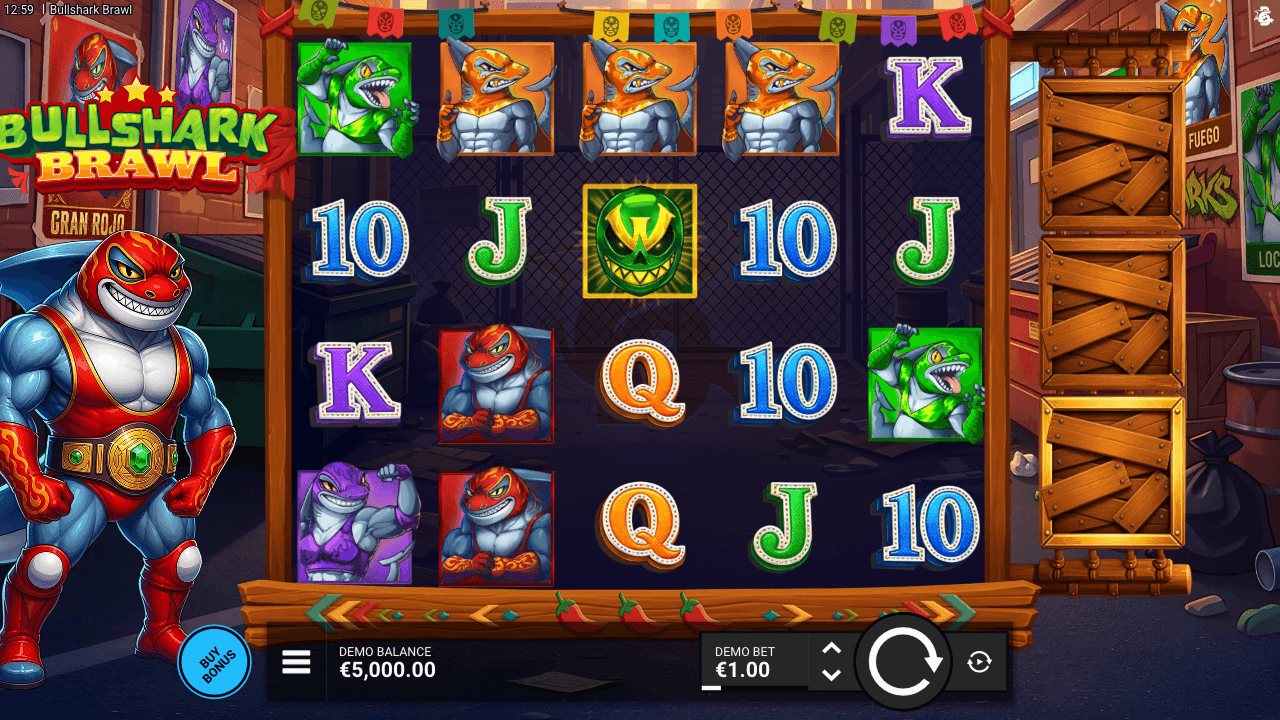
Bullshark Brawl is a 5x4, 20-payline wrestling slot from Bullshark Games, released on 10 August 2026 and built and distributed on Hacksaw Gaming's OpenRGS platform. The headline figures are a default RTP of 96.27%, a hit frequency of 20.19%, a maximum win of 10,000x the stake and a volatility rating of 4 out of 5 on the studio's own scale. The demo above runs the studio's free-play build with a play-money balance, which is the sensible place to watch the multiplier mechanic cycle before any real money is involved. The game is approved for Malta, Curacao, Denmark, Latvia, the Netherlands, Ontario, Romania, Greece, Georgia, Portugal and Colombia, and it is not available to UK players. 18+ only.
How the game plays
Three Bullshark wrestlers headline a conventional reel-spinning layout: five reels, four rows, 20 fixed paylines running left to right, with stacked reels doing the heavy lifting on the symbol distribution. There are no cascades, no reel expansions and no cluster maths. A spin resolves once, line wins are paid, and the next spin begins. Wilds substitute for all paytable symbols and can land in both the base game and the bonus rounds.
What makes the loop different from a standard 20-line game is the Multiplier Symbol layer sitting on top of it. On every spin, either 0, 1, 2 or 3 symbols are randomly unlocked as Multiplier symbols, each carrying a random value from a ladder that runs 2x, 3x, 4x, 5x, 6x, 7x, 8x, 9x, 10x, 15x, 20x, 25x, 50x, 75x and 100x. Any paying symbol or a Wild can be chosen. If that symbol forms part of a winning line, its multiplier is applied to the payout. Each Multiplier symbol is unique, and the third one, when three unlock, is guaranteed to be a high-paying symbol or a Wild. In the base game, the selection resets with every new spin.
The features, and what each does to the maths
Multiplier symbols and the Wild interaction
The Wild rule is where the real upside lives. If a Wild is selected as a Multiplier symbol, its multiplier applies to every win it participates in. If a Wild and another symbol are both Multiplier symbols and both appear in the same win, their values are added and then applied. That additive stacking is a deliberate design choice: it flattens the ceiling relative to a multiplicative system, so the top end is reached through repeated moderate boosts rather than one freak collision. It also explains the studio's 10,000x cap, which is modest by Bullshark's own standards — several of their titles run to 12,000x or 15,000x.
Rookie Rumble and King of the Ring
The free spins rounds change the Multiplier symbols from a per-spin lottery into a persistent state. Trigger a bonus and the unlocked Multiplier symbols stay unlocked for the duration, while special symbols during the round can unlock additional Multiplier symbols or increase the values of existing ones. In maths terms, the bonus converts a volatile, resetting modifier into an accumulating one, which is where the distribution's long tail is generated. Rookie Rumble is the common round; King of the Ring is the rare, higher-ceiling version.
Feature buys
The sheet lists four feature RTPs: BonusHunt FeatureSpins at 96.31%, Shark Slam FeatureSpins at 96.32%, Rookie Rumble at 96.28% and King of the Ring at 96.32%. All four sit at or marginally above the 96.27% base figure, which is unusually tidy — many studios shave a tenth or two off the direct buys. BonusHunt FeatureSpins is the cheap route rather than a true buy: it raises the chance of any bonus to 1 in 44.1 per spin against 1 in 226.1 in the base game.
Reading the maths
RTP versions
Bullshark Brawl ships in two configurations: 96.27% and 94.27%. Casinos choose which one they run, and a two-point gap is substantial over any meaningful number of spins. Check the game's info or paytable screen at your operator before staking anything; if it reads 94.27%, play somewhere else. This is the single most important number on the page and it is the one the marketing will never mention.
Hit rate and bonus frequency
A 20.19% hit frequency means roughly one spin in five returns something, and that is the lowest of any Bullshark title on the studio's current list — lower than Jawsome Pirates at 20.88% and far below the cluster games at 33-38%. Combined with a 4-of-5 volatility rating, this describes a session with long, silent stretches. Organic bonus odds of 1 in 226.1 for any bonus reinforce it: at 20 spins per session minute you are looking at a wait measured in hundreds of spins, and King of the Ring at 1 in 2,602.5 is effectively a once-in-a-blue-moon event you should not plan around. The sheet also lists a near-identical set of figures under a "1st Gamble" heading, with King of the Ring at 1 in 2,601.9 — statistically the same game.
Volatility and bankroll
With a 10,000x cap, a one-in-five hit rate and a bonus every 226 spins or so, the practical implication is straightforward: stake small and budget for depth, not duration. A bankroll of 500 base-game spins at a stake you can comfortably lose is the honest minimum framing for a game shaped like this. Using BonusHunt FeatureSpins compresses the wait fivefold but costs proportionally more per spin, so it changes the shape of the session rather than the expected return.
How it compares
| Game | RTP | Hit rate | Max win | Grid |
|---|---|---|---|---|
| Bullshark Brawl | 96.27% | 20.19% | 10,000x | 5x4 paylines |
| Jawsome Pirates | 96.28% | 20.88% | 12,000x | 5x4 paylines |
| Mafia Clash | 96.35% | 31.92% | 10,000x | 5x4 paylines |
| Ancient Paws | 96.16% | 26.35% | 15,000x | 5x4 paylines |
Set against the rest of the Bullshark Games catalogue, Brawl is the driest of the payline titles without buying the biggest ceiling in exchange. Jawsome Pirates offers a similar hit rate with 12,000x on top and a gentler 3-of-5 volatility rating; Ancient Paws asks for a 5-of-5 tolerance but pays 15,000x for it. Mafia Clash, on the same grid and win type, hits half again as often.
Who it suits and who should skip it
It suits players who like modifier-driven payline slots and are specifically chasing the persistent-multiplier bonus — the round is the game, and the base game is the toll you pay to reach it. It also suits anyone who values consistency across feature RTPs, since the buys here are not quietly worse value than the base game.
Skip it if you want regular small returns to keep a balance ticking over, if you are playing short sessions where a 1 in 226.1 bonus is unlikely to appear at all, or if max-win hunting is your motivation — 10,000x is the lower boundary of Bullshark's range and the additive Wild multiplier maths makes it a genuinely rare outcome.
Verdict
Bullshark Brawl is honestly specified and cleanly built. The multiplier ladder is transparent, the Wild interaction is spelled out rather than hidden, and the feature RTPs match the base figure, which is more than many studios manage. The maths does match the marketing: a 4-of-5 volatility claim backed by a genuinely thin 20.19% hit rate is not a studio overselling itself. The reservations are real, though. This is the driest-paying game in the Bullshark range and it does not compensate with a bigger ceiling, and the existence of a 94.27% build means the game you load may not be the game described here. Check the info screen, treat the base game as a waiting room, and judge it on the bonus.
Bullshark Brawl pros & cons
- Feature RTPs (96.28%-96.32%) all sit at or above the 96.27% base figure, so the buys are fair value
- Multiplier mechanic is fully disclosed, including the additive Wild stacking rule
- Persistent, upgradeable multipliers in the bonus give the distribution a genuine long tail
- Volatility rating of 4/5 is honestly matched by the actual hit rate rather than overstated
- 20.19% hit frequency is the lowest in the entire Bullshark catalogue
- 10,000x maximum win is at the bottom of the studio's range, with no ceiling compensation for the dry base game
- A 94.27% RTP version exists and operators choose which build to run
- King of the Ring at 1 in 2,602.5 organically is too rare to realistically factor into a session