 EN
EN Italiano
 Nederlands
 Slovenščina
Blood Rebels Slot Review
 Bullshark Games4.3/5 · Excellent
 Reviewed by Spencer Mitchell, Bonus & Payments Editor · Updated October 2026 · 18+
Ad disclosure: we may earn a commission when you visit a casino through our links. Commissions never influence our scores — here's how we make money. 18+.
Play Blood Rebels Free Demo
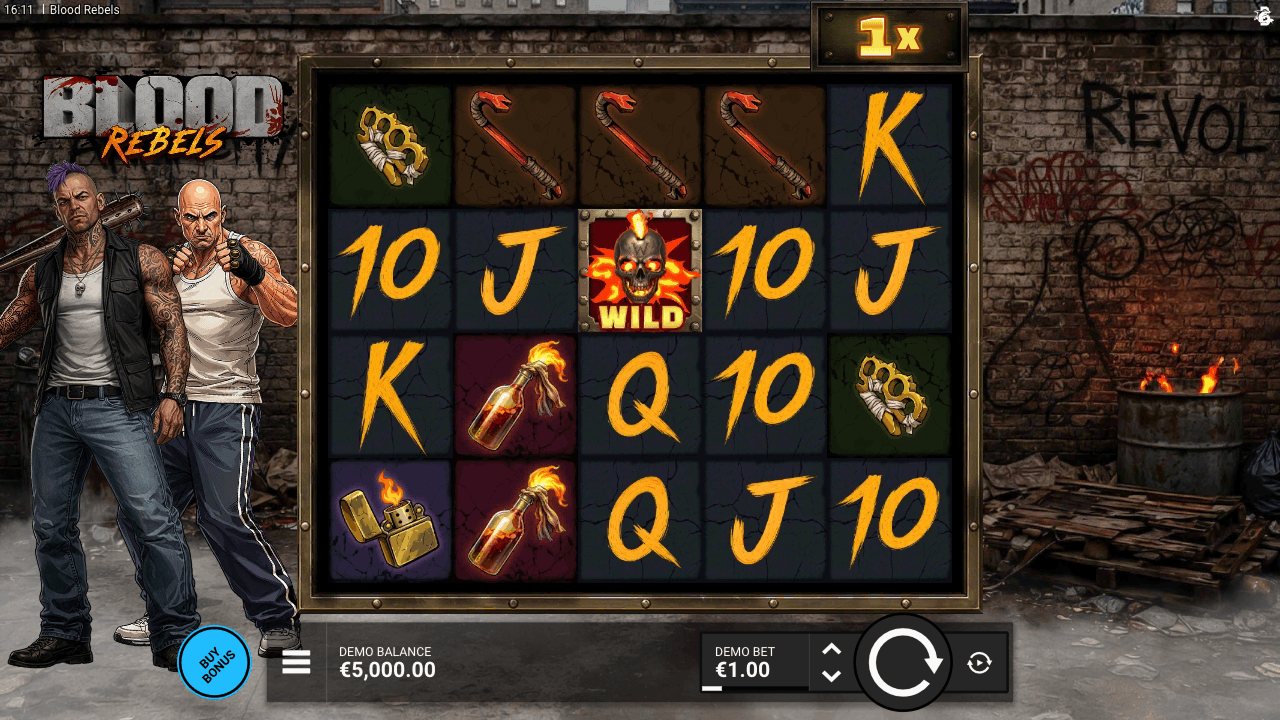
Blood Rebels is a 5x4, 20-payline slot from Bullshark Games, released on 21 August 2026 and distributed on Hacksaw Gaming's OpenRGS platform. The demo above is the studio's own free-play build, running on a play-money balance, so you can watch the Flip symbols behave without staking anything. The headline numbers: 96.26% RTP in the default configuration, a 25.1% hit frequency, a 12,000x maximum win and a volatility rating of 3 out of 5 on the studio's own scale. It is not available to UK players; the approved list covers Malta, Curacao, Denmark, Latvia, the Netherlands, Ontario, Romania, Georgia, Portugal and Colombia.
Thematically it is two brothers, a city block and a riot, with the loot somewhere in the middle. That is the wrapper. What matters is that the maths underneath is more lopsided than the volatility badge suggests, and that is the thing worth unpacking before you commit a bankroll to it.
How the game plays
This is a conventional reel-spin payline game, not a cluster or scatter-pays design. Five reels, four rows, 20 fixed lines evaluated left to right. No cascades, no respins in the base loop — one spin, one evaluation, one result. That structure matters because it caps how much a single base spin can do on its own: with 20 lines across four rows, the ceiling on an ordinary hit is modest, and all the heavy lifting is pushed onto the multiplier layer.
Every spin starts with a Global Multiplier set to 1x. It applies to all wins on that spin and, in the base game, it resets at the start of the next one. So the core loop is: spin, see whether anything lands that raises the Global Multiplier, and see whether the grid has been reshaped enough to make that multiplier worth having. Without a Flip symbol, you are playing a plain 20-line game with a 25.1% chance of a return.
The features, and what they do to the maths
Single Flip symbols
The Flip symbol is the engine. When one lands, it randomly selects a single type of low-paying symbol and converts every instance of that symbol on the grid into a Wild before wins are calculated. The Flip itself also becomes Wild. If several Flips land at once, each picks a different low-pay type, so two or three of them can strip most of the low-value symbols off the grid in one go.
There is an honest caveat in the studio's own documentation: the Flip can select a symbol type that is not currently on the grid, in which case it simply turns Wild itself and nothing else changes. That is a real source of variance within the feature — the same trigger can produce a board-wide transformation or almost nothing.
The multiplier ladder
A Flip may also reveal a multiplier, which is added to the Global Multiplier before wins are calculated. The possible values are 1x, 2x, 3x, 4x, 5x, 6x, 7x, 8x, 9x, 10x, 15x, 20x, 25x, 50x and 100x. Note the word added: multiple Flips stack additively into one Global Multiplier rather than multiplying each other, which smooths the top end compared with multiplicative designs and makes the 12,000x ceiling a function of a genuinely large transformed board rather than a single lucky stack.
Breaking Curfew and Total Anarchy
The two bonus rounds change one rule, and it is the important one: the Global Multiplier becomes progressive and never resets for the duration of the feature. Every Flip multiplier you collect stays on the counter. That turns the bonus from a series of independent spins into a single accumulating run, where the last few spins are worth far more than the first few.
Total Anarchy, triggered by five scatter symbols, adds exclusive Sticky Wilds that lock in place for the whole feature. Combine locked Wilds with a multiplier that only goes up and you have the structure that produces the max win. Breaking Curfew is the common round; Total Anarchy is the rare one.
Reading the maths
Start with the RTP. The default build returns 96.26%, which is a fair industry figure. Blood Rebels also ships in a 94.3% version, and the operator chooses which one to run. That is close to two full percentage points of edge, and nothing on screen announces it. Check the game's info screen at your casino before you play, every time — if it reads 94.3%, the game is materially worse than the one reviewed here.
Now the hit rate. 25.1% means roughly one spin in four returns something, and in a 20-line game a sizeable share of those returns will be at or below stake. For context, that is in the same band as Holy Heist (24.75%) and Pickle Bandits (23.78%) and well below Bullshark's cluster titles. Pair it with the bonus frequency and the session shape becomes clear: any bonus arrives once every 227.3 spins in the base game, Breaking Curfew once every 243.9, and Total Anarchy once every 3,332.7 spins. At 500 spins an hour you would average roughly two bonus entries an hour, and you might go several hours without seeing Total Anarchy at all.
That combination is why I would treat the 3-of-5 volatility label with scepticism. A bonus roughly every 227 spins is not mid-volatility territory by most studios' standards; it is a long dry stretch punctuated by one meaningful event. The rating is defensible only because the additive multiplier and the modest 20-line structure keep individual bonus outcomes from being wildly dispersed. The practical reading: budget for 250 to 300 spins between features and size your stake so that a 300-spin drought costs you a fraction of your bankroll, not most of it.
The buy options compress all of that. On BonusHunt FeatureSpins the frequencies become 1 in 43.9 for any bonus, 1 in 48.3 for Breaking Curfew and 1 in 476.2 for Total Anarchy — roughly a fivefold acceleration, with Total Anarchy still rare. The feature RTPs are well constructed: BonusHunt FeatureSpins 96.29%, First Stone FeatureSpins 96.29%, Breaking Curfew 96.32% and Total Anarchy 96.31%. All four sit at or marginally above the default base RTP, so you are not paying an entry tax for convenience, which is more than can be said for plenty of buy menus. The sheet lists First Stone FeatureSpins with an RTP but no separate frequency figures.
The 12,000x ceiling is standard for the studio — the same as Wild Dojo Strike, Junkyard Kings and Jawsome Pirates — and realistically it lives inside Total Anarchy, behind a 1 in 3,332.7 base-game door.
How it compares
| Game | RTP | Hit rate | Max win | Grid |
|---|---|---|---|---|
| Blood Rebels | 96.26% | 25.1% | 12,000x | 5x4 paylines |
| Pickle Bandits | 96.27% | 23.78% | 12,000x | 5x4 paylines |
| Holy Heist | 96.24% | 24.75% | 20,000x | 5x4 paylines |
| Wild Dojo Strike | 96.27% | 35.33% | 12,000x | 5x4 paylines |
Against its stablemates, Blood Rebels is the middle option: a slightly better hit rate than Pickle Bandits, a lower ceiling than Holy Heist, and far drier than Wild Dojo Strike, which returns something on more than a third of spins at a near-identical RTP. If you want to see how the studio's catalogue spreads across hit rates and grids, the wider Bullshark Games range covers everything from 20.88% to 38.34%.
Who it suits and who should skip it
It suits players who like a clean payline game with one strong idea, who are comfortable with long stretches of nothing, and who understand that the progressive Global Multiplier in the bonus is where the value sits. It also suits buy-feature players, given the honest feature RTPs.
Skip it if you want frequent base-game feedback — a 25.1% hit rate on 20 lines will feel sparse — or if you are chasing a headline ceiling, where Holy Heist's 20,000x is the better target. And skip the 94.3% build entirely. 18+; set a loss limit before you start.
Verdict
Blood Rebels is a well-engineered payline slot with a genuinely interesting conversion mechanic and an unusually honest buy menu. The Flip symbols do something structurally different from standard Wild scatters, and the never-resetting bonus multiplier gives the features real shape. The reservations are concrete: the 3-of-5 volatility badge undersells a 1 in 227.3 bonus rate, the base game is thin between features, and the existence of a 94.3% version means your actual expected return depends on which operator you walk into. Strong maths, slightly mislabelled, worth checking the info screen for.
Blood Rebels pros & cons
- Flip symbols transform entire low-pay types into Wilds, a genuinely distinct mechanic rather than a reskinned expanding Wild
- Buy-in feature RTPs (96.29% to 96.32%) all sit at or above the default base RTP, so there is no convenience penalty
- Progressive Global Multiplier that never resets inside Breaking Curfew and Total Anarchy gives bonus rounds real build-up
- Clean 5x4, 20-line structure with no cascades to obscure what is actually happening to your stake
- A 94.3% RTP version exists and operators choose it silently; you must check the info screen every time
- Volatility rated 3 of 5 despite a base-game bonus arriving only once per 227.3 spins, which understates the drought risk
- 25.1% hit rate on 20 paylines makes for a sparse base game with many sub-stake returns
- Total Anarchy, the round that realistically delivers the 12,000x ceiling, sits behind 1 in 3,332.7 spins
- Not available to UK players, and absent from Sweden, Germany, Italy and Brazil