EN
 Italiano
 Nederlands
 Slovenščina
 Suomi

Doctor Dust Slot Review
 Bullshark Games4.3/5 · Excellent
 Reviewed by Spencer Mitchell, Bonus & Payments Editor · Updated October 2026 · 18+
Ad disclosure: we may earn a commission when you visit a casino through our links. Commissions never influence our scores: here's how we make money. 18+.
Play Doctor Dust Free Demo
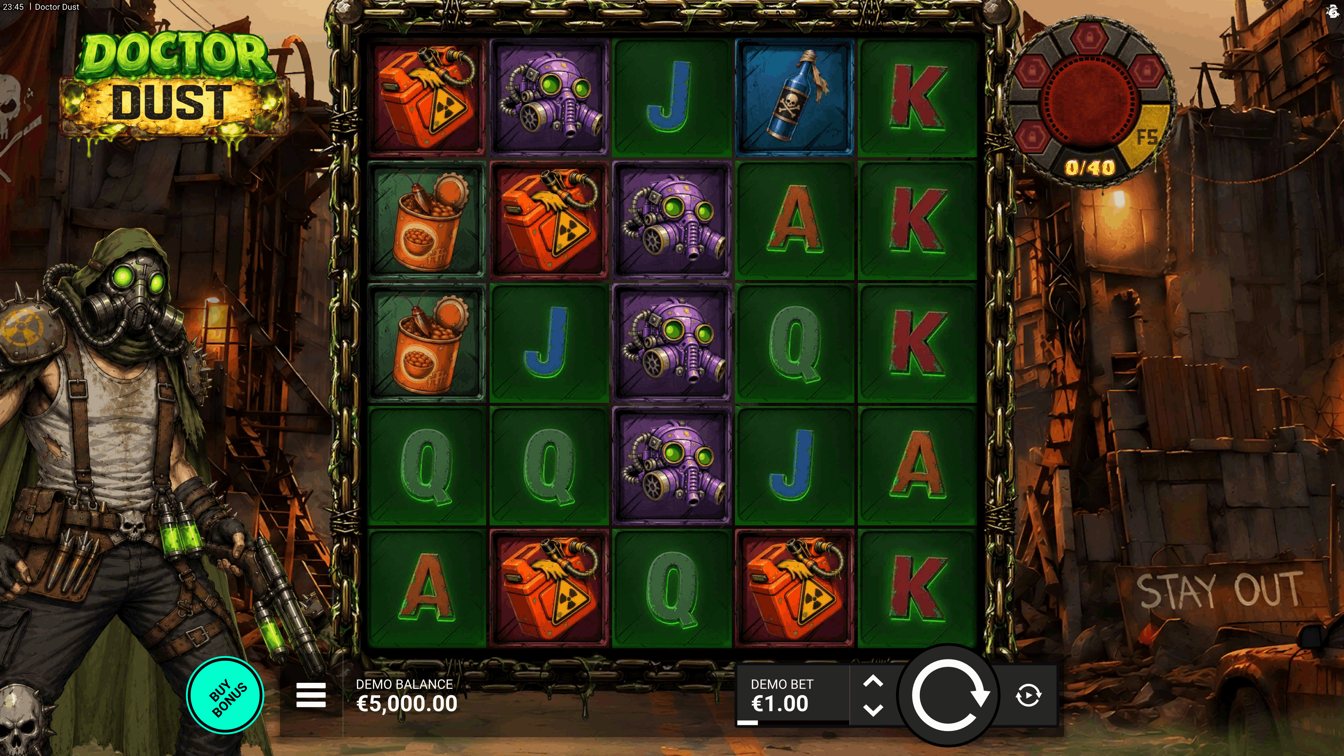
Doctor Dust is a 5×5 cascading cluster game from Bullshark Games, released on 9 October 2026 and built and distributed on Hacksaw Gaming's OpenRGS platform. The numbers that matter before anything else: 96.3% RTP in the default build, a hit frequency of 20.65%, a maximum win of 12,000x the stake and a volatility rating of 5 out of 5 on the studio's own scale, the very top of their range. The demo above runs the studio's free-play build with a play-money balance, so you can watch the collection bar fill and the Grid Boosters reshape the grid without staking anything. 18+ only.
The theme is a bleak post-apocalyptic wasteland with a plague doctor scavenging the ruins for components. It is atmospheric rather than cheerful, and the maths underneath it is just as unsentimental.
How the game plays
The grid is five reels by five rows, 25 positions, and wins are paid as clusters: four or more matching symbols. There are no paylines and no ways, so symbol count and position do all the work. Winning symbols are removed and new ones cascade in, which means a single spin can be a chain of several resolutions rather than one event.
The core loop is the collection bar sitting beside the grid. Every winning symbol produced during a spin is counted into it. The bar has five segments and each segment holds eight symbols. Fill the first and you are awarded a random Grid Booster; fill the second, third and fourth and you collect three more, each awarded only once per spin and in random order. Fill all five, 40 collected symbols in a single spin, and the bonus game triggers.
Because the bar resets, the whole 40-symbol accumulation has to happen inside one spin and its cascade chain. That is the single most important structural fact about Doctor Dust: it is not a slow-burn collector across hundreds of spins, it is a game that asks one spin at a time to escalate dramatically or produce nothing at all.
The features, and what they do to the maths
Grid Boosters
Each Grid Booster reshapes the grid in its own way. Mechanically they are the game's self-feeding engine: a spin that pays once gets a booster, the booster improves the odds of paying again, each new win feeds more symbols into the bar, and the next booster arrives. That feedback loop is precisely why the hit rate can sit at 20.65% while the ceiling reaches 12,000x. Most spins never start the loop; the ones that do can run away.
The bonus game
The bonus is an open-ended run of spins rather than a fixed count. Every spin inside it comes with at least one Grid Booster, and the run continues for as long as at least eight winning symbols are collected during a spin. There is no counter ticking down, the feature lives or dies on its own productivity, which is an elegant way of making bonus length itself a volatile variable.
Pre-filled segments
Collection does not stop at 40. Every additional eight symbols adds +1 to the number in the centre of the bar, to a maximum of 4, and that number is how many bar segments start pre-filled when the bonus begins. A triggering spin that keeps cascading therefore buys you a materially better bonus, not just a bonus. This is the detail worth watching in the demo, because it is where the top end of the distribution is built.
Surface Search and Toxic Vault
Two named bonuses exist, and the frequencies tell you everything about their roles. In the base game, any bonus arrives once per 251.3 spins, and Surface Search accounts for essentially all of it at the same 1 in 251.3. Toxic Vault sits at 1 in 1,493,705.1. That is not a feature most players will ever see; treat it as a structural rarity rather than something to chase.
Feature buy modes
BonusHunt FeatureSpins shortens the wait considerably: any bonus at 1 in 82.6, Surface Search at the same 1 in 82.6, Toxic Vault at 1 in 870,132.7. The return figures the studio publishes are tightly clustered, BonusHunt FeatureSpins 96.30%, Dust Raid FeatureSpins 96.32%, Surface Search 96.31%, Toxic Vault 96.33%. In other words, no mode is a better deal than another in expectation; they only change the shape and speed of the ride.
Reading the maths
Start with the hit rate. At 20.65%, roughly one spin in 4.8 returns something, and that something includes four-symbol clusters that will not cover the stake. Run the geometry and about one block of ten spins in ten will be completely blank. Compare that with Piggy Cluster Hunt at 38.34% and you can feel the difference: Doctor Dust pays about half as often.
Now the bonus. One trigger per 251.3 spins has a median wait of roughly 174 spins, which means half of all droughts are shorter than that and half are longer, and a meaningful minority run past 500. If you stake with a budget that supports 200 spins, there is a genuine chance you never reach the feature at all. In BonusHunt FeatureSpins the median wait drops to around 57 spins, which is the real argument for that mode: not better value, just less waiting.
The default RTP is 96.3%, which is a fair, standard figure. The game also ships in a 94.26% version, and operators choose which to run. That is a 2.04-point gap and it is entirely invisible unless you look, check the game's info screen at your casino before you stake, every time. The studio's sheet does not state approved markets and lists no exclusions, so availability will depend on where your operator is licensed.
The 12,000x ceiling is where I have a reservation. A 5-of-5 volatility rating normally buys you a bigger top end, and within Bullshark's own range Piggy Cluster Hunt offers 15,000x at a 3-of-5 rating while Holy Heist reaches 20,000x. Doctor Dust charges maximum variance for a mid-table maximum. Bankroll accordingly: small unit stakes, a session budget you have already written off, and no expectation that the bonus owes you anything.
How it compares
| Game | RTP | Hit rate | Max win | Grid |
|---|---|---|---|---|
| Doctor Dust | 96.3% | 20.65% | 12,000x | Cluster (5x5) |
| Age Of Seth | 96.29% | 29.11% | 10,000x | Cluster (6x5) |
| Piggy Cluster Hunt | 96.23% | 38.34% | 15,000x | Cluster (7x7) |
| Junkyard Kings | 96.26% | 37.14% | 12,000x | Cluster (7x7) |
Age Of Seth is the closest sibling on volatility at 5 of 5, yet it still pays 29.11% of the time on a larger grid. Doctor Dust is the driest cluster title in the Bullshark Games catalogue by some distance, and the small 25-position grid is the reason: fewer cells, fewer cluster opportunities, sharper swings.
Who it suits and who should skip it
It suits players who understand what a 20.65% hit rate feels like over a few hundred spins and are comfortable sitting through it for the chance of a cascading spin that fills the bar four or five times over. The open-ended bonus and the pre-filled-segment mechanic reward patience with genuine escalation, and the feature RTPs are consistent enough that buy-mode players are not being quietly penalised.
Skip it if you play short sessions, if you need regular small returns to keep a balance alive, or if you are drawn in by the idea of the Toxic Vault, at 1 in 1,493,705.1 in the base game, that is not a plan. Junkyard Kings or Piggy Cluster Hunt give you the same studio's cluster maths at roughly double the hit rate.
Verdict
Doctor Dust is an honestly built high-variance cluster game. The Grid Booster loop is a genuinely clever way to turn a 25-cell grid into something explosive, the open-ended bonus length is a smart design choice, and the published figures are coherent: everything the game takes from the hit rate it gives back at the top of the distribution. The default 96.3% is fine and the feature modes are priced consistently.
Two things hold it back. The 12,000x ceiling is modest for a maximum-volatility game when stablemates at lower ratings go higher, and the existence of a 94.26% build means a share of players will be getting notably worse value without realising. Judged on the maths rather than the mood, this is a well-made specialist title with a ceiling that does not quite justify the drought.
Doctor Dust pros & cons
- Grid Booster collection loop turns a small 25-cell grid into a genuine escalation mechanic
- Open-ended bonus length and pre-filled segments give the top of the distribution real substance
- Feature RTPs are consistent across all modes (96.30%-96.33%), so no buy option is quietly worse value
- Default 96.3% RTP is a fair figure for a 5-of-5 volatility release
- 20.65% hit rate is the driest of Bullshark's cluster games - roughly one blank run of ten spins in every ten
- 12,000x maximum is modest for maximum volatility when lower-variance stablemates reach 15,000x and 20,000x
- A 94.26% version exists and operators can run it, a 2.04-point drop that is invisible unless you check
- Toxic Vault at 1 in 1,493,705.1 in the base game is effectively unreachable for almost every player