
 EN
 Italiano
 Nederlands
 Slovenščina
 Suomi

Junkyard Kings Slot Review
 Bullshark Games4.3/5 · Excellent
 Reviewed by Mike Malkovich, Senior Casino Reviewer · Updated October 2026 · 18+
Ad disclosure: we may earn a commission when you visit a casino through our links. Commissions never influence our scores: here's how we make money. 18+.
Play Junkyard Kings Free Demo
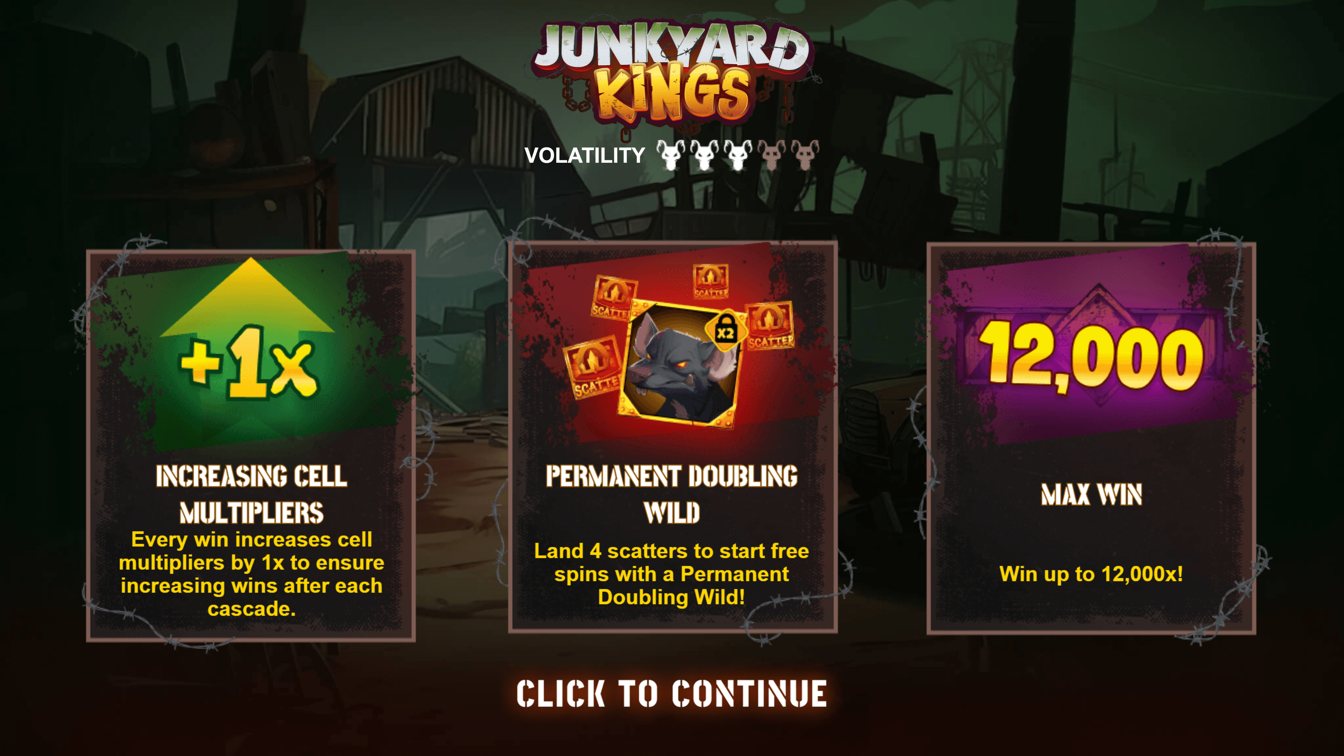
Junkyard Kings is a 7x7 cluster-pays slot from Bullshark Games, released on 28 May 2024 and built on Hacksaw Gaming's OpenRGS platform, which the studio confirmed to us. The theme is a scrapyard ruled by rats, and the mechanical hook is a grid of cell multipliers that climb as symbols are cleared, pushed along by three different flavours of wild. The headline numbers are a default RTP of 96.26%, a hit frequency of 37.14%, a maximum win of 12,000x the stake and a volatility rating of 3 out of 5 on Bullshark's own scale. The demo above runs the studio's free-play build with a play-money balance, so you can watch the multiplier grid behave without risking anything. Junkyard Kings is not available to UK players; the sheet lists approvals for Malta, Curacao, Denmark, Latvia, Spain, the Netherlands, Ontario, Romania, Greece and Portugal. 18+ only.
How the game plays
Wins are formed by clusters of five or more matching symbols, which is a low bar on a 49-cell grid and explains why better than one spin in three returns something. Winning symbols are removed, remaining symbols cascade down and new ones drop in, so a single paid spin can resolve into several consecutive win events. The core loop is therefore not "spin and look" but "spin, clear, re-clear", and the longer that chain runs, the more cells on the board carry a multiplier.
That multiplier grid is the whole design. Every cell starts at 1x. When a winning symbol occupies a cell, that cell's multiplier rises by 1x once all wins for the cascade have been calculated, so the first clearance takes an empty cell to 2x. Multipliers apply to any subsequent win that touches the cell and they are cumulative across cells, capping at 100x each. The critical distinction: in the base game those multipliers reset at the end of every spin, while in free spins they persist and keep climbing until the feature ends. That single rule is what separates a modest base game from a bonus round with genuine top-end potential.
The features, and what each does to the maths
Doubling Wild
Lands on a cell and doubles that cell's multiplier immediately, with no existing multiplier the cell is treated as 1x, so it becomes 2x. It then acts as a standard wild, substituting for paying symbols, and is removed with the rest of the winning symbols. In base-game terms this is a modest kicker, because the doubled cell dies with the spin.
Permanent Doubling Wild
Same doubling effect, but after taking part in a win it stays on the grid and shifts to an adjacent cell, doubling that one too. In the base game it survives only the extra cascades of the current spin; in free spins it remains for the entire feature, moving each spin and doubling a new cell as it goes. Doubling applied repeatedly to an already-rising multiplier grid is where the exponential curve comes from, and it is the mechanical reason the 12,000x ceiling exists at all.
Walking Wild
Lands and then walks 2 to 10 steps in a random direction, leaving a trail of regular wilds behind it. A long walk can manufacture clusters that would never have formed naturally, which props up the hit rate rather than the top end.
Scavenger Spins
Three scatters award 10 free spins with cell multipliers that increase until the feature ends. Four scatters upgrade the round, adding a permanent doubling wild that is active from the first spin and stays for the duration, the sheet lists this upgraded version as Extreme Junkyard Scavenger Spins.
Reading the maths
Start with the RTP. The default build returns 96.26%, which is unremarkable but honest for 2024. Bullshark also ships a 94.33% version, and the operator, not you, decides which one is loaded. That is close to two full percentage points of edge, and it is invisible unless you look: check the game's info or paytable screen at your casino before you commit a bankroll, every time.
The feature RTPs are consistent rather than punitive. Junkyard Scavenger Spins run at 96.29%, Extreme Junkyard Scavenger Spins at 96.26%, BonusHunt FeatureSpins at 96.29% and FeatureSpins at 96.41%, the last of those sitting slightly above the default base game, which is unusual and quietly in the player's favour if your casino offers it.
The hit rate of 37.14% is the highest-touch part of the design and typical of the cluster format: frequent small returns, many of them below stake, with the cascade mechanic making a 37% hit frequency feel busier than it is. Set against that, the bonus frequency is genuinely stingy. In the base game any bonus arrives once per 275.6 spins on average, with Junkyard Scavenger Spins at 1 in 306.1 and the four-scatter Extreme version at 1 in 2,770.0. In plain terms, a player doing a few hundred spins at a sensible stake may well never see the feature, and the four-scatter upgrade is a once-in-a-very-long-while event. The base game's multiplier reset means that between features the game is mostly grinding small clusters.
BonusHunt FeatureSpins compresses that wait dramatically: any bonus at 1 in 45.4, standard Scavenger Spins at 1 in 49.6 and the Extreme version at 1 in 528.8. It costs more per spin, so the variance per unit of bankroll rises accordingly, but it is the honest route for anyone whose interest in this game is the free spins rather than the base grind.
The tension in the sheet is between a 3-of-5 volatility rating and a 12,000x ceiling. Those sit together because the base game is deliberately damped, multipliers reset, wins are small and regular, while the entire tail lives inside a feature you reach roughly once in 276 spins. Treat the volatility figure as a description of the base game, not of your bankroll's experience if you chase bonuses. Budget for several hundred spins per trigger and size your stake so that surviving 300 spins is comfortable.
- Total staked
- €100.00
- Theoretical return
- €96.26
- Theoretical cost
- €3.74
RTP is the share of all stakes a slot pays back over a very large number of spins, so these are long-run averages, not a forecast: one session can end well above or below them. Some studios supply casinos with more than one RTP version, so check the figure in the game’s own info panel where you play.
How it compares
| Game | RTP | Hit rate | Max win | Grid |
|---|---|---|---|---|
| Junkyard Kings | 96.26% | 37.14% | 12,000x | 7x7 Cluster |
| Piggy Cluster Hunt | 96.23% | 38.34% | 15,000x | 7x7 Cluster |
| Amazing Miceketeers | 96.24% | 33.65% | 12,000x | 7x7 Cluster |
| Culinary Clash | 96.29% | 33.66% | 10,000x | 7x7 Cluster |
Junkyard Kings sits mid-pack within the studio's own 7x7 range. Piggy Cluster Hunt edges it on both hit rate and ceiling at a fractionally lower RTP; Culinary Clash offers a slightly higher RTP but a lower top end and a harder volatility rating of 4. Across the wider Bullshark Games catalogue, the house style is clear enough: RTPs clustered tightly around 96.2–96.35%, ceilings of 10,000x to 20,000x, and feature sets that do the heavy lifting.
Who it suits and who should skip it
It suits players who enjoy cluster cascades for their own sake and are content with a long, low-intensity base game punctuated by rare but meaningful features. It suits BonusHunt users particularly well, because the feature-buy RTPs are in line with the base game rather than shaved. It suits anyone who likes watching a multiplier board compound rather than waiting on a single big symbol.
Skip it if you need regular bonus entries, 1 in 275.6 is a long wait at a medium volatility rating, and the base game offers no persistent multiplier to show for the time spent. Skip it if you are chasing 12,000x on a modest bankroll, because that figure depends on a four-scatter trigger occurring once in 2,770 spins and then running hot. And skip it if your casino is running the 94.33% build.
Verdict
Junkyard Kings does what its marketing claims, with one asterisk. The persistent-multiplier free spins and the permanent doubling wild are a coherent route to the advertised 12,000x, and the feature RTPs confirm the studio has not clipped the bonus to fund the base game. The 37.14% hit rate gives the base game enough texture to be watchable. The defect is the gap between a 3-of-5 volatility badge and a bonus that shows up once per 276 spins with the headline version at 1 in 2,770, that is a high-volatility waiting game wearing a medium-volatility label, and players who read the sheet casually will misjudge their bankroll. Combined with the existence of a 94.33% build at operator discretion, it lands as a solid, well-constructed cluster slot with caveats you need to check before you play.
Junkyard Kings pros & cons
- Free-spins cell multipliers persist and compound for the whole feature, giving the 12,000x ceiling a credible mechanical route
- Feature RTPs are honest: 96.29% for Scavenger Spins and BonusHunt, and 96.41% for FeatureSpins, slightly above the base game
- 37.14% hit frequency keeps the 7x7 cluster grid active between features
- BonusHunt FeatureSpins cuts the wait for any bonus from 1 in 275.6 to 1 in 45.4 without cutting the return
- Base-game bonus frequency of 1 in 275.6 is a long wait for a game rated only 3 of 5 for volatility
- The four-scatter Extreme Junkyard Scavenger Spins trigger at 1 in 2,770.0 means most players will never see the upgraded round
- A 94.33% version exists and the casino chooses which build to run, so the advertised 96.26% is not guaranteed
- Base-game cell multipliers reset every spin, leaving long stretches with no accumulating progress to show for the time spent