 EN
EN Italiano
 Nederlands
Goose Boom Bang! Slot Review
 Belatra Games4.5/5 · Excellent
 Reviewed by Mike Malkovich, Senior Casino Reviewer · Updated September 2026 · 18+
Ad disclosure: we may earn a commission when you visit a casino through our links. Commissions never influence our scores — here's how we make money. 18+.
Play Goose Boom Bang! Free Demo
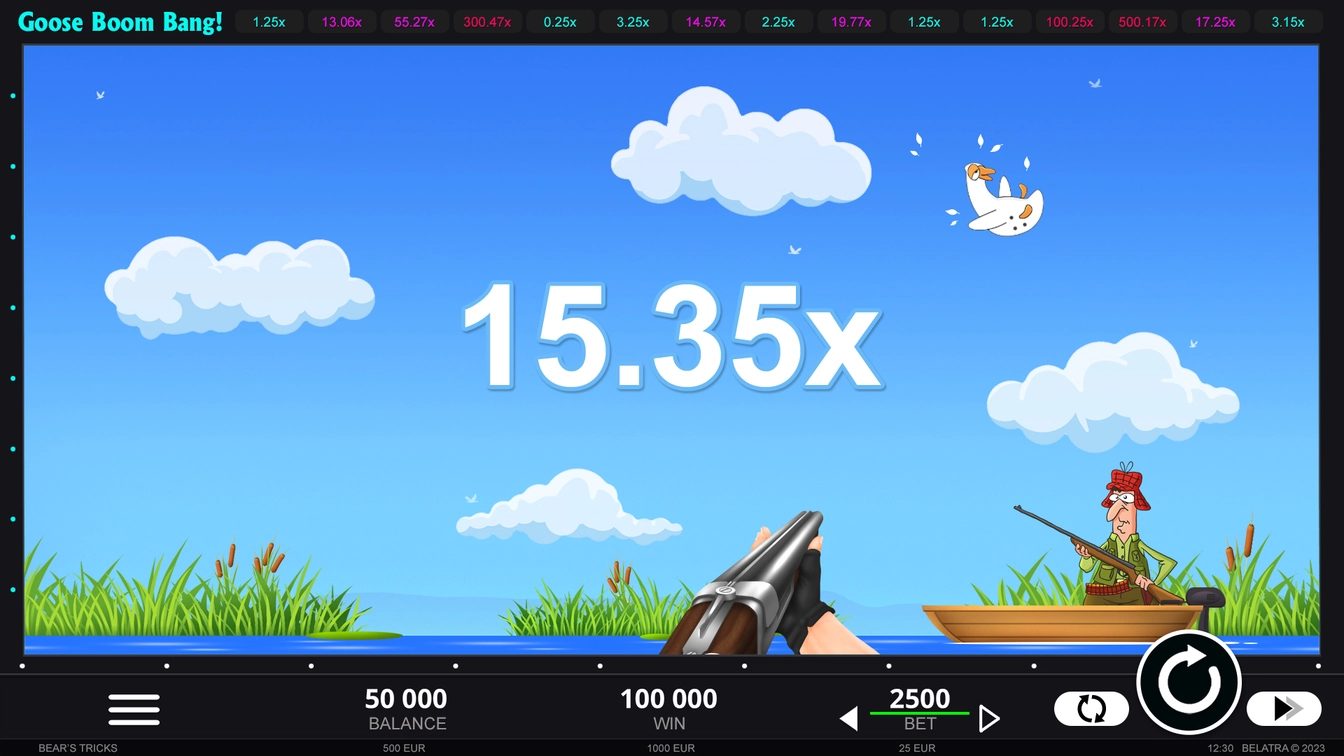
Goose Boom Bang! is Belatra's first crash game, released on 25 September 2025 for desktop and mobile. The numbers that matter are an RTP of 97.06%, very high volatility — the studio's own roadmap rates it five stars out of five on that scale — and a maximum win of 1000x the stake. The demo running above is served from Belatra's own demo server, which means it is the same build a licensed operator receives, with the real money stripped out. That makes it useful for learning the rhythm of a round and for testing how the coefficient selection behaves, and useless as a predictor of results. Demo play is still 18+ territory in spirit, and nothing here should be read as a way to make money.
How Goose Boom Bang! actually plays
This is a crash game, so the slot vocabulary does not apply. There are no reels, no grid and no paylines, and Belatra does not publish any because the format has none. A round begins, the Goose takes off, and a multiplier climbs from the bottom of the scale upward. Your job is to take the money before the flight ends. The studio's description frames the hazards as the Hunter, the Kite and the Crocodile — three ways the run can be cut short rather than a single generic bust. What Belatra has not published is how those three hazards differ mechanically, whether they resolve at different points in the curve, or whether any of them behaves differently from the others in probability terms. Until the studio releases a full rules sheet, treat them as presentation layered over one underlying distribution.
Equally unpublished: minimum and maximum stake, round duration, whether two simultaneous bets are supported, and whether there is a live-bet feed or leaderboard. Those are the details that separate a good crash game from a merely functional one, and they are absent from the material Belatra has released. I would rather flag that gap than guess at it.
The features and what they do to the maths
Belatra's own feature list for this title runs to two entries: the crash game itself, and selection of the coefficient.
Selection of the coefficient
This is the auto cash-out. You nominate a target multiplier before the round and the game banks your stake automatically if the Goose survives that far. It is the single most important control in any crash title, and it does something specific to the maths: it does not change the RTP by a single decimal, but it completely reshapes the distribution of your outcomes. A 1.2x target converts the game into something that pays small and often with occasional wipe-outs. A 50x target converts it into a lottery ticket with a long dry stretch attached. Same 97.06%, entirely different session.
The crash mechanic itself
Listing "crash game" as a feature is a formality, but it carries a real implication. Because you set the exit point, you are choosing your own volatility band within the studio's very high rating. The 5-of-5 rating describes what the game can do at the aggressive end, not what it must do at every stake and every target.
Reading the maths
RTP against the Belatra range
97.06% is the strongest number in this review. For context, PingWin Fly — the closest comparable title in Belatra's catalogue — carries 96.16%. Goose Boom Bang! returns 0.90 percentage points more, which on a per-round basis is the difference between an expected loss of roughly £2.94 and £3.84 per £100 wagered. Over a long crash session with fast rounds, that gap compounds far quicker than it would on a slot, because you can get through a lot of rounds in an hour. Anything above 97% is above the industry norm, and it is well above what most crash products from mid-sized studios offer.
Feature frequency is not a hit rate
Belatra quotes a feature frequency band of 1 in 1.04 to 1 in 1042.42. That is a range covering different features, not a single figure, and it is worth being precise about what it means. Feature frequency tells you how often a bonus element arrives. It does not tell you how often a round pays anything. Belatra does not publish a hit rate for this game, and I am not going to estimate one.
The range itself is instructive. At the 1 in 1.04 end, something is happening in essentially every round — that is the everyday layer of the game. At the 1 in 1042.42 end, you are looking at an event that, at a brisk crash pace, most players will never see. A session lasting a couple of hundred rounds has a realistic chance of the frequent element and effectively no chance of the rare one. Plan around the first number, not the second.
What 1000x is actually worth
The cap is 1000x the stake. That is respectable for a crash game but not extraordinary — it is the same ceiling PingWin Fly carries, and it means the Goose can be shot down at 1000x regardless of how the curve is running. At a £1 stake that is £1,000, and the probability of reaching it is not published. Practically, the cap matters most to players setting very high auto cash-out targets: above 1000x there is nothing to chase.
Volatility and bankroll
Five out of five volatility with a player-set exit point is an unusual combination, because you hold part of the dial. If you play low targets, the swings are milder than the rating suggests. If you chase three figures, the rating is honest and your bankroll needs to survive long losing runs without you increasing stakes to compensate. Session limits and a fixed stake are the two things that keep this game playable.
How it compares within Belatra's catalogue
Belatra has published full figures for only one directly comparable release, so the table below is short by design. I will not pad it with titles whose numbers the studio has not disclosed.
| Game | RTP | Volatility | Max win | Feature frequency |
| Goose Boom Bang! | 97.06% | Very high (5/5) | 1000x | 1:1.04 – 1:1042.42 |
| PingWin Fly | 96.16% | Medium-high | 1000x | 1:8.38 – 1:12.18 |
The contrast is clean. PingWin Fly has a narrow, predictable feature band — something arriving roughly every eight to twelve rounds — and a lower RTP. Goose Boom Bang! trades that predictability for a much wider spread and hands back nearly a point of RTP. You can browse the wider Belatra games hub for the studio's slot output if the crash format is not for you.
Who it suits and who should skip it
It suits players who already understand crash games and want the best return rate they can find in the format. 97.06% with a working auto cash-out is a genuinely competitive package, and the ability to set your own coefficient means a cautious player and an aggressive one can both find a version of the game they can tolerate.
Skip it if you want documented rules before you stake. The Hunter, Kite and Crocodile are presented as distinct threats with no published explanation of how they differ, and the absence of a hit rate, stake range or round-length figure means you are buying on RTP and volatility alone. Skip it too if you need frequent, visible bonus structure — a crash round is a single decision repeated, and there is no feature ladder to break up the session. Players who want Belatra's traditional slot maths should look elsewhere in the range first; you can check which operators carry the studio at our list of casinos with Belatra games.
Verdict
Belatra's first move into crash is more confident than most debut entries into a new genre. The RTP is the headline and it is a real one: 97.06% beats the studio's own comparable release by nearly a point, and in a format where round volume is high, that gap is the most player-friendly thing about the game. The coefficient selection is implemented as it should be, letting you set your own risk band inside a five-star volatility rating. The marks against it are documentation rather than design — no published hit rate, no published stake range, and three named hazards whose mechanical differences are nowhere explained — plus a 1000x cap that is fair without being ambitious for the genre. The maths matches the marketing here, which is more than many crash releases manage.
Goose Boom Bang! pros & cons
- 97.06% RTP is nearly a full point above Belatra's comparable crash release and above the industry norm
- Coefficient selection lets you set your own risk band inside a very high volatility rating
- Published feature frequency range is honest about how wide the spread is, from near-every-round to near-never
- Demo build is served from Belatra's own server, so it matches the live product minus real money
- No hit rate published, so you cannot tell how often a round returns anything
- The Hunter, Kite and Crocodile are named but their mechanical differences are not explained anywhere
- 1000x cap is only matching PingWin Fly and is modest for a crash game
- Stake range, round length and whether dual bets are supported are all unpublished