 EN
EN Italiano
 Nederlands
 Slovenščina
Junkyard Kings 2 Slot Review
 Bullshark Games4.3/5 · Excellent
 Reviewed by Mike Malkovich, Senior Casino Reviewer · Updated October 2026 · 18+
Ad disclosure: we may earn a commission when you visit a casino through our links. Commissions never influence our scores — here's how we make money. 18+.
Play Junkyard Kings 2 Free Demo
Junkyard Kings 2 is Bullshark Games' follow-up to its own scrapyard cluster slot, released on 29 April 2026 and built and distributed on Hacksaw Gaming's OpenRGS platform, which the studio confirmed to us. The headline numbers are a default RTP of 96.29%, a hit frequency of 24.49%, a 7x7 cluster grid and a maximum win of 20,000x the stake. The demo above runs the studio's own free-play build with a play-money balance, so nothing you see there is staked or won for real. Real-money play is 18+ and the game is not available to UK players — the studio's approved list covers Malta, Curacao, Denmark, Latvia, Spain, the Netherlands, Ontario, Romania, Greece, Georgia, Portugal, Colombia and Buenos Aires Province, with the UK, Sweden, Germany, Croatia, Italy and Brazil excluded.
The marketing promises "metal mayhem" and "total industrial chaos". My job is to check whether the maths agrees. Mostly it does, but the sequel has been rebuilt around a very different payout rhythm to the original, and that is the single most important thing a returning player needs to know before loading it.
How the game plays
This is a 7x7 cluster game with cascades. You need five or more matching symbols touching to form a win; winning symbols are removed, new ones drop in, and the sequence continues until no further clusters form. There are no paylines and no ways — position and adjacency are everything, which means a single lucky drop can keep one spin alive for several consecutive cascades while an unlucky board dies instantly.
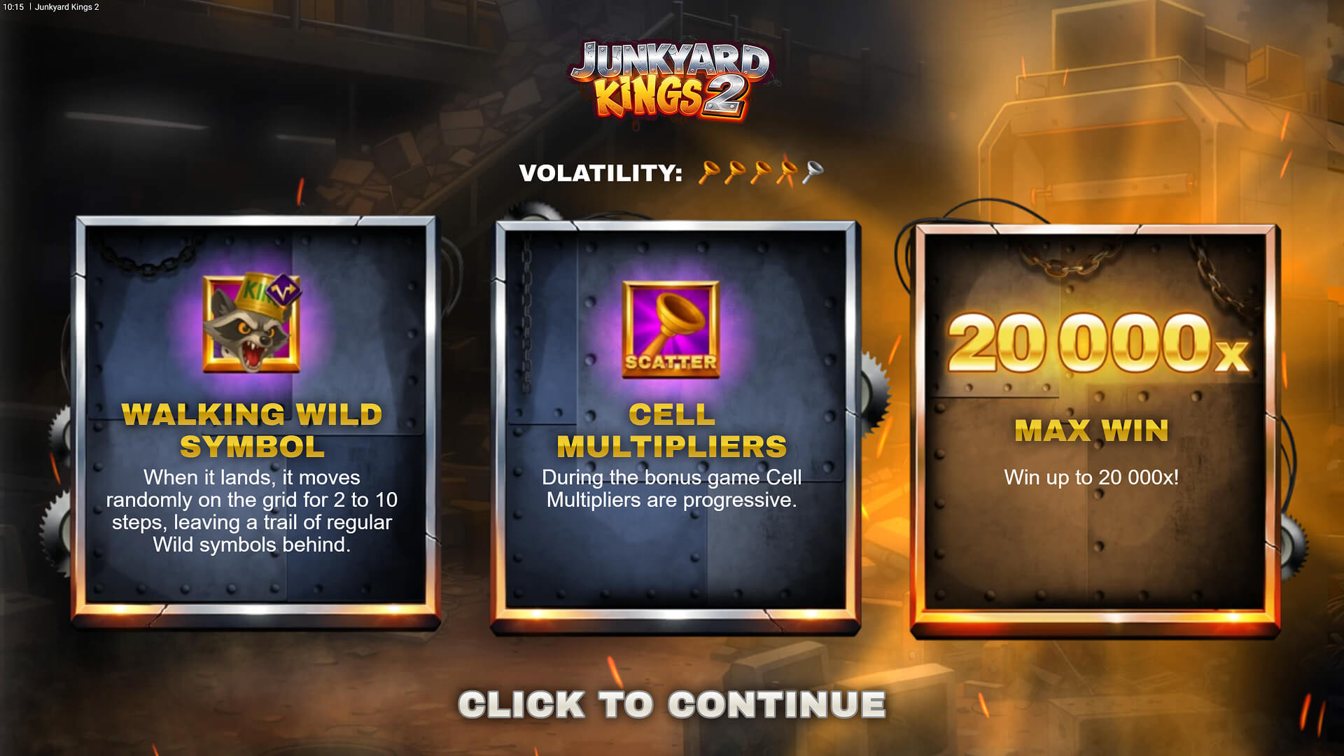
The core loop is built around cell multipliers rather than symbol values. When a symbol in a cell is part of a winning combination, that cell's multiplier increases by +1x. Cells start with no active multiplier and the first win switches a cell to 2x. The multiplier is applied to any win that includes a symbol from that cell, and if a cluster touches several multiplied cells, those values are added together before being applied. Multipliers are progressive across all cascades within a spin but reset at the start of the next one, and a single cell caps at 100x.
That additive structure is the design's smartest decision. In many cluster games multipliers multiply each other and the result is either a dud or a number so large it breaks the session into two unrelated experiences. Addition keeps escalation legible: you can watch a board build value and understand roughly what a long cascade chain is worth.
The features and what they do to the maths
Wilds
Walking Wild symbols move across the grid, extending the life of a board by filling awkward gaps and letting marginal clusters connect. Booster Wild symbols can land in both the base game and the bonus rounds, and they raise the multiplier of the cell they land on before wins are calculated — so the uplift applies to the same cascade, not just future ones. In practice these two wilds are the mechanisms that convert the game's relatively thin hit rate into occasional outsized spins.
Bonus rounds
There are two: Junkyard Jive and Rule The Yard. Both carry permanent Walking Wild and permanent Booster Wild symbols, which compound over the round rather than resetting each spin. Note the one piece of fine print that matters: cell multipliers from the triggering spin do not carry into the bonus, so you start the round fresh.
The feature RTPs are published and they are tight. Junkyard Jive runs at 96.31%, Rule The Yard at 96.31%, BonusHunt FeatureSpins at 96.26% and Rust Rush FeatureSpins at 96.30%. The spread between the cheapest and most generous route is five hundredths of a percent. Players are not being taxed for buying in, which is more than can be said of plenty of releases in this space.
Reading the maths
Start with RTP. The default build is 96.29%, which is comfortably in line with the rest of Bullshark's catalogue. But the game also ships in a 94.32% version, and the operator — not the studio, and certainly not you — chooses which one to run. That is a two-point swing, and over any meaningful number of spins it is the difference between a fair game and a poor one. Check the info screen in the game itself before your first real-money spin; the number displayed there is the number you are actually playing. This applies across much of the studio's range, which you can compare on our Bullshark Games hub.
Now the rhythm. A 24.49% hit frequency means roughly three spins in every four return nothing at all. Pair that with a base-game bonus trigger of 1 in 201.4 spins for any bonus — 1 in 224.8 for Junkyard Jive and 1 in 1,935.7 for Rule The Yard — and you have a game that asks for patience measured in hundreds of spins, not dozens. A player doing 300 spins might reasonably expect one bonus and could easily see none. Bankroll accordingly: if your balance only covers 150 spins at your chosen stake, you are buying a lottery ticket on the base game, not playing the feature set.
Rule The Yard deserves a blunt note. At 1 in 1,935.7 in the base game and 1 in 1,582.0 even inside BonusHunt FeatureSpins, it is not a round most players will ever see. It exists as a tail event. If BonusHunt FeatureSpins is available at your casino, it compresses any-bonus frequency to 1 in 37.6, which is the only realistic way to experience the bonus content with any regularity.
The 20,000x ceiling is the joint-highest figure on Bullshark's sheet, matched only by Holy Heist. With a 100x per-cell cap and additive multipliers across a cluster, the route to it is at least mathematically visible, but treat it as what it is: an extreme outlier, not a target. The studio has not published a usable volatility rating for this title — every other game on the sheet carries one — and that omission is a genuine irritation, because the hit rate and bonus gap do most of the talking anyway.
How it compares
| Game | RTP | Hit rate | Max win | Grid |
|---|---|---|---|---|
| Junkyard Kings 2 | 96.29% | 24.49% | 20,000x | Cluster (7x7) |
| Junkyard Kings | 96.26% | 37.14% | 12,000x | Cluster (7x7) |
| Piggy Cluster Hunt | 96.23% | 38.34% | 15,000x | Cluster (7x7) |
| Amazing Miceketeers | 96.24% | 33.65% | 12,000x | Cluster (7x7) |
The table tells the story of the sequel in one line. RTP is marginally up on the original, the ceiling has risen from 12,000x to 20,000x, and the hit rate has fallen from 37.14% to 24.49%. Bullshark has moved payout weight from frequency to magnitude. Anyone who liked Junkyard Kings because it kept the board busy will find the sequel markedly quieter.
Who it suits and who should skip it
It suits players who already enjoy sparse cluster games and are happy to grind toward a feature, who stake low enough to absorb a few hundred blank spins, and who are chasing a big ceiling rather than steady returns. The additive cell multiplier system rewards attention, and the permanent wilds in the bonus rounds give the features a genuine identity rather than being free spins with a reskin.
Skip it if you want the original's tempo, if your session budget is small, or if you play primarily for frequent small returns — Piggy Cluster Hunt or Amazing Miceketeers do that job far better within the same studio. And skip it entirely if the info screen shows 94.32%.
Verdict
Junkyard Kings 2 is an honest piece of maths wrapped in loud presentation. The default RTP is respectable, the bonus-buy RTPs are within five hundredths of base, and the cell multiplier system is clean and well explained in the paytable rather than hidden behind effects. The problems are real but specific: a 24.49% hit rate that will feel barren to anyone arriving from the first game, a second bonus round so rare it is effectively decorative, a missing volatility figure, and the ever-present risk of landing on a 94.32% build. The marketing says chaos; the maths says patience. Those are not the same thing, but the game is still well put together.
Junkyard Kings 2 pros & cons
- 96.29% default RTP with bonus-buy RTPs of 96.26-96.31%, so no meaningful penalty for buying in
- 20,000x maximum win, the joint-highest figure in Bullshark's published catalogue
- Additive cell multipliers (up to 100x per cell) make escalation easy to read and genuinely rewarding on long cascades
- Permanent Walking Wild and Booster Wild symbols give the bonus rounds a distinct identity rather than plain free spins
- 24.49% hit rate is a steep drop from the original Junkyard Kings' 37.14% — roughly three in four spins return nothing
- A 94.32% RTP version exists and the operator chooses it, a two-point swing outside the player's control
- Rule The Yard at 1 in 1,935.7 base-game triggers is effectively unreachable in a normal session
- No usable volatility rating published, unlike every other title on the studio's sheet