EN
 Italiano
 Nederlands
 Slovenščina
 Suomi


Every slot is built to keep a slice of what is wagered, and no betting pattern, lucky hour or "hot machine" changes that. What you can change is how big the slice is, how fast you hand it over, and whether a bonus tilts the maths your way. This guide covers the few things that move the number and the many that do not.
The short answer
Four things decide what you lose at slots over time, and only one of them can ever turn the maths in your favour:
- RTP (return to player) sets your expected loss per euro wagered. A 96% slot keeps €4 of every €100 put through it, averaged over millions of spins.
- Volatility sets how that loss arrives: a steady drip of small wins and small losses, or long dry runs broken by big hits.
- Bet size and speed set how much goes through the game per hour, which is what the house edge is applied to.
- Bonus terms are the only lever that can push expected value above zero, and only when the wagering requirement is low.
Everything else, from the time of day to the stop button, has no effect on the result. The sections below show the numbers behind each point so you can see which habits actually matter.
How a slot decides each spin
An online slot does not have reels. It has a random number generator (RNG) that produces a result the instant you press spin, and an animation that plays it back. Each result is independent of the last one, so a game that has not paid for an hour is not "due" and a game that just paid a big win is not "empty". Our guide to how RNGs work covers the mechanism in detail.
Licensed casinos cannot sell an untested RNG. Test houses such as GLI, iTech Labs and eCOGRA check that the generator is random and that the game pays out at its stated RTP, and regulators such as the UK Gambling Commission and the Malta Gaming Authority require that certificate before a game goes live. That is why a licence matters more than any strategy: it is the only thing that guarantees the odds printed in the info panel are the odds you get. Our licensing guide explains how to check one.
RTP: the number that sets what you lose
RTP is the share of all money wagered that a slot returns to players over its lifetime. It is a long-run average, so a single session can end anywhere, but the more spins you play the closer your result drifts towards it. The practical way to read it is as an expected cost per spin:
- At €0.50 a spin for 200 spins you put €100 through the game. At 96% RTP the expected loss is €4; at 92% it is €8.
- At €2 a spin for 500 spins you put €1,000 through. At 96% the expected loss is €40; at 92% it is €80.
The same amount of play on a lower-RTP game costs twice as much. Nothing else in this guide moves your expected result as far as that choice.
The same slot can run at different RTPs
Many studios ship each game in several RTP versions and let the casino pick one. Push Gaming lists Wild Swarm at 97.03% or 94.67%. Quickspin lists Big Bad Wolf at 97% or 90%. Yggdrasil gives Jokerizer a range from 88.8% to 98%. The game looks identical in every version, so the only way to know which one you are playing is the info or paytable screen inside the game at that casino. Check it before you deposit, and check it again at a new casino, because the figure is set per site.
Slots with a studio-published RTP above 97%
These figures were read on each studio's own game page, not copied from a listing site. Volatility is shown only where the studio publishes it.
| Slot | Studio | RTP | Volatility |
|---|---|---|---|
| Book of 99 | Relax Gaming | 99% | not published |
| Mega Joker | NetEnt | 99% | not published |
| 1429 Uncharted Seas | Thunderkick | 98.6% | Low |
| Dr Jekyll Goes Wild | Light & Wonder | 98.2% | not published |
| Blood Suckers | NetEnt | 98% | not published |
| Money Cart | Relax Gaming | 98% | not published |
| Jokerizer | Yggdrasil | 98% (range from 88.8%) | High |
| 888 Gold | Pragmatic Play | 97.52% | not published |
| Beware the Deep Megaways | Pragmatic Play | 97.47% | not published |
| Joker's Million | BGaming | 97.34% | Medium-high |
The full list of 35 verified slots at 96.5% and above, with a calculator that turns RTP into an expected cost for your own bet size, is on our highest RTP slots page. Where a studio offers several versions, the table shows the highest one, so confirm the figure in the game before you play.
Volatility: same RTP, different ride
Two slots can share a 96% RTP and feel nothing alike. A low-volatility game pays small amounts often, so a session wanders gently around the average. A high-volatility game pays rarely and in bigger lumps, so most sessions end below the average and a few end far above it. The expected loss is identical; the spread of outcomes is not.
Studios that publish volatility give you a direct read. Thunderkick lists 1429 Uncharted Seas as low and Belatra lists Stars Blast as low; Pragmatic Play lists Gates of Olympus as high and BGaming lists Gemhalla as very high. Where it is not published, the maximum win is the next best clue: a game advertising 10,000x or more has to fund that prize with long stretches of nothing.
The practical rule: the higher the volatility, the more spins your bankroll needs to cover before the maths has a chance to show, and the more likely a short session ends empty. Our slot volatility simulator runs hundreds of spins of a low, medium and high model side by side so you can see the difference before you pay for it.
Bet size: what max bet does and does not do
RTP is a percentage of the amount wagered, so a €5 spin has the same expected return per euro as a €0.20 spin. Betting the maximum does not raise your odds; it multiplies both the swings and the speed at which your money goes through the house edge. The one real exception is a game whose paytable or jackpot eligibility changes with the bet level. Some classic-style slots only open the top prize at the maximum stake, and the paytable says so. If the paytable is the same at every level, there is nothing to gain from betting more.
A better way to pick a bet is to count spins. Divide your session money by the stake: €50 at €0.20 a spin is 250 spins; at €2 a spin it is 25. Decide how long you want the session to last and let that set the bet, not the other way round.
Speed works the same way. Turbo modes and autoplay do not change the odds, but 600 spins an hour cost twice what 300 do at the same stake. Slowing down is the cheapest "strategy" there is.
Bonuses: the one place the maths can tilt
A deposit bonus is money the casino lends you on the condition that you wager it a set number of times. Because every spin during that wagering carries the house edge, the requirement has a predictable cost: the amount you must wager multiplied by (100% minus the RTP). Put the numbers in and most bonuses stop looking generous.
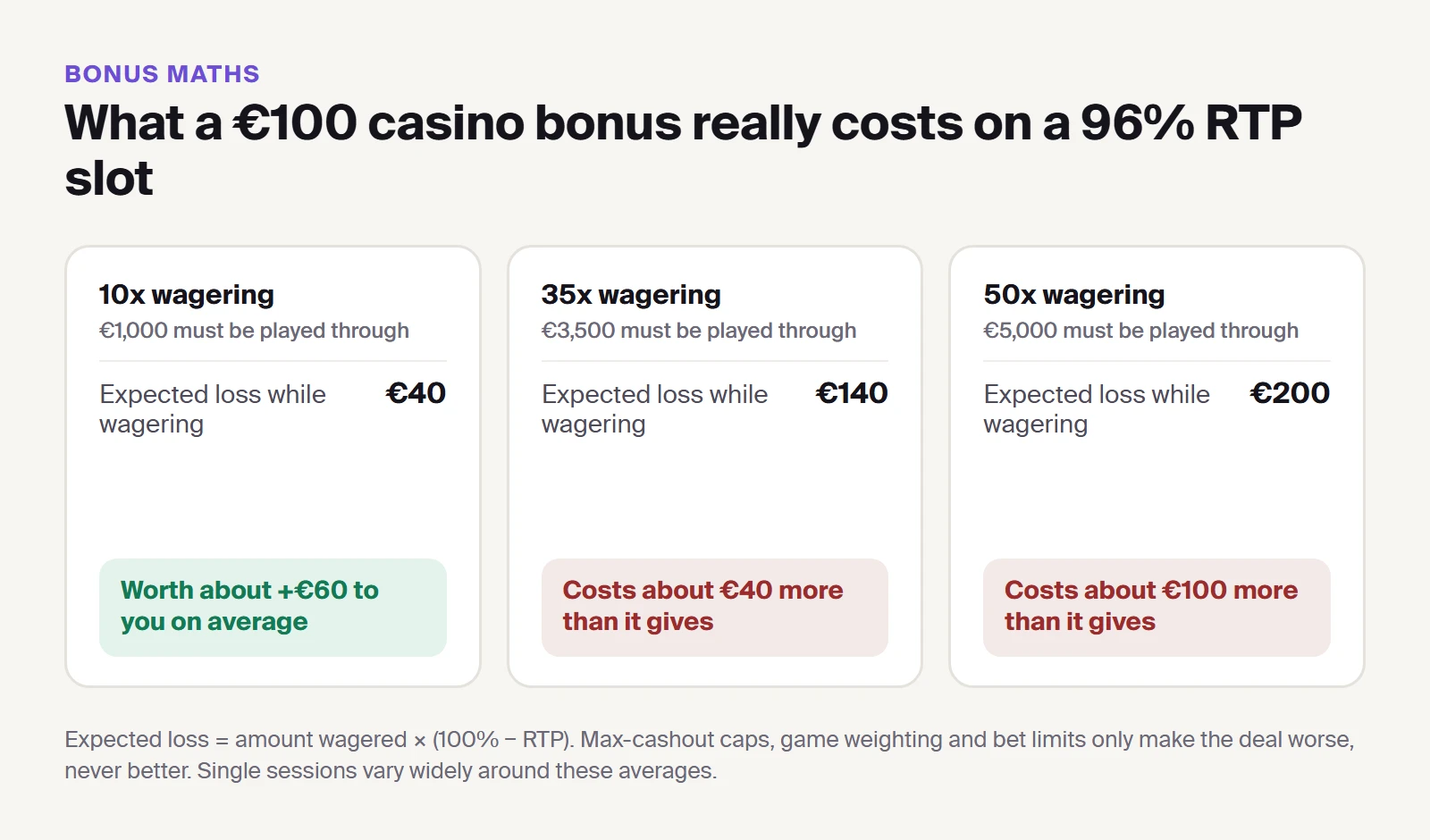
What to check before you accept any offer:
- Wagering requirement: anything above about 25x on a 96% slot has a negative expected value once the cost of play is counted. The lower the better; zero is best. Our no-wagering bonuses page lists offers where wins are paid as cash.
- Game weighting: slots usually count 100% towards wagering while table games count a fraction or nothing. Wagering on a low-RTP slot because it counts fully is a trap; the calculation above still applies.
- Maximum bet while wagering: breaching it usually voids the bonus and the wins.
- Maximum cashout: a cap of, say, 5x the bonus turns a big win into a small one.
- Expiry: a 7-day window on 35x wagering forces fast, high-stake play.
Free spins follow the same logic, with a fixed stake per spin and usually a cap on what the wins can be converted to. The bonus calculators turn any offer's terms into an expected cost in seconds, and our guide to reading bonus terms covers the clauses that matter. For current spin offers see free spins bonuses.
Feature buys and progressive jackpots
A bonus buy lets you pay for the free-spins round directly, typically at 50x to 100x the base bet. It is not free money and it is not a scam; it is a different, much more volatile way to wager the same amount. Many studios publish a separate RTP for the buy, and it can sit above or below the base game, so read the info panel. The one thing a buy guarantees is that a large sum leaves your balance at once, which is why a bankroll that is fine for base-game spins can vanish in three purchases.
Progressive jackpots fund the prize by taking a slice of every bet, so the base game returns less than the headline RTP unless the jackpot itself is counted. The pot is a lottery ticket attached to a slot, and its odds do not improve because it has been a while since the last win. The honest comparison is in our guide to progressive versus regular jackpots.
Myths that cost money
- "It is due." Spins are independent. A slot that has not paid all evening has exactly the same odds on the next spin as one that just hit.
- "Hot and cold machines." A streak is what randomness looks like over a few hundred spins. It carries no information about the next one.
- "Play late at night, or at the start of the month." The RNG does not know the time, the day or how full the casino is.
- "The casino turns the slots down when you are winning." A casino chooses the RTP version when it installs a certified game. It cannot adjust individual spins, and changing the version is a configuration change the test lab and regulator can audit.
- "Stopping the reels early changes the result." The result is decided when you press spin. The stop button skips the animation.
- "Near misses mean a win is close." Two scatters and a blank is a losing spin. The reels do not remember where they stopped.
- "Using a loyalty card makes the game pay less." The game does not know the card exists. Use it; comps are the only return that is not subject to the RTP.
A session plan that actually helps
None of this stops a slot from being fun, and none of it means you cannot walk away ahead on a given night. It means the only decisions that change your long-run cost are made before the first spin:
- Set the money and the time first. Pick an amount you are fine losing and a stopping time, and set both as limits in your casino account rather than in your head. Every licensed casino offers deposit limits and session reminders.
- Pick the game by its info panel. RTP first, then volatility or maximum win, then the features you enjoy. Most of our slot reviews include a free demo so you can test the ride before staking anything.
- Size the bet by spins, not by hope. Decide how many spins the session should last and divide.
- Run the bonus maths before you opt in. If the expected cost of the wagering is higher than the bonus, decline it and play with your own money. Declining is always allowed.
- Stop at the limit, either way. A stop-win target does not change the odds, but cashing out a good session is the only way a short-term swing ever becomes money in your pocket.
- Treat the spend as the price of the entertainment. If it stops feeling like a price you are happy to pay, use the tools in our responsible gambling guide, including self-exclusion.
Frequently asked questions
Is there any way to beat slots?
No. A certified slot returns less than 100% of what is wagered, and no betting pattern changes that average. You can win on a given session through variance, and you can reduce what you lose by choosing high-RTP games, lower stakes, slower play and low-wagering bonuses.
Does betting the maximum increase the RTP?
Not on most slots. The return per euro is the same at every stake. The exception is a game whose paytable or jackpot eligibility changes with the bet level, which the paytable will state. Max bet otherwise just raises the variance and the hourly cost.
What is a good RTP for an online slot?
Most online slots are built around 96%. Anything from 97% upwards is good, and figures below 94% mean you are paying roughly twice the usual price to play. Always read the figure inside the game at the casino you are using, because studios ship several versions.
Which slots have the highest RTP?
Among games whose studios publish the figure, Book of 99 (Relax Gaming) and Mega Joker (NetEnt) are listed at 99%, 1429 Uncharted Seas (Thunderkick) at 98.6% and Dr Jekyll Goes Wild (Light & Wonder) at 98.2%. Our verified high-RTP list has the rest, with the source for each.
Can a casino control when a slot pays out?
A casino picks which RTP version of a game it installs, where the studio offers more than one. It cannot decide the outcome of a spin on a certified game; that is generated by the RNG, and both the generator and the payout rate are tested by an independent lab as a condition of the licence.
Are new slots better to play?
Release date has no effect on the odds. New games are worth a look for their features and sometimes launch with promotions, but check the RTP like any other game. Our new slots page lists recent releases with their published figures.
Are free spins worth taking?
Sometimes. The value depends on the stake per spin, the wagering applied to the winnings and the cap on what can be cashed out. Spins with no wagering are worth their face value; spins with 40x wagering on the winnings are usually worth very little. The bonus calculators work this out for a specific offer.
Sources
RTP and volatility figures were read on the studios' own pages on 21 October 2026.
- Relax Gaming: Book of 99
- NetEnt: Mega Joker and Blood Suckers
- Thunderkick: 1429 Uncharted Seas
- Light & Wonder: Dr Jekyll Goes Wild
- Relax Gaming: Money Cart
- Yggdrasil: Jokerizer
- Pragmatic Play: 888 Gold, Beware the Deep Megaways and Gates of Olympus
- BGaming: Joker's Million and Gemhalla
- Push Gaming: Wild Swarm (two RTP versions)
- Quickspin: Big Bad Wolf (two RTP versions)
- Belatra Games: Stars Blast
- Test laboratories: GLI, iTech Labs, eCOGRA
- UK Gambling Commission: Remote gambling and software technical standards
- Support: BeGambleAware (UK), National Council on Problem Gambling (US)